
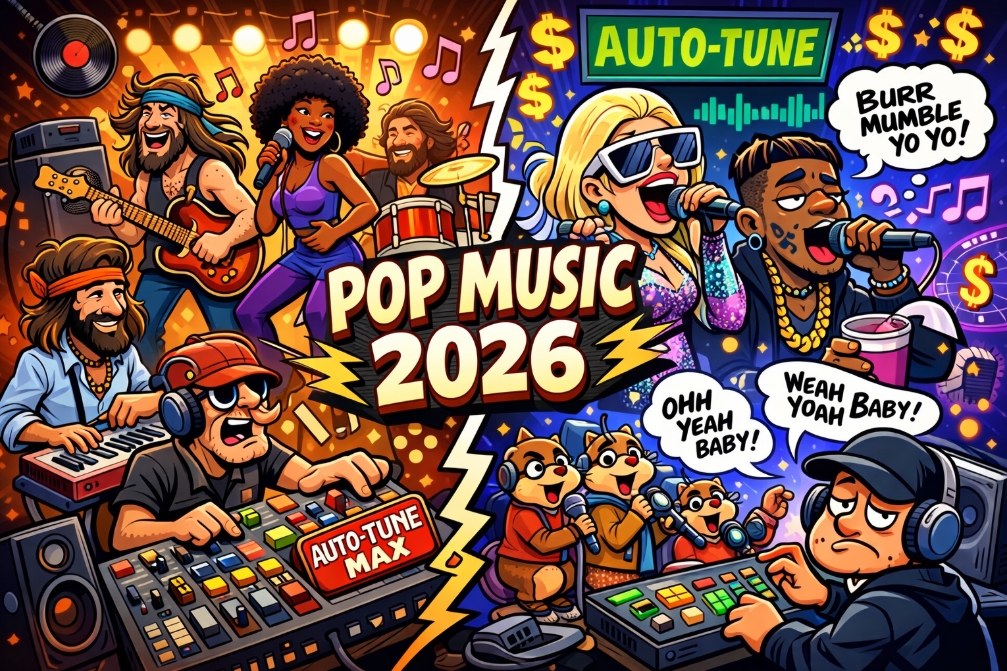
Brutally Honest Truth Comedy Roast about How Bad it Sucks
Prepare for the ultimate takedown! We’re not holding back as we brutally roast the pathetic state of pop music in 2026. If you’re tired of auto-tuned mumbling, soulless beats, and “artists” who couldn’t hit a note without a computer, then this is for you. We’re calling out the lack of talent, the overproduction, and the endless repetition that has turned modern music into PURE GARBAGE. This isn’t just a grumpy old person’s opinion; it’s a necessary truth. Get ready to laugh, cringe, and maybe even smash your headphones. #PopMusicRoast #2026MusicSucks #AutoTuneNightmare #MusicCritics
Alright, settle down, music lovers, and welcome to the stage, the year 2026! A year where, apparently, musical innovation went on a permanent vacation and left a pile of recycled beats and vocal fry in its wake. And before you Gen Z’ers start tweeting about “boomers gonna boom,” let me stop you right there. This isn’t your grandpappy’s “get off my lawn” rant. This is a cold, hard, hilarious look at how pop music in 2026 has managed to achieve a level of mediocrity so profound, it’s almost… impressive.
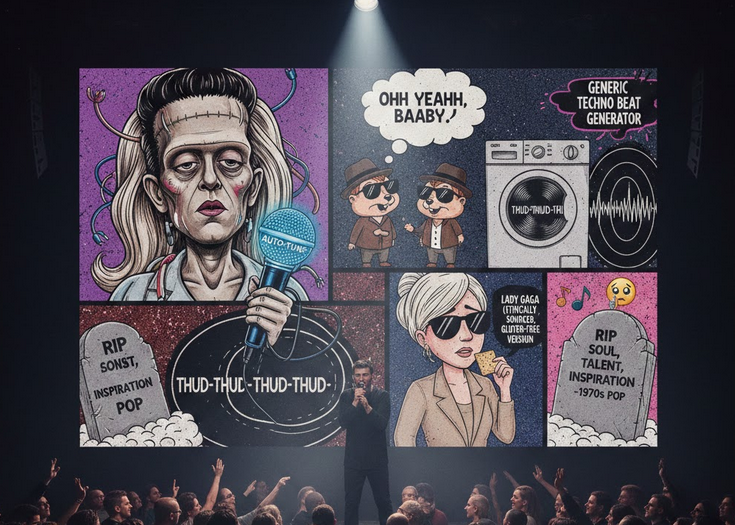
Remember the 70s? The sheer unadulterated talent of Stevie Wonder, the vocal acrobatics of Freddie Mercury, the raw energy of Led Zeppelin? Even disco, with all its sparkly excess, had undeniable grooves and legitimate musicianship. Fast forward to 2026, and it feels like the music industry collectively decided, “You know what the world needs? More auto-tuned mumbled whispers over a beat that sounds like a washing machine on spin cycle.”
Let’s talk about the production. “Over-produced” is an understatement. It’s like every track has been run through a digital meat grinder, stripped of any organic warmth, and then dipped in a vat of synthetic sheen. Remember when you could actually hear individual instruments? Now it’s just a blurry sonic landscape where everything sounds compressed, polished, and utterly devoid of soul. It’s like listening to a perfectly sculpted plastic fruit – looks good, but tastes like nothing.
And the auto-tune! Oh, the glorious, ubiquitous auto-tune! It’s not just a tool for correction anymore; it’s practically a lead instrument. These days, if a singer can hit a note without the assistance of a benevolent computer algorithm, it’s considered a miracle. It’s gotten so bad, I heard a rumor that some artists are now intentionally singing off-key just so the auto-tune has something to do. It’s the vocal equivalent of a participation trophy, guaranteeing everyone sounds “good” even if they couldn’t carry a tune in a bucket. It’s like listening to a choir of Alvin and the Chipmunks trying to cover a Barry White song – “Ohh yeahhh, baaabyyy,” squeaked through a digital filter, managing to be both creepy and monotonous at the same time.
And what’s with the complete lack of skilled musicians? Where are the guitar solos that made your spine tingle? The drum fills that made you want to air-drum until your arms fell off? The basslines that actually had some funk and personality? Now, it’s all synthesized, pre-programmed, and as generic as a stock photo of a smiling person holding a salad. It’s not music; it’s a soundtrack to a particularly bland elevator ride in a corporate office building.
The repetition! My God, the repetition! It’s like they found one vaguely catchy four-note melody and decided, “You know what? Let’s just loop this for three minutes and call it a day.” And don’t even get me started on the techno-repetitive bass beat. It’s the same thud-thud-thud that’s been assaulting our eardrums for the last decade, just slightly re-pitched and given a new, equally uninspired name. It’s less like a song and more like an auditory assault designed to numb your brain into submission.
It’s all following the same template, isn’t it? Every pop song in 2026 sounds like a watered-down, ethically-sourced, gluten-free version of a Lady Gaga B-side from 2011. There’s no originality, no daring, no sense of genuine artistic expression. It’s focus-grouped, market-researched, and engineered for maximum passive consumption. It’s like they took all the sharp edges, all the interesting textures, and sanded them down until all that was left was a smooth, bland, forgettable pebble.
Where’s the inspiration? Where’s the ability to inspire? When I listen to pop music in 2026, I don’t feel a surge of emotion or a desire to dance or even a spark of genuine interest. I feel… nothing. It’s musical Ambien, designed to lull you into a state of polite indifference. It’s a sonic shrug, a melodic meh, a rhythmically acceptable “whatever.”
So, congratulations, 2026 pop music. You’ve achieved something truly remarkable: you’ve managed to make “boring” an art form. You’ve taken all the joy, all the grit, all the genuine talent out of music and replaced it with a perfectly packaged, auto-tuned, anodyne product. And for that, we salute you… with a collective yawn.
The Sad State of Pop Music in 2026
Let’s get one thing out of the way immediately: this is not “grumpy old person” energy. This isn’t “back in my day” nostalgia goggles. This is more like: we have better technology than any generation in history… so why does so much pop music in 2026 sound like it was assembled by a malfunctioning Roomba stuck in a nightclub bathroom?
We’re not mad at new music. We’re mad at lazy music wearing a new outfit.
Pop music in 2026 can largely be summarized by a few recurring themes:
- Over-produced
- Auto-tuned within an inch of its life
- Vocals that sound like they’re being sung through a Bluetooth speaker submerged in LaCroix
- Zero visible musicianship
- Repetitive beats that loop like a broken elevator soundtrack
- Lyrics that feel AI-generated by a bot trained exclusively on Instagram captions and vape shop signage
And yes. Auto-tune again. Because if you say it three times, it appears behind you and corrects your pitch.
Auto-Tune: The Musical Participation Trophy
Auto-tune used to be seasoning. Now it’s the whole meal.
Once upon a time, pitch correction was like makeup: subtle, supportive, meant to enhance natural features. In 2026, auto-tune is more like one of those Snapchat filters that turns you into a neon alien with cheekbones sharp enough to open mail.
Nobody sings to the note anymore.
They sing near the note and let software call an audible.
It’s not “vocal performance.”
It’s karaoke assisted by NASA-grade processing power.
At some point you stop asking, “Can this person sing?”
And start asking, “Is this person legally required to sing at all?”
Mumble Rap: The Art of Saying Nothing, Quietly
Mumble rap didn’t evolve. It expired and became a ghost that still haunts the charts.
Lyrics now arrive in the form of half-audible murmurs, like the artist is trying not to wake their roommate. It’s less “song” and more “audio note accidentally sent to millions of people.”
You don’t hear the lyrics.
You interpret them like modern art.
“Is that a metaphor?”
“No, that’s just bad diction.”
If you need Genius annotations, three podcasts, and a Reddit thread to figure out whether the song is about love, money, sadness, or a parking ticket—the song has failed.
Overproduction: When Music Becomes a Spreadsheet
Everything is polished. Perfect. Quantized. Aligned to a grid so precise it could guide a missile.
The problem?
Human music is not supposed to be perfect.
In the 1970s, if a drummer rushed a beat, that was feel.
In 2026, if a beat breathes at all, a producer panics and snap-aligns it back into submission.
Modern pop production feels like:
“Okay, let’s remove every mistake, every quirk, every emotion, and every soul—
but add a bass drop that sounds like IKEA furniture falling down the stairs.”
The result is music that’s technically flawless and emotionally vacant.
Like a very attractive mannequin.
The Bass Beat That Ate the Industry
You know the beat.
You’ve always known the beat.
It’s the same four-on-the-floor thump that’s been recycled more times than a plastic grocery bag. It’s not even aggressive anymore. It’s just… present.
That bassline doesn’t say anything.
It doesn’t go anywhere.
It just exists, like background radiation.
At this point, the beat isn’t driving the song.
It’s holding the song hostage.
Every track sounds like it was made using the same “Sad Club Anthem Starter Pack™.”
Vocals So Processed They’re No Longer Human
Listen closely to enough pop songs in 2026 and you’ll start to notice something unsettling:
The singers don’t sound like people.
They sound like emotion presets.
You don’t hear breath.
You don’t hear strain.
You don’t hear effort.
You hear something halfway between a robot, a ghost, and Alvin & the Chipmunks after a bad breakup.
At some point you start wondering if the backing vocals are actually rodents with Spotify accounts.
Lyrics: Written by Vibes, Not Brains
Let’s talk about lyrics.
Or rather, the absence of meaningful ones.
Modern pop lyrics often feel like they were assembled by throwing buzzwords into a blender:
- “Yeah”
- “Baby”
- “Tonight”
- “Feel this”
- “My vibe”
- “Don’t leave”
- “Oh yeah, baby” (the off-brand Barry White impression that sounds like parody, but isn’t)
There’s no story.
No imagery.
No point.
It’s not poetry.
It’s auditory wallpaper.
Older pop didn’t just sound good—it said something, even when it was simple. Heartbreak. Joy. Rebellion. Desire. Life.
Now it’s just vibes doing laps.
Where Did the Musicians Go?
Here’s the real tragedy.
In earlier eras, pop music was still built on musicians:
- People who practiced
- People who failed
- People who learned instruments
- People who sounded different from each other
In 2026, pop stars feel less like artists and more like brand ambassadors for a sound template.
You don’t ask, “What does this artist sound like?”
You ask, “Which preset did they choose?”
Nobody’s bad at music anymore—
because nobody’s really playing music anymore.
Inspiration vs. Imitation
There’s a difference between influence and copying.
Pop music in 2026 has crossed that line so hard it’s filing a forwarding address.
Everything sounds like a watered-down version of something that was already watered down. A remix of a remix of a parody of a style that peaked ten years ago.
It’s not innovation.
It’s algorithmic cosplay.
Music made to perform well in clips.
Built for 15 seconds.
Designed to be skipped without consequence.
“But People Like It!”
Sure. People also eat gas station sushi. Popularity is not quality control.
When the system rewards repetition, the system gets repetition.
And when the industry chases trends instead of talent, you end up with music that sounds like it was focus-grouped by caffeine-deprived interns staring at engagement graphs.
This Isn’t Anti-New Music. It’s Anti-Bullshit.
There is great modern music. Incredible artists. Real singers. Real bands. Real writers.
They just aren’t being pushed by the pop machine—
because soul doesn’t always test well.
This isn’t about age.
It’s about effort.
We’re not asking for perfection.
We’re asking for honesty.
Sing badly but mean it.
Play sloppy but feel it.
Write something that risks embarrassment.
Because the biggest sin of pop music in 2026 isn’t that it’s bad.
It’s that it’s safe, sterile, and soulless.
And honestly?
That deserves to be roasted. 🔥
If this article offended you, don’t worry—
there’s probably a perfectly auto-tuned, bass-heavy, emotionally vacant pop song playing somewhere right now to help you forget it…