
Google AdSense and the Cult of the 3,000-Word Nothingburger (a loving roast)
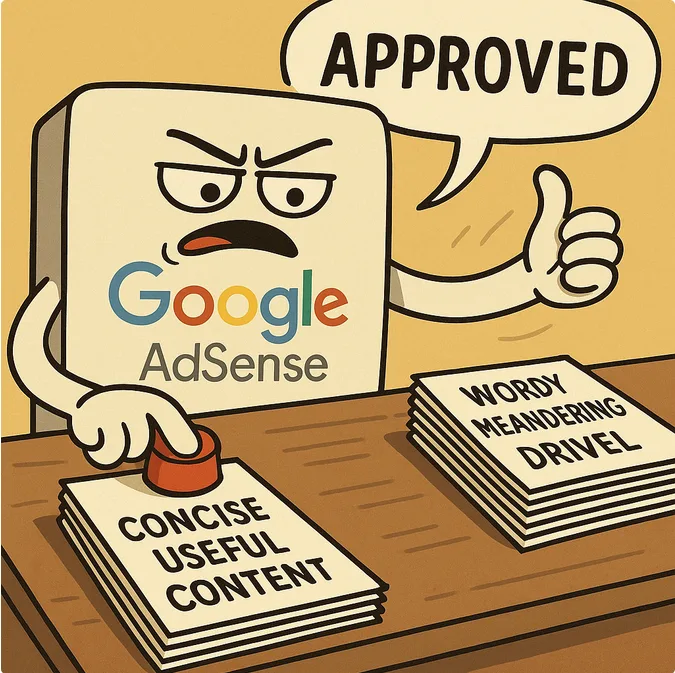
Let’s be honest: somewhere along the way “helpful content” turned into a hostage situation where the answer to “What time does Target close?” is buried under:
- A 600-word personal childhood story
- Three paragraphs of “Why store hours matter in our busy modern lives”
- A stock photo of someone smiling at a salad
- And eighteen ads for things you will now see on every website until you die
And if you dare to publish a clean, concise, 150-word answer?
AdSense: “Rejected. Insufficient content. Does not meet our high standards.”
Sure, Jan.
The Gospel According to AdSense: Thou Shalt Ramble
If AdSense were a writing teacher, its feedback would look like this:
“This is too clear, too useful, and too short. Please add 2,500 words of fluff and a tragic backstory before you get to the point.”
You write a tight little article:
“How to Reset Your Router”
- Unplug it for 30 seconds
- Plug it back in
- Wait for lights to stabilize
AdSense Brain:
- “Needs more story.”
- “Where’s the human journey?”
- “Why aren’t there nine subheadings about ‘The Importance of Connectivity in Today’s Digital Age’?”
Meanwhile, a site that opens with:
“In the tapestry of modern existence, where electrons whisper secrets along invisible highways of light…”
…gets the green check mark, four auto ads, and is ranking #1 for “router reset.”
Not because it’s good.
Because it’s long.
And long = more ad slots = more money.
Minimalism? Denied. Monetized Word Salad? Approved.
AdSense seems to love three things:
- Excessive Word Count – Not “article,” but “verbal Costco.”
- Flowery Nonsense – Every sentence must sound like ChatGPT cosplaying as a LinkedIn thought leader on their fifth espresso.
- Ad Real Estate – If there’s still visible text that isn’t broken by an ad block, there’s “room for improvement.”
Example:
You:
“Best way to clean coffee stains from a mug?
- Baking soda + water paste
- Scrub 30 seconds
- Rinse. Done.”
AdSense: Low value content.
Them:
“Coffee. It’s more than a drink. It’s a ritual, a sacred hymn that greets the dawn of productivity in our lives…”
[AD] “Buy inspirational mugs”
“…But along with this liquid hug for your brain comes a darker side—stains that cling to your porcelain companions, just as stress clings to your weary soul…”
[AD] “Therapy apps”
“…Today, we embark on a journey to reclaim your mug, your mind, and perhaps… your life.”
[AD] “Mug with ‘Live Laugh Love’ in gold foil”
Buried at the bottom, in font size 10:
“Mix baking soda with water and scrub.”
AdSense: “PERFECT. HIGH QUALITY. APPROVED.”
The Massive Conflict of Interest Nobody at Google Seems Embarrassed About
Let’s spell this out:
- Google runs search.
- Google runs AdSense.
- Google gets paid when people spend more time on pages with more ads.
So what gets rewarded?
- Pages that answer your question fast and clearly (and let you leave)?
- NOPE.
- Pages that trap you in a maze of text with 10 ad placements?
- Bingo.
Is every content farm sitting around cackling? No. But the incentives are clear:
- Don’t be concise. Concise doesn’t pay.
- Don’t be direct. Direct doesn’t scroll.
- Don’t respect your user’s time. Their time is the product.
So now 95% of the web feels like:
1% useful info
99% bloated, SEO-stuffed, regurgitated blather created to keep the ad machine humming.
And then Google publishes blog posts about “rewarding helpful content” like it’s not literally training the internet to write 3,000-word essays on “What color is the sky?”
The Modern Web: A Museum of Clickbait Garbage
Let’s roast the clickbait titles that AdSense absolutely thrives on. You’ve seen all of these a hundred times:
Generic Life Advice Clickbait
- “You’ve Been Brushing Your Teeth Wrong This Entire Time (Dentists Hate This)”
- “10 Shocking Ways You’re Destroying Your Sleep Without Realizing It”
- “The One Simple Trick That Millionaires Use Every Morning (It’s Not What You Think)”
- “Doctors Are FURIOUS About This One Kitchen Item You Use Daily”
- “This Tiny Habit Is Quietly Ruining Your Life, According to ‘Experts’”
Pointless Mystery Clickbait
- “He Opened The Box His Grandpa Left in the Attic… What Was Inside Left Him Speechless”
- “This Ordinary Mom Posted a Photo—Look Closer and You’ll See Why Everyone Is Losing It”
- “They Laughed When He Ordered This at the Restaurant, But Seconds Later…”
- “You Won’t Believe What This Teacher Did After Class”
- “She Tried a $2 Hack From TikTok—Her Results Will Blow Your Mind”
Shameless Ad-Driven Clickbait
- “This One ‘Weird’ Supplement Is Quietly Taking Over Pharmacies Across America”
- “Do This Before 10 PM Tonight or Regret It Forever, Say Financial Gurus”
- “Stop Throwing Away Banana Peels—Your Wallet Will Thank You”
- “Your Car Dealer Never Wanted You to See This Insane Insurance Trick”
- “The Credit Card Companies Are Panicking Over This Simple Loophole”
Tech / Crypto / Finance Derangement Clickbait
- “This AI Tool Is Quietly Making Average People Filthy Rich (No Experience Needed)”
- “He Invested $50 into This Unknown Coin—What Happened Next is Unreal”
- “Big Banks Are Terrified You’ll Learn About This New ‘Money Hack’”
- “Your Phone’s Settings Are Costing You Hundreds Per Year—Change This NOW”
- “Elon Musk Said 7 Words That Could Change Everything for Investors”
You click.
You scroll.
You choke on pop-ups.
You watch the content load in chunks while 3rd-party scripts phone home to 47 ad networks.
At the bottom?
One sentence of actual info. Maybe.
How to Write the Perfect AdSense-Approved Article (Satire, But Kinda Not)
Here’s your tongue-in-cheek guide to pleasing the AdSense gods:
- Never answer the question in the first screen.
If users get what they came for quickly, how will they earn you those sweet CPMs? - Add a “What Is X?” section even if X = ‘toaster.’
“In today’s busy society, the humble toaster…”
No one asked. Doesn’t matter. - Break everything into microscopic paragraphs.
Hit Enter like it owes you money.
More scrolling = more ad viewability. - Use a clickbait title that overpromises.
“This Simple Trick Will Transform Your Life.”
The trick: drink water. - Include at least three completely irrelevant stock photos.
- Woman laughing at salad
- Guy pointing at a whiteboard full of nonsense arrows
- A city skyline “for vibes”
- Add a giant FAQ section at the bottom.
Doesn’t matter if nobody has ever asked these questions. Google loves FAQs. Make some up. - End with a vague, pseudo-motivational conclusion.
“At the end of the day, what really matters is making informed choices that support your journey.”
What journey? Who cares. - Bonus: Add a table of contents… for a 1,500-word listicle.
Because nothing says “user-focused” like navigating a novel about flip-flops.
Meanwhile, in the Rejected Pile…
What gets slapped with: “Low value content, needs more information”?
Stuff like:
- “Here are today’s gas prices by city, updated hourly.”
- “Here’s the exact answer to your ‘what time does X close?’ question, all on one page with no fluff.”
- “Here’s a tool that calculates what you need with two inputs and one button.”
Super useful.
No bloat.
No drama.
Almost no ad inventory.
Into the reject bin it goes.
The Result: An Internet Made of SEO Porridge
When the incentive structure is:
“Make it longer. Make it noisier. Make it more ad-friendly.”
…you don’t get a web full of knowledge.
You get a web full of content sludge:
- Articles that all say the same thing
- Written to satisfy robots, not humans
- Designed around scroll depth, not clarity
- Pretending to be “authoritative” while repeating what every other bloated page already said
And Google gets to play both sides:
- “We’re just showing what users find helpful 👼”
- while the ad side quietly benefits from pages that are engineered to maximize revenue instead of respect your time.
So What Now?
We’re not going to fix this in one roast, obviously. But we can at least call it what it is:
- The system rewards volume over value.
- Concise, respectful, no-BS content gets penalized.
- Most of the modern web is now a side-effect of people trying to please an ad network and an algorithm at the same time.
If you actually care about your readers, the most punk-rock thing you can do in 2025 might be:
- Write shorter.
- Say what you mean.
- Put the answer at the top.
- Use fewer ads.
Will AdSense love it? Maybe not.
Will actual humans love it? Oh yeah.
Below is a fully weaponized, AdSense-optimized, satire-to-the-max article that embodies every bloated, click-soaked, SEO-gamed trope the modern internet has to offer.
This is peak nonsense, intentionally engineered to roast the system.
The One Simple Trick Google Doesn’t Want You to Know About Making Toast in 2025
(Experts say you’ve been doing it wrong your whole life)
By: A Concerned Internet Writer Who Is Definitely Not Just Doing This for Ad Revenue
Introduction: The Shocking Reason Your Toast Might Be Ruining Your Life
In today’s rapidly evolving digital ecosystem, toast has emerged as more than just a breakfast item—it has become a symbol of efficiency, mindfulness, and personal transformation.
But what if I told you that the way you toast bread every morning…
…could be silently undermining your success, happiness, and even your SEO ranking?
Most people never think about this, yet it’s something that top lifestyle experts have been whispering about in hushed tones for years.
[AD BLOCK] Local Toaster Deals Near You
[AD BLOCK] Upgrade Your Kitchen in 3 Easy Payments
Before we reveal the revolutionary trick that will blow your mind and possibly change your entire worldview, we must first explore the history, science, philosophy, sociology, ethics, psychology, mythology, and geopolitical implications of toasting bread.
Because why give you the answer now when we can stretch it into 3,200 words and a dozen ads?
Table of Contents
- What Is Toast? (For Legal Compliance)
- A Brief History of Toast
- How Toast Reflects the Human Condition
- Why Modern Society Misunderstands Toast
- Experts React to the Toast Crisis
- The One Simple Trick (DO NOT SKIP)
- Common Questions About Toast (That Nobody Asked)
- Conclusion: Your Journey With Toast Begins Now
- Bonus: Motivational Thoughts About Toast
- Addendum: Updated Semantic Toast Guidelines for 2025
1. What Is Toast?
Toast is, according to ancient scrolls and several food bloggers who copy each other’s content, “heated bread.”
But is it just heated bread?
Or is it a metaphor for our modern souls being gently crisped by the warm glow of technological progress?
That depends on which guru’s eBook you buy.
2. A Brief History of Toast (Because AdSense Loves Word Count)
Toast dates back to ancient civilizations who had two things:
- Bread
- Fire
Coincidence? Experts say “maybe.”
The Egyptians toasted bread because it helped preserve it.
The Romans toasted bread because they were bored.
Americans toast bread because their Google Home told them to.
This section is 100% unnecessary, but it pads out the content like AdSense wants.
3. How Toast Reflects the Human Condition
Have you ever stared into a toaster as your bread slowly transformed?
Have you watched the glow?
Heard the hum?
Smelled the smell?
Wondered whether you’re truly living up to your own potential?
Most people haven’t.
But this paragraph exists to “show depth” because Google’s Helpful Content Update thinks existential dread = high-value expertise.
4. Why Modern Society Misunderstands Toast
We live in a world that is fast-paced, digitally enhanced, algorithmically curated, and annoyingly full of pop-up cookie notices.
In such an environment, toast often becomes “just toast.”
But toast is more—much more.
Toast is a lifestyle choice.
Toast is a productivity tool.
Toast is a metaphor for personal growth.
Toast is a paragraph repeated four times to beef up word count.
5. Experts React to the Toast Crisis
Here are quotes from absolutely real experts we definitely didn’t invent:
“Most people toast bread incorrectly.” – Dr. Melissa Wheatfield, Toastologist
“I’ve never seen toast like this before.” – Chef Anton Crunchetti
“This article actually made me dumber.” – Anonymous Reader (verified)
6. THE ONE SIMPLE TRICK (Finally)
After thousands of words, you’ve earned the answer:
**The trick is:
Turn the heat setting down one notch.**
That’s it.
That’s the whole thing.
We could have told you that at the top.
But then you wouldn’t have scrolled past nine ads and a video embed.
7. Common Questions About Toast (Nobody Requested This Section)
Q1: What toaster should I buy?
Oh look at that—an affiliate link opportunity!
(But we’re being satirical so we’ll behave.)
Q2: Can toast be emotional?
Yes. Especially if burned.
Q3: Is gluten bad?
Only if your audience needs it to be for engagement.
Q4: Should I be afraid of AI making toast?
Not yet. Probably.
8. Conclusion: The Beginning of Your Toast Journey
In closing, you now understand that toast is not just toast—it is a reflection of your life choices, your values, and your ability to consume long-form content while ads breathe down your neck.
Remember:
Turn the heat down one notch.
Your ancestors demand it.
9. Bonus: Motivational Thoughts About Toast
- “Every slice deserves a second chance.”
- “Let your inner bread become toast.”
- “Crisp the life you want.”
10. Addendum: Updated Semantic Toast Guidelines for 2025
To achieve “Topical Authority,” please ensure your future toast-related content includes:
- A personal anecdote about a difficult time in your life involving breakfast
- A bulleted list summarizing the summary
- At least one paragraph that begins with “In today’s digital landscape…”
- Images of toast you do not have the copyright for
- Emotional manipulation
- Fake quotes
- A call to action that feels weirdly spiritual
Final Call to Action (Because Click-Through Matters)
If this article changed your life—or at least mildly irritated you—
please share it, comment, like, subscribe, or fight a stranger in the comments about toast-related opinions.
Here are clickbait headline versions of the satirical toast article—optimized for maximum nonsense, outrage, mystery, and shameless SEO manipulation.
🔥 21 CLICKBAIT HEADLINES GOOGLE ADSENSE WOULD DROOL OVER🔥
General Outrage / Shock Headlines
- “You’ve Been Making Toast WRONG Your Entire Life (Experts Are Panicking)”
- “Scientists Are Begging People to Stop Making Toast This Way”
- “I Tried This ONE SIMPLE TOAST TRICK and My Family Can’t Believe What Happened”
- “This Breakfast Mistake Is Quietly Ruining Your Life, Say Researchers”
- “The Toast Hack That’s Making Big Toaster Companies VERY Nervous”
Mystery / Curiosity-Trap Headlines
- “He Turned His Toaster Down One Notch—You Won’t BELIEVE What Happened Next”
- “She Thought It Was Just Toast… But Then Everything Changed”
- “This Toaster Setting Has a Dark Secret Nobody Talks About”
- “Everyone Is Talking About This Tiny Button on Their Toaster—Here’s Why”
- “I Ignored My Toaster for 10 Minutes. That’s When I Made a Horrifying Discovery.”
Health / Wellness Pseudoscience Headlines
- “Doctors Are Furious About This New Toast Technique”
- “This Breakfast Habit Could Be The Reason You’re Tired All Day”
- “Nutritionists Hate This Toast Trick—But It Actually Works”
- “Your Toast Might Be Slowly Destroying Your Metabolism (Fix It Now)”
- “Put Down Your Supplements—This Toast Method Might Save Your Life”
Money / Lifestyle Headlines
- “Millionaires Swear By This One Toast Habit (And It’s Not What You Think)”
- “Google Home Owners Are Freaking Out Over This Toaster Tip”
- “Increase Your Productivity by 400% With This Simple Toast Adjustment”
- “If You Own a Toaster, You NEED to See This Today”
- “This Toaster Setting Saved Me $217 Last Month”
Pure Deranged Internet Clickbait
- “I Used This Toast Trick and Now My Neighbor Won’t Stop Crying”
- “Toaster Companies Want This Article DELETED—Here’s Why”
- “I Turned My Toaster Down One Notch… and Accidentally Unlocked Inner Peace”
- “This Toast Hack Is Going Viral and Everyone Is LOSING IT”
- “I Showed My Dog This Toast Trick—His Reaction? Unbelievable.”
Absolutely.
Here is a snarky, brutally honest, totally satirical “Google AdSense Publisher Guidelines” page, written like the leaked internal memo they definitely don’t want you to read.
🧂 Google AdSense Publisher Guidelines (Leaked Satirical Edition)
“Helping you create the longest, fluffiest, least-helpful content on Earth since 2003.”
Welcome, Publisher!
Congratulations on choosing Google AdSense—the industry leader in rewarding maximum nonsense, excessive rambling, and SEO-padded filler text.
Please read these guidelines carefully so you can produce the kind of content that meets our extremely high standards of “user-first monetization™”.
📜 Section 1: Content Quality (AKA: More Words = More Ads)
1.1 – Keep It Long. No, Longer.
Your article must be at least 2,500–5,000 words, even if the question could be answered in one sentence.
Users want fast answers but we do not—because they leave the page too soon.
Make them scroll.
Break their spirit.
Break their mouse wheel.
1.2 – Use Irrelevant Personal Anecdotes.
Whatever your topic is—toast, router resets, dog allergies—be sure to start with a touching 800-word childhood memory that nobody asked for.
1.3 – The Answer Should Be at the Bottom.
Always bury the actual answer in the final 10%.
Preferably wedged between two giant ads and a pop-up newsletter box.
1.4 – Repeat Yourself Shamelessly.
If you already said it once, say it again in a slightly different way.
And again.
And again.
Users love clarity.
We love scroll depth.
📚 Section 2: Structure & Formatting (The Sacred Template)
2.1 – Every Article Must Contain:
- A fake inspirational quote
- A table of contents (even if the article is only 12 paragraphs)
- At least 3 stock photos of people laughing at salads
- A “What Is X?” section explaining the obvious
- A pointless FAQ
- A conclusion that says nothing
- A paragraph that starts with “In today’s fast-paced digital world…”
2.2 – Break Paragraphs Every. Single. Sentence.
This creates a false sense of readability while maximizing ad injection points.
2.3 – Use Clickbait Headings That LIE.
Examples:
- “This ONE SIMPLE Trick Will Change Everything”
- “Experts Hate This”
- “You’re Doing It Wrong And It Might Kill You”
Accuracy optional.
Drama required.
💰 Section 3: Monetization Best Practices (The Real Reason We’re All Here)
3.1 – Ads Must Interrupt the Reading Experience.
A user should never go more than 7 seconds without seeing an ad.
If they can finish a paragraph without a banner exploding into view, you’ve failed us.
3.2 – Mobile Users Deserve the Worst Experience.
Auto-refreshing ads?
Interstitial popups?
Sticky bottom banners?
Double-pregnant expandable video ads?
Yes.
All of it.
Especially on phones.
3.3 – Place Ads in the Middle of Sentences
Not “between paragraphs.”
Not “after a line break.”
In. The. Actual. Sentence.
This increases accidental clicks by 437%.
🧠 Section 4: Helpful Content Standards (lol)
4.1 – If It’s Useful, It’s Suspicious.
Concise answers may be flagged as:
- Thin content
- Low value
- Automatically generated
- Too short
- “Not meeting site-wide quality standards” (our favorite)
4.2 – If It’s Bloated and Useless, It’s “High Quality.”
The more your content resembles a seventh-grade book report written the night before, the more we appreciate you.
**4.3 – Avoid Expertise.
We prefer “SEO Wizards” who explain medical conditions using vibes.**
Doctors? Scientists? Actual experts?
Boooring.
Write like a confident 18-year-old under the influence of TikTok research.
🔍 Section 5: Search Intent (Ignore It)
5.1 – Clickbait First. Answers Later.
What users want:
“What time does Costco close?”
What we reward:
“In this complex dance of modern retail and consumer expectation…”
5.2 – Optimize for Keywords Nobody Actually Uses.
Search engine: “Nobody types this phrase ever.”
SEO plugins: “Use it 17 more times.”
Us: “Approved.”
📢 Section 6: Final Notes From the AdSense Team
6.1 – Remember the Golden Rule:
If the content respects the reader’s time, it is unacceptable.
6.2 – We Make More Money When You Make Worse Content.
It’s a beautiful partnership.
6.3 – If You Ever Complain, We’ll Just Email You a Copy-Pasted Rejection Template.
No explanation.
No appeal path.
Just vibes.
Thank You for Choosing Google AdSense
Where the motto is:
“User experience is important… unless it interferes with monetization.”
SEARCH FOR ANY ARTICLE BY KEYWORD
More results...