
Stop Correcting Everyone: Handy dandy (how to) Social Guide for Chronic Nitpickers
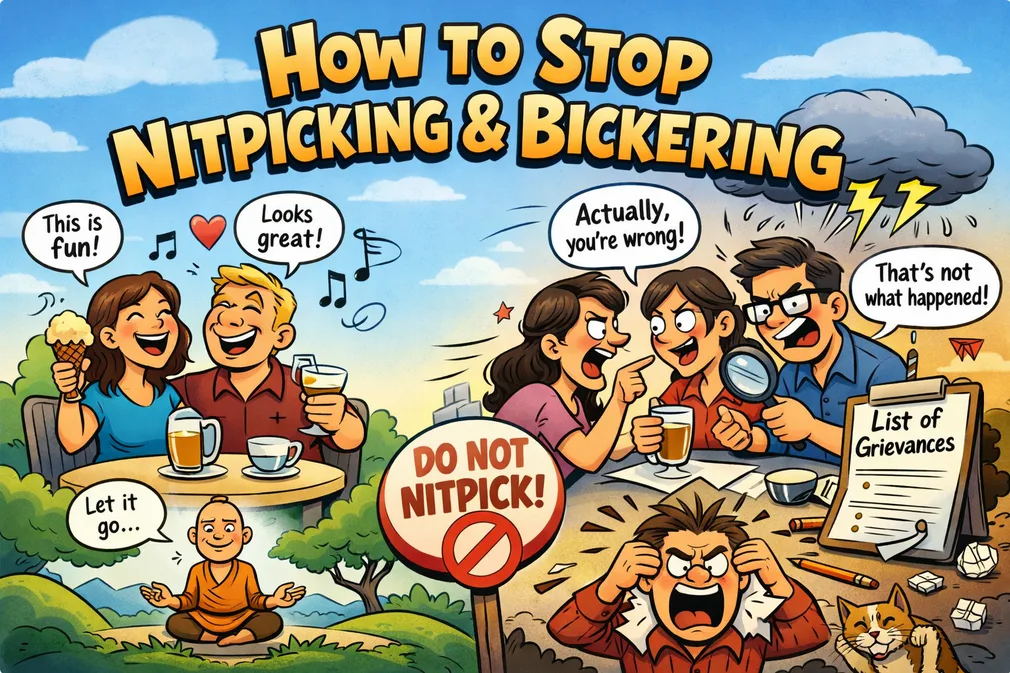
We’ve all met them, and if we’re being honest, some of us are them: the person who can’t let a single factual error, mispronunciation, or slightly inefficient way of loading the dishwasher go unremarked. It starts with a well-intentioned “Actually…” and ends with everyone in the room wishing they were somewhere else—ideally somewhere where the word “actually” has been banned by federal law.
If you have a PhD in pointing out the obvious and a minor in “Well, technically,” this guide is for you. Constant nitpicking and bickering aren’t just personality quirks; they are social sandpaper that wears down relationships and leaves you wondering why your phone stopped buzzing. It’s time to trade in your red pen for a little bit of peace.
The High Cost of Being Right
The urge to correct someone usually comes from a place of wanting to be helpful or a drive for precision. However, in the social wild, being “right” is often the consolation prize for being lonely. When you correct a friend’s story about their vacation because they said it was Tuesday when it was clearly Wednesday, you aren’t “helping.” You’re breaking the flow of human connection.
Bickering is the louder, uglier cousin of nitpicking. It’s the habit of turning every minor preference into a cross-examination. It turns homes into courtrooms and friendships into endurance tests. To stop the cycle, we have to recognize that most things in life don’t require a verdict.
Choose Connection Over Correction
The secret to being a pleasant person isn’t knowing everything; it’s knowing when to keep it to yourself. Before you jump in to fix a detail or argue a point, ask yourself: “Does this correction improve the moment, or just my ego?” If the answer is your ego, take a metaphorical seat.
Learning to be agreeable doesn’t mean you’re becoming a pushover.
It means you’ve realized that harmony is more valuable than being a walking encyclopedia. Most people aren’t looking for a debate coach; they’re looking for a friend.
The “Am I the Problem?” Comparison
If you aren’t sure if you’ve crossed the line into chronic nitpicker territory, check this table. Compare how an agreeable person handles a situation versus someone who just can’t let it go.
| The Situation | The Agreeable Response | The Chronic Nitpicker |
| A friend tells a story with a minor factual error. | Nods and enjoys the point of the story. | Interrupts to fix the date or location. |
| Your partner loads the dishwasher “wrong.” | Says “Thank you for doing the dishes!” | Re-loads it while sighing loudly. |
| Someone mispronounces a word. | Ignores it and continues the chat. | Repeats the word correctly with a smirk. |
| A coworker has a “bad” idea. | Says “Interesting, how would that work?” | Says “That won’t work because…” |
| You disagree on a movie’s quality. | “I see why you liked it, but it wasn’t for me.” | Spends 20 minutes explaining why they are wrong. |
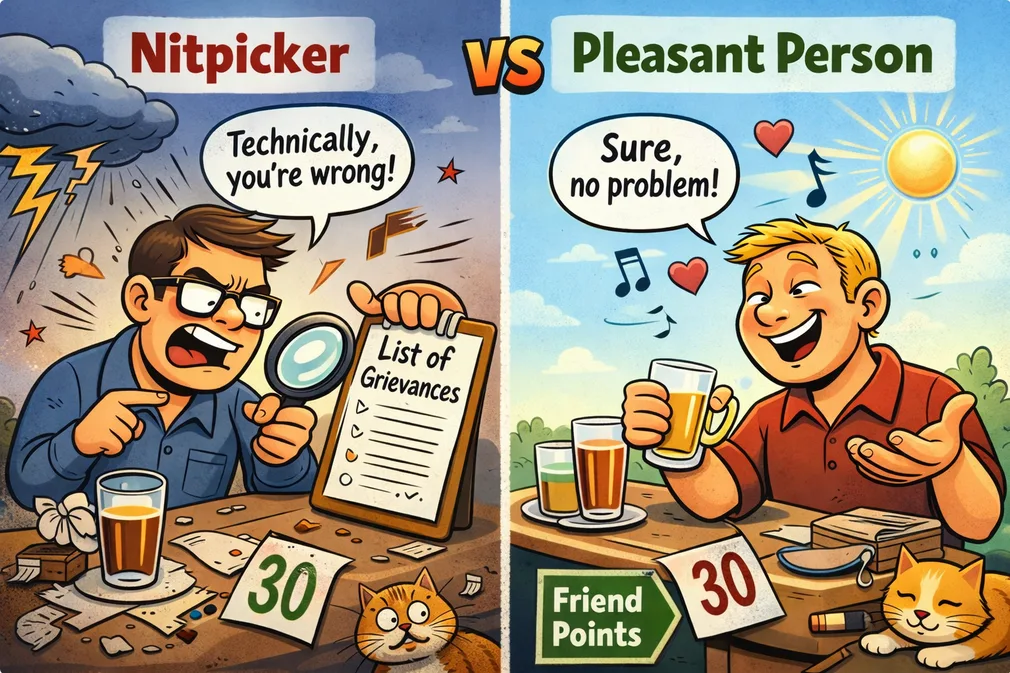
Agreeable vs Disagreeable: Same Situation
| Situation | Agreeable Person | Disagreeable Person |
|---|---|---|
| Someone tells a story | Listens, laughs, engages | Interrupts to correct details |
| Restaurant choice | “Sounds good to me” | “Actually, that place went downhill” |
| Minor mistake | Lets it slide | Makes sure everyone notices |
| Group plans | Goes with the flow | Needs a committee meeting |
| Different opinion | Curious | Personally offended |
| Small inconvenience | Shrugs | Builds a case file |
Notice something? The agreeable person doesn’t “lose.” They WIN socially!
Top 10 Signs You’re About to Start a Pointless Argument
- You start your sentence with “Well, technically…”
- You feel a physical itch when someone uses the wrong “there/their/they’re” in a text.
- You’ve said the phrase “I’m not arguing, I’m explaining why I’m right” in the last 24 hours.
- People have stopped telling you stories because you “fact-check” them in real-time.
- You find yourself debating the “correct” way to fold a towel for more than five minutes.
- You think “playing devil’s advocate” is a fun Friday night activity.
- You’ve ever corrected a child’s imaginary story for lack of realism.
- You value “the truth” more than the feelings of the person standing in front of you.
- You can’t remember the last time you just let a minor annoyance slide.
- You’re currently thinking of a way to correct this list.
How to Soften Your Social Edges
If you’ve realized you’re the one holding the magnifying glass, don’t panic. You can retrain your brain to be less reactive. Start by practicing the “Is it True? Is it Kind? Is it Necessary?” filter. If your comment doesn’t pass all three, swallow it.
Another helpful tool is the “Five-Year Rule.” Will this thing you’re about to bicker about matter in five years? If not, it’s not worth the breath. When you feel that surge of “I must correct this,” try replacing it with a question. Instead of “That’s wrong,” try “Oh, I hadn’t heard it that way, tell me more.” It keeps the conversation moving and keeps your blood pressure down.
Resources for the Recovering Perfectionist
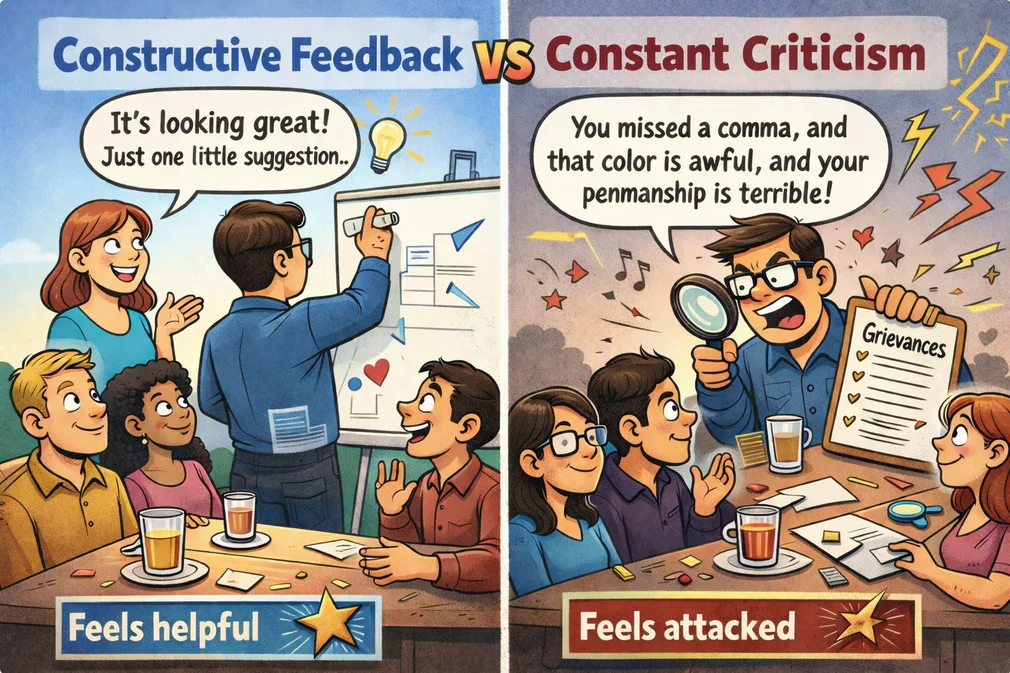
If you’re ready to dive deeper into self-awareness and trade your bickering for bonding, these resources are excellent starting points:
- How to Win Friends and Influence People by Dale Carnegie: The gold standard for learning that being liked is better than being “right.”
- The Untethered Soul by Michael Singer: Great for learning how to let go of the internal “narrator” that wants to judge everything.
- The “Let It Go” Challenge: Choose one thing every day that you could correct, and purposely stay silent. Notice how the world doesn’t end.
- Gratitude Journaling: Shifting your focus to what’s going right makes it harder to spot what’s going wrong.
Becoming a person people want to be around isn’t about losing your intelligence; it’s about gaining the wisdom to use it kindly. Life is much more fun when you aren’t constantly trying to fix it.
This challenge is designed for the person who feels a physical twitch when someone uses “less” instead of “fewer.” It’s a 30-day “Social Detox” to help you move from being a walking red pen to a person people actually want to grab a coffee with.
The 30-Day “Zip It” Challenge: A Recovery Plan for Chronic Nitpickers
The goal isn’t to become a silent monk; it’s to break the reflex of immediate correction and bickering. By the end of this month, your relationships will feel lighter, and your stress levels will drop because you aren’t carrying the weight of everyone else’s “wrongness.”
Week 1: The “Stay in Your Lane” Phase
The Goal: Stop correcting harmless factual errors and minor pronunciation slips.
- Day 1-3: If someone tells a story and gets a date, location, or name wrong—but the point of the story remains the same—you must stay silent.
- Day 4-5: The “Typo Amnesty.” Do not correct a single typo in a text or email. Even if they used “your” instead of “you’re.” Let it live.
- Day 6-7: Practice the “Wait 5 Seconds” rule. Before responding to anything that irritates you, count to five. Most urges to nitpick fade by the time you hit four.
Week 2: Domestic Diplomacy
The Goal: Stopping the “My Way is the Only Way” bickering at home.
- Day 8-10: The “Dishwasher Rule.” If someone does a chore in a way that is safe but “inefficient,” you are forbidden from re-doing it or commenting on it.
- Day 11-12: Total ban on the phrase “Well, technically…” and its cousins (“Actually,” “To be fair,” “If you really think about it”).
- Day 13-14: Give three unprompted, sincere compliments about things you usually overlook.
Week 3: The Opinion Pivot
The Goal: Learning to disagree without being disagreeable.
- Day 15-17: Practice the “Agree to Disagree” exit. If a debate starts over something subjective (movies, food, music), end your side with, “I can see why you feel that way,” and change the subject.
- Day 18-20: No “Devil’s Advocate.” For three days, you are retired from the position of Professional Contradictor. Even if you see a flaw in an idea, keep it to yourself unless safety is at risk.
- Day 21: The “Ask, Don’t Tell” Day. Instead of correcting someone, ask a curious question. Instead of “That’s not how that works,” try “How does that part work?”
Week 4: The Ego Exit
The Goal: Solidifying your new identity as an easygoing human being.
- Day 22-24: Practice “Self-Correction.” If you catch yourself mid-nitpick, stop immediately and say, “Actually, you know what? It doesn’t matter. Please keep going with your story.”
- Day 25-27: Accept a minor inconvenience without a single sigh, eye roll, or “I told you so.”
- Day 28-29: The “Benefit of the Doubt” focus. Assume everyone is doing their best with the information they have.
- Day 30: Reflection Day. Look back at the last 30 days. Did the world fall apart because you didn’t correct that coworker? Probably not—but your social life probably got a lot better.
“Cheat Sheet” for surviving the urge to correct. These phrases are designed to keep the conversation flowing and keep your friends from checking their watches while you talk.
The “Actually” Replacement Guide
Five phrases to keep you from being “That Person.”
1. Instead of: “Well, technically, that’s not right…” Try: “Oh, interesting! I hadn’t heard that version.” Why it works: It acknowledges the other person without making them feel stupid. It treats their “error” as a new piece of information rather than a crime against humanity.
2. Instead of: “You’re doing that the wrong way.” Try: “I love seeing how different people tackle this.” Why it works: This is the ultimate “dishwasher” phrase. It frames their method as a personal quirk rather than a failure of logic. It lets you walk away without re-loading the rack.
3. Instead of: “I’m just playing devil’s advocate…” Try: “I see your point. That’s a unique way of looking at it.” Why it works: The devil doesn’t need an advocate; he’s doing just fine. By validating their perspective, you end the “bicker-loop” before it even starts.
4. Instead of: “Actually, it was [Specific Date/Fact]…” Try: [Complete Silence + A Smile] Why it works: Honestly, silence is the most powerful tool in your kit. If the factual error doesn’t change the outcome of the story, just let it slide. The person is sharing a memory, not testifying in court.
5. Instead of: “I told you so.” Try: “That sounds like a tough situation. How can I help?” Why it works: “I told you so” is the victory cry of the lonely. Replacing it with empathy builds a bridge instead of a wall. It turns a moment of friction into a moment of support.
Pro-Tip: The “Internal Red Pen”
When you feel the urge to correct someone, imagine you are holding a physical red pen. Mentally “drop” the pen on the floor and take a breath. It sounds silly, but that physical visualization can help break the reflex.
How to Be More Pleasant Without Feeling Fake
Being easy to deal with isn’t about pretending. It’s about emotional efficiency.
- Listen more than you speak
- Let others finish their thoughts
- Assume good intentions
- Laugh at small errors
- Accept that your way isn’t the only way
Pleasant people don’t micromanage conversations. They create space.
Resources for Becoming More Self-Aware
If this hit a nerve (a tiny, correct nerve), these books help build awareness, emotional intelligence, and calmer communication:
- How to Win Friends & Influence People – Still relevant. Still humbling.
- Crucial Conversations – Learn when to speak and when to let it go.
- Emotional Intelligence – Understand what’s actually driving your reactions.
- The Four Agreements – Especially the part about not taking things personally.
- Nonviolent Communication – For saying things without starting fires.
SEARCH FOR ANY ARTICLE BY KEYWORD
More results...