
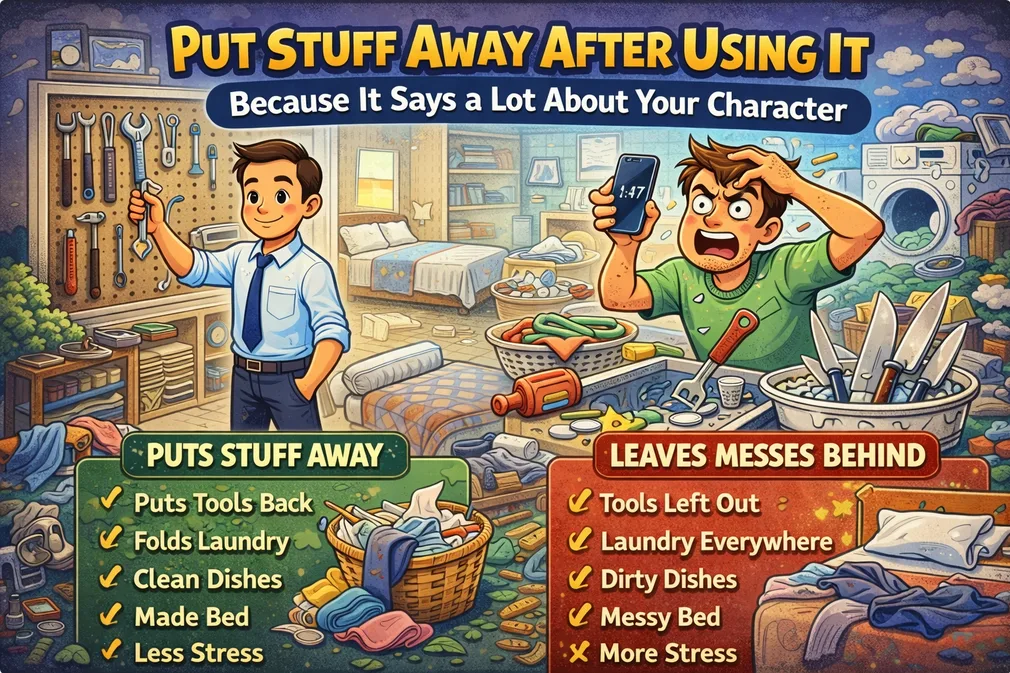
Because It Says a Lot About Your Character
A Funny Commentary About Self-Respect and Follow-Through
- Why This Tiny Habit Quietly Separates Adults from Chaos
- Doing Things Right Is Not Uptight
- The Small Habit That Reveals Everything
Let’s start with something radical:
Putting things away after you use them is not a personality trait.
It’s not “anal.”
It’s not “Type A.”
It’s not a cry for help.
It’s just… finishing the task.
And yet, this one microscopic habit somehow exposes entire worldviews.
Because the same people who don’t put things away are often the same people who:
- Procrastinate constantly
- Leave messes “for later”
- Complain about systems, rules, and structure
- Criticize others for not doing things well
- And mysteriously can’t find anything they need
This article is not about hating anyone.
It’s about calling out the behavior — with humor, honesty, and just enough psychological poking to make it uncomfortable in a productive way.
Because “I’ll deal with it later” is not a strategy.
It’s a lifestyle.
🧠 WHAT PUTTING THINGS AWAY ACTUALLY MEANS
When you put something away after using it, you’re saying:
- “I finish what I start.”
- “I respect my future self.”
- “I respect other people who might need this.”
- “I don’t outsource my mess.”
When you don’t put something away, you’re quietly saying:
- “Someone else will deal with this.”
- “Future Me can suffer.”
- “This isn’t worth my attention.”
And before anyone says, “It’s just a screwdriver / dish / jacket / knife / pile of laundry” —
That’s exactly the point.
Small habits scale.
🔍 A VERY GENTLE PSYCHOANALYSIS (OKAY, NOT THAT GENTLE)
People who don’t put things away usually aren’t evil.
They’re not malicious.
They’re just stuck in one (or more) of these mental loops:
1. Deferred Responsibility Syndrome
“I’ll do it later” feels good because it postpones discomfort.
Unfortunately, later becomes never, and never becomes stress.
2. Task Amputation
In their mind, the task ends when their need ends.
- Used the tool? Task over.
- Ate the food? Task over.
- Wore the clothes? Task over.
Cleanup doesn’t count because it doesn’t deliver dopamine.
3. Chaos Normalization
They’ve lived with clutter so long it no longer registers as a problem.
They don’t see mess — they see background noise.
4. False Identity Protection
Some people defend mess because admitting it matters would require change.
So instead they label people who finish things as:
- “Uptight”
- “Obsessive”
- “Trying too hard”
Translation: Please don’t make me confront this.
🧹 PUTTING THINGS AWAY IS A TEAM SPORT
This is why companies, workshops, kitchens, hospitals, and high-performing teams obsess over systems:
- Tools have homes
- Supplies are labeled
- Processes are standardized
Not because they’re boring — but because chaos is expensive.
When things are:
- Always returned
- Always clean
- Always ready
Then:
- No one wastes time searching
- No one ruins equipment
- No one steps on someone else’s mess
That’s not control.
That’s cooperation.
⚖️ PEOPLE WHO PUT THINGS AWAY VS. PEOPLE WHO DON’T
| Situation | Puts Stuff Away | Leaves Stuff Out |
|---|---|---|
| Uses tools | Returns them | “Where’d I leave it?” |
| Cooks | Cleans as they go | Sink hostage situation |
| Laundry | Folded & stored | Clothing limbo |
| Knives | Hand-washed, dried | Soaking (crime) |
| Shared space | Reset for next person | Walk-away chaos |
| Stress level | Lower | Always “behind” |
| Reputation | Reliable | “Kind of a mess” |
🔪 SPECIAL MENTION: THE KNIFE IN THE SINK
Let’s pause here.
Leaving a high-quality knife soaking in water is not laziness.
It’s disrespect with bubbles.
It dulls the blade.
It damages the handle.
It endangers fingers.
And it perfectly captures the mindset:
“This isn’t my problem anymore.”
If that sentence shows up elsewhere in life — work, relationships, finances — the pattern becomes obvious.
🏠 WHY THIS ONE HABIT AFFECTS EVERYTHING ELSE
People who consistently put things away tend to also:
- Finish tasks
- Communicate clearly
- Respect shared spaces
- Anticipate consequences
- Take pride in small details
People who don’t often struggle with:
- Procrastination
- Missed deadlines
- Friction with others
- Chronic overwhelm
This isn’t morality.
It’s momentum.
🎤 COMEDY ROAST INTERMISSION
If you:
- Can critique customer service
- Can complain about “standards slipping”
- Can explain how things should be done
But can’t:
- Put tools back
- Clean one pan
- Finish a basic task
You don’t have high standards.
You have high commentary.
🛠️ HOW TO START PUTTING THINGS AWAY (WITHOUT BECOMING A MONK)
1. Redefine “Done”
The task isn’t done until everything is back where it belongs.
2. Lower the Activation Energy
If putting things away is hard, the system is broken — not you.
- Hooks
- Bins
- Labels
- Drawers
Design beats willpower.
3. Use the “Next Person” Rule
Leave the space ready for someone else — even if that person is future you.
4. One-Minute Rule
If it takes less than a minute, do it immediately.
That’s how clutter dies.
5. Stop Calling It Uptight
Finishing things is not obsessive.
It’s respectful.
🧭 A SIMPLE PHILOSOPHY
“Leave things better than you found them.”
That applies to:
- Tools
- Spaces
- Work
- Relationships
- Reputation
Putting things away is just that philosophy in physical form.
🏁 FINAL THOUGHT
This isn’t about perfection.
It’s about completion.
Putting things away after using them:
- Reduces friction
- Builds trust
- Signals competence
- Shows self-respect
And no — being diligent is not one of the seven deadly sins.
Sloth is.
So next time you finish something, ask yourself:
“Am I actually done… or am I just tired?”
Because how you treat the end of small tasks
is usually how you treat everything else.
SEARCH FOR ANY ARTICLE BY KEYWORD
More results...