
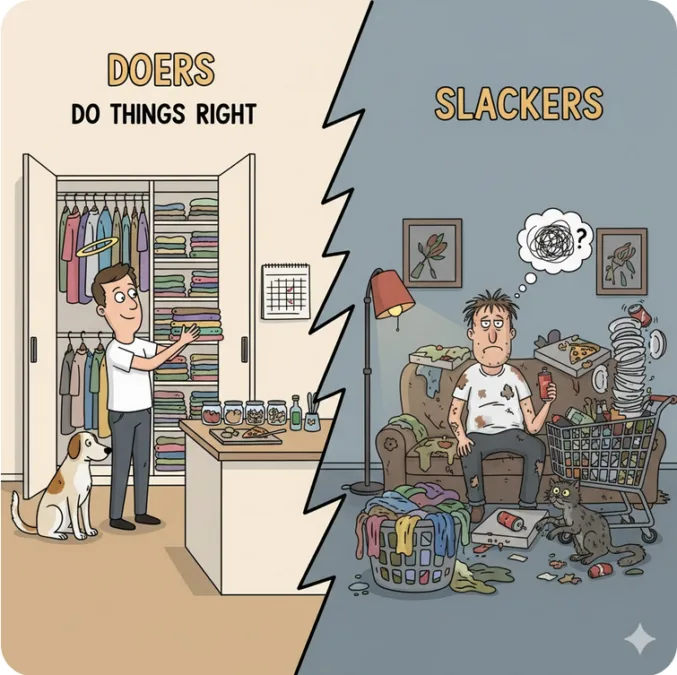
Why Your ‘Chill’ Vibe is Actually Just Laziness: A Guide to Not Being a Slob.
- Stop Calling Organized People ‘Uptight’ Just Because You Can’t Find Your Keys.
- The Excellence Manifesto: How to Stop Half-Assing Life and Start Giving a Damn.
- The High Cost of Low Effort: Why Mediocrity is the New Passive-Aggressive.
In a world increasingly obsessed with “life hacks” and “quiet quitting,” we’ve reached a weird cultural tipping point. We’ve started mistaking basic competence for neuroticism. If you fold your laundry the day you wash it, you’re “high-strung.” If you arrive at a meeting three minutes early with a prepared agenda, you’re “a try-hard.”
The “Half-Assers” – those who move through life like a human shrug – have flipped the script. They’ve managed to frame their own lack of effort as a relaxed, breezy personality trait, while labeling anyone who actually gives a rip as “uptight” or a “control freak.”
Let’s get one thing straight: Doing things right isn’t about being perfect; it’s about being respectful. It’s the difference between being a contributing member of a civilization and being a human-shaped pile of “I’ll do it later.”
The Psychology of the “Half-Asser”
Psychologically speaking, the Half-Asser is often engaging in a defense mechanism called Self-Handicapping. By not trying, they never have to face the possibility that their “best” isn’t good enough. If they fail, it’s because they “didn’t really try.”
But the real kicker is the Passive-Aggressive Projection. When a Half-Asser sees a “High-Efforter” (an A-Gamer), it triggers a deep-seated sense of guilt. To alleviate that guilt, they must belittle the effort. “Wow, you actually color-coded your pantry? Must be nice to have so much free time,” is Half-Asser speak for, “I am ashamed that I can’t find the paprika and it’s buried under a box of stale crackers from 2022.”
The Great Divide: A Comparison of Philosophies
| The A-Gamer (Doing it Right) | The Half-Asser (Phoning it In) |
| Motto: “Leave it better than you found it.” | Motto: “Nobody’s gonna notice anyway.” |
| View of Space: A shared resource to be respected. | View of Space: A temporary landing pad for their trash. |
| Response to Feedback: “How can I improve?” | Response to Feedback: “Why are you being so mean?” |
| Social Energy: Genuine curiosity and active listening. | Social Energy: Checking their phone while you talk. |
| Work Ethic: Finishes the job and double-checks the details. | Work Ethic: Does the bare minimum to avoid getting fired. |
| Philosophy: Excellence is a habit. | Philosophy: Precision is a mental illness. |
10 Common Ways People Half-Ass Life (And How to Do It Right)
1. The “Open-Air” Storage System (Not Putting Stuff Away)
The Half-Asser doesn’t “put things away.” They “set things down.” They finish the milk and leave the empty carton on the counter. They use the hammer and leave it on the dining table for three weeks.
- The Right Way: The “One-Touch Rule.” If it takes less than 60 seconds, do it now. Put the milk in the recycling. Put the hammer in the toolbox.
- The Excuse: “I’m just going to use it again later!” (Translation: “I am a chaotic neutral entity.”)
2. Conversational Grazing
Have you ever talked to someone who just waits for their turn to speak? They aren’t listening; they’re just reloading. This is half-assing human connection.
- The Right Way: Active listening. Asking follow-up questions. Showing genuine curiosity about another person’s internal world.
- The Excuse: “I’m just a bad listener.” (No, you’re just selfish.)
3. The “Reply Guy” Work Ethic
This person sends emails that say “Let’s discuss” without providing any context, data, or times to meet. They outsource the actual thinking to you.
- The Right Way: Anticipate needs. Provide solutions, not just problems.
- The Excuse: “I’m a big-picture person.” (No, you’re just avoiding the labor of the details.)
4. The Shopping Cart Abandonment
The ultimate litmus test for a functioning society. A Half-Asser leaves the cart wedged against the curb of a parking spot.
- The Right Way: Walk the 20 yards to the corral. It’s a basic social contract.
- The Excuse: “They hire people to do that.” (This is the same logic used by people who pee on the floor in public restrooms.)
5. Kitchen “Science Experiments”
Loading a dishwasher is an art. The Half-Asser throws a bowl face-up so it collects a pool of dirty, grey pasta water.
- The Right Way: Organize for efficiency so things actually get clean.
- The Excuse: “You’re such a dishwasher Nazi!” (No, I just want clean plates.)
6. The RSVP Ghost
The Half-Asser treats invitations as “maybe, if nothing better comes along.” They don’t respond until the morning of, or worse, they just show up – or don’t.
- The Right Way: A prompt “Yes” or “No.” Respect the host’s time and budget.
- The Excuse: “I’m just spontaneous!” (Spontaneous is a code word for “unreliable.”)
7. Half-Baked Hygiene (Public Spaces)
Ever walked into a gym where the previous person left 300 lbs of plates on the leg press and a puddle of sweat on the bench? That is the peak of “phoning it in.”
- The Right Way: Wipe it down. Strip the bar.
- The Excuse: “I was in a rush.” (We are all in a rush. Some of us just aren’t jerks.)
8. The “Gift” of Clutter
Bringing over a bag of your random unwanted junk and calling it a “gift” to a friend so you don’t have to drive to Goodwill.
- The Right Way: Only give things people actually want. Dispose of your own trash.
- The Excuse: “I thought you could use it!”
9. The Selective Memory of Debts
“Oh, I’ll Venmo you later.” They never do. You have to ask three times, making you feel like the “uptight” one for wanting your $40 back.
- The Right Way: Pay immediately.
- The Excuse: “I forgot! Why are you so stressed about money?”
10. The Passive-Aggressive Critique
When someone sees you doing something right – like prepping your meals for the week or keeping your car clean – and says, “I wish I had your OCD.”
- The Right Way: “Wow, you’re really disciplined. That’s cool.”
- The Excuse: “I’m just keeping it real.”
Cultural Perspectives: The Japanese Concept of Omotenashi
In many Western cultures, we prioritize the individual’s “freedom” to be a slob. In contrast, Japanese culture often emphasizes Omotenashi – wholehearted hospitality – and Osouji – the ritual of cleaning. This isn’t about being “uptight”; it’s about the deep-seated belief that your environment reflects your state of mind and your respect for others.
When a Japanese student cleans their own classroom, they aren’t being “punished” or “controlled.” They are learning that their actions have an impact on the collective. They are learning that excellence is an act of service.
Top 10 Signs You Are “Phoning It In” (A Self-Assessment)
- You have more than 4,000 unread emails.
- Your car floor is a graveyard for fast-food receipts.
- You’ve used the phrase “It’s fine” to describe a job that was clearly not fine.
- You wait until the gas light is on to refuel, every single time.
- You think “Doing the Dishes” means “Putting them in the sink to soak for three days.”
- You’ve called someone a “perfectionist” as an insult.
- You “double-tap” a message instead of actually typing a thoughtful response.
- You leave 1 second left on the microwave timer without clearing it.
- You consider “winging it” a valid strategy for a professional presentation.
- You’re reading this and feeling personally attacked.
How to Stop Half-Assing and Join the Ranks of the Competent
If you’ve realized you’re a Half-Asser, don’t worry. Change is possible. It’s not about becoming a rigid robot; it’s about becoming a person people can actually rely on.
Step 1: Own the Shame
Read The Life-Changing Magic of Tidying Up by Marie Kondo or Extreme Ownership by Jocko Willink. One will teach you how to respect your socks; the other will teach you how to respect your mission. Both are essentially telling you the same thing: Take responsibility.
Step 2: The “Plus One” Rule
Whenever you finish a task, do one extra tiny thing to make it better. Fold the blanket and fluff the pillow. Wash the pan and dry the stove. It builds the “effort muscle.”
Step 3: Stop the Projection
The next time you see someone being “uptight” (i.e., organized and disciplined), instead of making a snarky comment, try saying: “Thank you for taking care of that.” It’s amazing how much better you’ll feel when you stop trying to drag everyone down to your level of chaos.
Step 4: Practice “Mise en Place”
This is a culinary term for “everything in its place.” Apply it to your life. Before you start a project – or even a day – get your tools ready. It turns out, it’s much harder to half-ass something when you’re actually prepared for it.
A Note on Excellence:
“We are what we repeatedly do. Excellence, then, is not an act, but a habit.” – Will Durant (summarizing Aristotle)
Conclusion
Doing things right isn’t “uptight.” It’s a gift you give to your future self and the people around you. It’s the realization that a life built on “good enough” is a life that’s constantly breaking down, losing keys, and apologizing for being late.
So, put the milk away. Respond to that email. Listen to your friend. Stop phoning it in and start showing up. Your “uptight” friends are waiting for you, and honestly? It’s a lot more relaxing over here.