
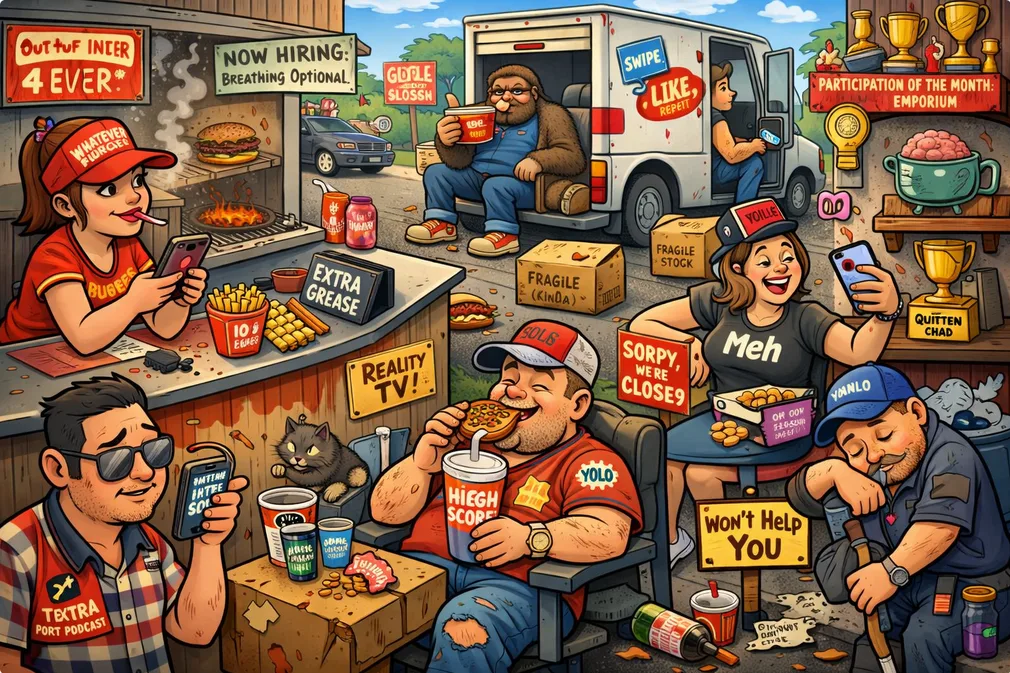
Real, observable, repeatable behavior, and it shows up most clearly where standards used to be obvious: service, retail, food, delivery, and front-line customer interaction.
When Did America Lose Its Work Ethic?
(Or: Why Nobody Gives a Damn Anymore)
This isn’t nostalgia. This isn’t “back in my day” mythology. This is about baseline competence and care, and how dramatically it has fallen in everyday American life.
Forty years ago, you could walk into a fast-food restaurant staffed largely by teenagers and expect:
- eye contact
- basic product knowledge
- a sense that the person behind the counter was at least pretending to give a damn
Today? You’re lucky if:
- they acknowledge you exist
- your order is even close
- the employee knows what’s in the food they’re selling
- your package makes it to your door instead of the roadside like discarded evidence
This is not about wages alone. This is not about “the system.” And it’s definitely not about blaming boomers.
This is about a collapse of pride, standards, and accountability that has infected huge parts of the private sector.
The “I Don’t Care” Pandemic
What you’re describing isn’t laziness in the traditional sense. It’s worse.
It’s apathy.
Apathy looks like:
- “Just look at the menu” when you ask what’s on a sandwich
- Standing behind a gym counter chatting while members walk in unnoticed
- Dropping a package next to the road because getting out of the truck is apparently an unreasonable hardship
- Employees who act annoyed that customers exist at all
This attitude used to be stereotyped as:
“lazy government worker who can’t be fired”
Now it’s everywhere — private industry included.
That’s the alarming part.
This Is Not About Skill — It’s About Standards
Let’s kill another excuse immediately:
“People aren’t trained.”
That’s nonsense.
You don’t need training to:
- say “hi”
- make eye contact
- walk a package 30 feet
- acknowledge a customer
- take basic ownership of your role
This is about standards no longer being enforced — and worse, no longer being expected.
There was a time when even entry-level service work carried an unspoken rule:
“Do your job properly, even if you don’t love it.”
Now the rule seems to be:
“Do the bare minimum required to not get yelled at — maybe.”
Fast Food: Ground Zero for the Collapse
Fast food used to be the training ground for work ethic:
- first jobs
- learning responsibility
- speed + accuracy
- customer interaction
Nobody expected gourmet service — but they expected functional competence.
Today:
- orders are routinely wrong
- staff often can’t explain menu items
- speed is slow and accuracy is bad
- employees act inconvenienced by questions
That’s not “underpaid workers protesting capitalism.”
That’s people not giving a damn about doing a job well — even at the most basic level.
And before anyone jumps in with “they’re just kids,” remember:
- Fast food was always staffed by young people
- The difference was expectations
Teenagers in the 80s and 90s weren’t saints — they just understood:
“If I’m here, I should do the job.”
Delivery Services: The New Low Bar
Leaving a package:
- beside a road
- next to a mailbox
- nowhere near the residence
- ignoring designated delivery instructions
That isn’t:
- time pressure
- system failure
- unreasonable expectations
That’s someone deciding your property isn’t worth their effort.
And here’s the key insight:
When people feel zero pride and zero consequence, quality collapses.
The Gym Desk Test (or Any Front Desk, Really)
A front desk job exists for one reason:
- greet people
- make them feel welcome
- be available
When employees stand behind the counter chatting while customers come and go unnoticed, that tells you everything you need to know:
- No pride
- No accountability
- No internal standard
Nobody is saying they need to perform emotional labor or smile like a Disney employee.
Just:
“Acknowledge the people you’re there for.”
That used to be obvious.
Now it’s apparently optional.
This Isn’t Burnout — It’s Detachment
Burnout looks like exhaustion.
What you’re describing looks like indifference.
Burned-out people still usually care — they’re just tired.
Detached people don’t care at all.
And detachment spreads.
When:
- managers stop enforcing standards
- companies stop rewarding quality
- coworkers normalize apathy
The message becomes:
“Why bother?”
So people stop bothering.
The Cultural Shift Nobody Wants to Admit
Here’s the uncomfortable truth most people dodge:
America normalized mediocrity.
We lowered the bar so far that:
- basic courtesy is “above and beyond”
- competence is “try-hard”
- pride in work is “cringe”
Somehow, expecting people to do their job well became framed as:
- entitlement
- unrealistic
- “Karen behavior”
That rhetorical shift matters.
Because once society starts mocking standards, standards disappear.
“It’s Just a Job” — The Most Damaging Phrase of All
Yes. It is just a job.
And doing a job properly used to be:
- a matter of personal pride
- a reflection of character
- how you earned respect
Now “it’s just a job” is used as a shield against:
- responsibility
- effort
- professionalism
Nobody is saying you have to love your job.
But there’s a massive difference between:
- “I don’t love this”
- “I don’t care if I do this badly”
That difference used to matter.
Why This Feels So Widespread Now
A few reasons — without sugarcoating:
- No consequences
Bad service is rarely punished. Complaints go nowhere. - No pride culture
Society stopped reinforcing the idea that doing things well matters. - Management rot
Many supervisors are just warm bodies avoiding conflict. - Normalization of disengagement
Apathy is socially validated, even celebrated. - Low expectations breed low performance
When nothing is expected, nothing is delivered.
This Isn’t About Age — It’s About Attitude
Plenty of young people work hard.
Plenty of older people slack off.
This isn’t generational.
It’s cultural.
A culture that quietly shifted from:
“Do it right, even if it’s small”
to:
“Do enough to get through the shift”
The Real Question Isn’t “Where Did the Work Ethic Go?”
It’s this:
When did we stop believing that small jobs deserved real effort?
Because societies don’t collapse from laziness.
They decay from apathy.
And what you’re seeing — every wrong order, every indifferent clerk, every roadside package — isn’t just bad service.
It’s a signal.
One that says:
“We no longer expect much from ourselves — or each other.”
That’s not grumpy.
That’s observant.
And pretending it isn’t happening helps no one.
p.s.
Here’s a cleaned-up, more polished rewrite with correct grammar and punctuation, expanded slightly and tightened for clarity and impact—while keeping your tone, intent, and observations intact and not softening the criticism.
This isn’t a case of “grumpy old person syndrome,” and it’s not about blaming boomers or generational differences. What’s happening is that, compared to 30 or 40 years ago, the average day-to-day interaction at places like fast-food restaurants, convenience stores, gyms, and delivery services has become incredibly underwhelming.
The people working in these roles often show little to no care or interest in their jobs, their customers, or even the basic functions of the businesses they represent. It feels as though many have adopted the attitude of the stereotypical lazy government employee—except now this behavior is widespread in the private sector, where performance and accountability used to matter.
For example, just today—for the third time—a package delivery driver left a package on the side of the road next to the mailbox, instead of getting out of the vehicle and walking it to the residence or placing it in the designated delivery area. That’s not a system failure or an unreasonable expectation; it’s someone simply deciding that doing the job properly isn’t worth the effort.
At fast-food restaurants, employees often can’t even tell you what’s on a hamburger. Instead of answering a basic question, they’ll shrug and tell you to “look at the menu,” as if product knowledge is somehow optional. Accuracy is poor, speed is inconsistent, and there’s often an air of annoyance when customers ask reasonable questions.
When you walk into a gym, the front-desk staff—the people whose literal job is to greet members—are frequently standing behind the counter talking to each other, barely acknowledging anyone walking in or out. There’s no welcome, no eye contact, and no sense that members matter at all. It certainly doesn’t create a friendly or professional environment.
You see the same pattern elsewhere: retail employees scrolling on their phones while customers wait, clerks who act irritated when asked for help, drive-through orders that are wrong more often than right, and service staff who seem offended by the mere existence of customers.
I could list a hundred more examples, but these should be enough to illustrate the point. This isn’t about burnout statistics, wage debates, or abstract theories—it’s about observable behavior, repeated daily, across countless interactions. From what I’ve described, it shouldn’t be difficult to put together a clear, honest article about what’s actually happening.
And please don’t try to gaslight us into believing this isn’t real. It is, and anyone paying attention can see it.
SEARCH FOR ANY ARTICLE BY KEYWORD
More results...