
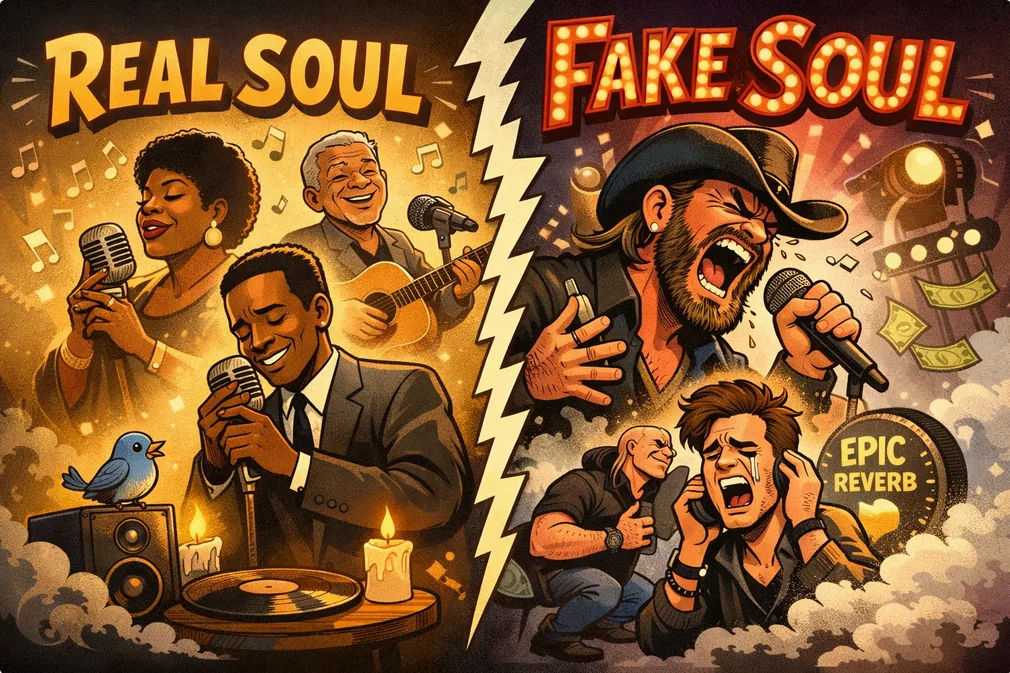
Soul You Feel vs. Soul You Hear
There’s a difference between sounding soulful and being soulful — and once you hear it, you can’t un-hear it.
Modern music is packed with singers who signal emotion instead of letting it happen. They lean hard on rasp, melodrama, dramatic pauses, and vocal strain, hoping the audience mistakes effort for authenticity. And to be fair, it often works.
Most listeners aren’t listening for pitch accuracy, breath support, or vocal placement. They’re responding to emotion, swagger, pain, and “vibes.” If you sell the feeling hard enough, people read it as real — even when the technique underneath is shaky.
That’s how a lot of singers coast by on over-singing, gravelly affectations, dramatic phrasing, and that familiar “I’m hurting so you should feel something” energy.
But here’s where the line appears.
Soul dies the moment the listener hears the strategy.
Once you clock the rasp, the phrasing tricks, the carefully timed strain — the spell breaks. Real soul doesn’t try to convince you. It leaks out. Sometimes despite the singer’s best efforts.
This isn’t about genre. And it’s not even strictly about technical skill. Some gritty singers actually have strong fundamentals and choose restraint and texture on top of them. Their rasp is controlled, their pitch solid, their dynamics intentional. The grit enhances the story — it doesn’t hide weakness.
The real offenders are the ones who can’t sing clean at all, lean on production to do the work, replace phrasing with volume, and confuse strain with depth.
With that in mind, here’s where things get fun.
Some singers feel like they’re acting soulful. Others just… are.
Fake Soul (Costume Soul)
- Chris Stapleton — Always-on rasp, dramatic pauses, and calculated pain. Technically capable, but you hear the performance before the feeling.
- Scott Stapp — Peak vocal posturing. Sounds like he’s auditioning for the role of “Man Experiencing Emotions.”
- Lewis Capaldi — Volume plus strain equals sadness, apparently. Emotional blunt-force trauma as a genre.
- Sam Smith — Big voice, carefully storyboarded ache. The pain feels rehearsed.
- Imagine Dragons — Inspirational grit with corporate polish. Soul by committee.
- Rag’n’Bone Man — Endless gravel and shouting. Blues costume, not blues life.
If you can hear how hard someone is trying to make you feel something, you stop feeling it.
Real Soul (Earned, Unavoidable)
- Bill Withers — The blueprint. Sounds like breathing. No tricks, no masks.
- Otis Redding — Emotion without theatrics. When he breaks, it’s because he can’t help it.
- Al Green — Warmth over flash. Seduction through restraint.
- Aretha Franklin — Ridiculous technique plus unavoidable feeling. Nothing performative about it.
- Sharon Jones — Raw, human, lived-in. Soul that earned every wrinkle.
- Leon Bridges — Retro without parody. Clean tone, natural phrasing, zero mugging.
- John Mayer, Miley Cyrus, Billy Joel, John Fogerty, Bruno Mars, John Papa, Stevie Ray Vaughan, Robert Plant, Randy Travis, Carrie Underwood, Garth Brooks.
What they share isn’t genre or vocal texture — it’s honesty. Pain without theatrics. Restraint over strain. Humanity over heroics. None of them sound like they’re trying to convince you of anything.
They just are.
Female Vocalists: Where Fake vs Real Shows Fast
Female singers expose this divide instantly because audiences are especially sensitive to over-signaled vulnerability. When the breathiness, cracks, or whispers feel weaponized, it reads as manipulation.
Fake soul shows up as:
- exaggerated fragility
- whisper-singing as a personality
- sadness-as-branding
Real soul shows up as control, phrasing, and emotional economy. Think singers who don’t need to sound broken to sound human. When they break, it surprises you — and that’s why it hits.
Male Vocalists: Strain Is Not Depth
For men, fake soul usually hides behind volume and grit. Shouting becomes a substitute for phrasing. Rasp becomes a substitute for tone. The louder and rougher it gets, the more “authentic” it’s supposed to feel.
But real male soul singers don’t muscle emotion into existence. They let tension build. They let silence do work. They trust the listener.
When you hear someone forcing it, you’re not moved — you’re just aware of effort.
Blues vs Rock: Where People Get Confused
Blues is lived-in. Rock often performs pain.
That’s not a knock on rock — it’s just a reality. Blues comes from repetition, survival, and familiarity with loss. Rock frequently borrows the aesthetic of suffering without the context.
That’s how you end up with:
- blues phrasing without blues restraint
- grit without groove
- shouting where space should be
When rock singers put on blues armor without the history, it feels like cosplay. When blues singers step into rock, the soul usually survives.
The “One Song Proves It” Challenge
Here’s a simple test.
If you can only prove a singer’s soul by pointing to their biggest, loudest, most dramatic song, that’s a red flag.
Real soul survives in:
- quiet tracks
- demos
- live acoustic performances
- imperfect recordings
If the emotion disappears when the production is stripped away, it was never real to begin with.
Why Audiences Confuse Effort with Authenticity
Because effort is loud.
Strain, rasp, crying vocals, dramatic pauses — these things are obvious. They feel like emotional labor, and people instinctively reward labor. We’re conditioned to think that if something looks hard, it must be meaningful.
But soul isn’t hard in that way.
Real soul often sounds accidental. It slips through restraint. It shows up when the singer isn’t pushing for it. And that subtlety gets missed in a world trained to respond to spectacle.
The irony is that the more a singer tries to sound soulful, the further away they usually get.
The Bottom Line
Soul isn’t volume.
It isn’t rasp.
It isn’t drama.
Soul is what’s left after the technique disappears.
And once you learn to hear the difference between performed soul and inherent soul — there’s no going back.
SEARCH FOR ANY ARTICLE BY KEYWORD
More results...