
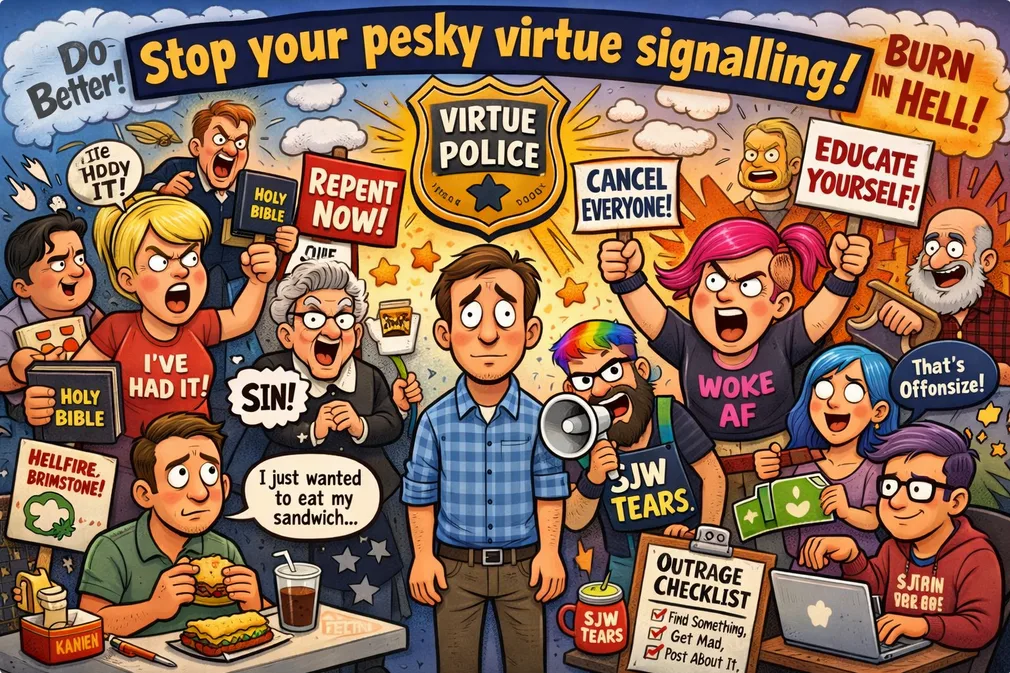
(SJWs vs. Bible Beaters)
There’s a special kind of person who can’t let a moment pass without polishing their halo in public. You could be eating a sandwich and somehow they’ll turn it into a TED Talk on sustainable gluten ethics. They don’t just have opinions — they have performances. And every performance ends with them glancing around the room like, “Did everyone see how morally toned my abs are?”
Once upon a time, these people lived exclusively in church basements and clutched hardcover books while condemning rock music. They were called Bible Beaters. Today, they live on social media and clutch smartphones while condemning your recycling habits. They are called Social Justice Warriors. Same energy, different soundtrack.
Let’s be clear: caring about things is good. Being compassionate is good. Wanting a better world is good. But if every interaction feels like you’re auditioning for the role of “Most Enlightened Human at the Potluck,” it stops being about compassion and starts being about ego cardio.
The Bible Beater used to say, “I’ll pray for you,” with the tone of someone reporting you to heaven’s HR department. The modern SJW says, “Educate yourself,” with the tone of someone assigning homework they themselves skimmed from a viral thread. One uses scripture, the other uses screenshots. Both are convinced they’ve been divinely selected to fix your moral posture.
The wild part? Most of the loudest anti-religion types didn’t actually reject religion. They just swapped uniforms. The pew turned into a podcast. The hymn turned into a hashtag. The sermon turned into a subtweet. Congratulations — you’ve left the church but kept the pulpit.
Virtue signalling is basically spiritual CrossFit. It’s not enough to quietly help someone or privately donate or calmly disagree. No, you need witnesses. You need applause. You need the moral equivalent of someone spotting you while you lift a 45-pound plate labeled “Empathy.”
The thing that unites SJWs and Bible Beaters is not politics. It’s not policy. It’s not even belief systems. It’s the itch — that irresistible urge to correct, scold, and display superiority disguised as concern. It’s less about helping the sinner and more about proving you’re not one.
Normal nice people don’t wake up thinking, “Who can I fix today?” They wake up thinking, “Where’s the coffee?” There’s a difference between caring about injustice and turning every brunch into a tribunal. The former builds bridges. The latter builds resentment and a group text without you.
Let’s examine some everyday scenarios.
You’re at a barbecue. Someone brings plastic forks. The Normal Nice Person shrugs and eats the potato salad. The Virtue signaler delivers a five-minute lecture on oceanic microplastics while no one can find the mustard.
You accidentally use the wrong word. The Normal Nice Person gently clarifies or ignores it. The Virtue signaler responds like you just detonated a cultural landmine and summons a 14-tweet educational thread.
Your friend makes a harmless joke. The Normal Nice Person laughs or doesn’t. The Virtue signaler gasps so loudly you’d think oxygen itself was problematic.
You post a vacation photo. The Normal Nice Person says, “Looks fun!” The Virtue signaler asks how you offset the carbon footprint of your happiness.
You mention you’re tired. The Normal Nice Person sympathizes. The Virtue signaler informs you that exhaustion is a privilege and you should unpack that.
You say you prefer one brand of coffee. The Normal Nice Person nods. The Virtue signaler launches into a supply chain ethics symposium.
You forget to bring a reusable bag. The Normal Nice Person hands you one. The Virtue signaler stares like you personally strangled a sea turtle.
You disagree on a policy issue. The Normal Nice Person debates calmly. The Virtue signaler labels you morally defective and schedules your cancellation.
You don’t repost the trending cause of the week. The Normal Nice Person assumes you’re busy. The Virtue signaler assumes you’re complicit.
You say, “I don’t know enough about that.” The Normal Nice Person respects that. The Virtue signaler says, “That’s the problem.”
Here’s the uncomfortable truth: the louder someone signals virtue, the less secure they usually feel about their own. It’s insecurity wearing a superhero cape stitched from trending hashtags or cherry-picked verses. If your identity depends on correcting strangers, you’re not enlightened — you’re addicted to control.
A little Jeff Foxworthy-style honesty
- If you’ve ever corrected someone’s grammar mid-apology, you might be a SJW.
- If you’ve ever said “Do better” without specifying how, you might be a SJW.
- If you’ve rehearsed outrage in the shower, you might be a SJW.
- If you treat social media like a confessional booth where others must repent, you might be a SJW.
- If you believe disagreement equals moral corruption, you might be a SJW.
- If you can’t enjoy a movie without scanning it for ideological violations, you might be a SJW.
- If you measure friendships by compliance, you might be a SJW.
- If you’ve ever started a sentence with “As someone who cares deeply…” you might be a SJW.
- If your activism evaporates once the trend dies, you might be a SJW.
- If being offended feels oddly energizing, you might be a SJW.
But let’s not let the Bible Beaters off the hook.
- If you’ve ever used “love the sinner, hate the sin” as a backhanded slap, you might be a Bible Beater.
- If you think eternal damnation is a light conversational icebreaker, you might be a Bible Beater.
- If you’ve ever prayed loudly enough for others to hear your humility, you might be a Bible Beater.
- If you treat morality like a scoreboard and you’re always winning, you might be a Bible Beater.
- If your compassion only extends to people who vote like you, you might be both.
Here’s a side-by-side comparison for clarity:
| Scenario | Normal Nice Person | Virtue signaler (SJW/Bible Beater Edition) |
|---|---|---|
| Someone makes a minor mistake | Gently corrects or ignores | Publicly shames to set an example |
| Disagreement arises | Asks questions | Assigns moral ranking |
| Friend struggles | Offers help | Offers a lecture |
| Sees injustice | Acts constructively | Posts passionately, then refreshes for likes |
| Conversation at dinner | Enjoys meal | Conducts ethical audit |
The point isn’t that causes are bad. It’s that ego disguised as righteousness is exhausting. When every interaction is a morality play starring you, people stop listening to the message and start muting the messenger.
Purpose doesn’t come from scolding strangers. It comes from building things, helping quietly, loving consistently, and occasionally minding your own business. The most genuinely good people I know rarely announce it. They don’t need the spotlight because they’re not performing.
So maybe before you “educate,” “correct,” “pray over,” or “call out,” ask a radical question: Is this about helping… or about me?
Because nothing says “nasty thing in common” quite like two people on opposite sides screaming at each other about who’s more virtuous — while the Normal Nice Person just wants to finish their sandwich in peace.
If You… Then You Might Be a SJW
- If you’ve ever corrected someone’s pronoun usage for a potted plant
- If your morning coffee comes with a side of outrage over the ethically sourced
- If you’ve ever started a sentence with, “As a privileged ally, I feel it’s my duty to explain…”
- If you believe that cultural appropriation extends to enjoying a taco
- If your entire personality revolves around what you’re against, rather than what you’re for
- If you’ve ever boycotted a company because their logo vaguely resembled something problematic
Ten Common Everyday Examples of Annoying Virtue Signalling Behavior:
- The “Did you know…?” Opener: This usually begins with a startling statistic about a global crisis, delivered at a casual gathering, effectively killing all lighthearted conversation.
- The Food Shaming: When you’re happily munching on a burger, and someone launches into a detailed exposé on the horrors of factory farming, complete with sound effects.
- The “Problematic” Interruption: You’re enjoying a classic movie, and suddenly, a voice pipes up to dissect every single element through a hyper-critical, modern lens, ruining the magic.
- The “I Read an Article” Rant: Armed with a single online article (often from a less-than-reputable source), they will passionately lecture you on a complex geopolitical issue as if they’ve just returned from the UN.
- The Environmental Guilt Trip: You reach for a plastic straw, and a hand shoots out to dramatically intercept it, followed by a dramatic sigh about the imminent demise of marine life.
- The Social Media Pile-On Initiation: They spot a minor misstep online and immediately rally their digital troops to descend with righteous fury, often over something utterly trivial.
- The Unsolicited Parenting Advice: Observing a child having a minor tantrum, they offer a lengthy dissertation on modern psychological techniques, implying your methods are barbaric.
- The “You Can’t Say That Anymore” Patrol: Constantly policing language, even in jest, to ensure no word, phrase, or casual idiom could possibly be misconstrued as offensive.
- The “My Suffering is Worse” One-Up: In any conversation about challenges or difficulties, they subtly (or not so subtly) pivot to how their own struggles are far more profound and complex.
- The Performative Apology Acceptance: Someone genuinely apologizes for a minor transgression, and they embark on a lengthy, dramatic explanation of why the apology was necessary, ensuring everyone knows how magnanimous they are for accepting it.
OFFICIAL CERTIFICATE OF MORAL EXCELLENCE that you can award to any annoying woke twats you happen to encounter.
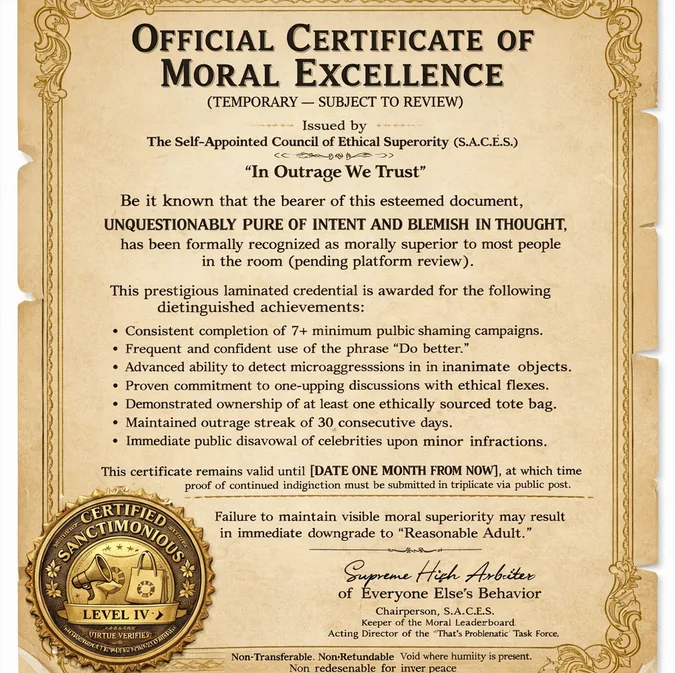
The New Religion of the High-Horse
It’s truly a marvel to witness how the modern “rebel” has somehow looped all the way back around to becoming a 1950s town gossip with a smartphone. These types have traded the wooden pews for reclaimed wood coffee shops, but the energy remains exactly the same: “I am better than you because I follow the rules that I just made up ten minutes ago.” If you look closely, the person screaming about a movie’s lack of diverse background extras is the exact same person who used to faint if a skirt was two inches above the knee.
They are essentially grabbing at straws to find a sense of purpose, turning every minor inconvenience into a holy war because, without the struggle, they’d have to face the terrifying reality that they’re actually quite boring. Instead of looking inward to fix their own messy lives, it’s much easier to scroll through a stranger’s digital history to find a “sin” from 2011 to repent for. It’s a secular Inquisition where the stake is a social media ban and the inquisitors are wearing overpriced sustainable loungewear.
At the end of the day, whether you’re beating people over the head with a King James Bible or a sociology textbook you haven’t actually read, you’re still just a loud-mouth with a superiority complex. True kindness doesn’t require a megaphone or a public announcement of your own “growth” and “learning.” If your “activism” or your “faith” primarily consists of making other people feel like garbage so you can feel like gold, you haven’t found a calling; you’ve just found a hobby that makes everyone hate going to brunch with you.
Normal People vs. SJWs in Everyday Scenarios
| Scenario | Normal Nice Person | Social Justice Warrior (SJW) |
| Ordering a Taco | “I’ll have two carnitas, please. These look delicious.” | “Is the chef from this specific region? Because otherwise, this is a literal act of culinary violence.” |
| A Friend Misspeaks | “Haha, I think you meant ‘hypothetically,’ not ‘hyperbolically.’ Anyway…” | “The etymology of that word is deeply rooted in 18th-century elitism. We need to unpack why you felt safe using it.” |
| Seeing a Puppy | “Oh my god, what a cute dog! Can I pet him?” | “Is that a purebred? Do you realize how many shelter dogs died while you were shopping for an aesthetic?” |
| Watching a Movie | “That was a fun action flick, though the CGI was a bit wonky.” | “The lack of representation in the third act was a violent erasure of my specific lived experience.” |
| Workplace Small Talk | “How was your weekend? Did you do anything fun?” | “I spent forty-eight hours decolonizing my bookshelf and checking my privilege. How about you, oppressor?” |
| Receiving a Gift | “Thank you so much! This is so thoughtful of you.” | “While I appreciate the gesture, the carbon footprint of this gift wrap is basically a hate crime against the planet.” |
The Ultimate Survival Guide: How to Handle the Moral High-Grounders
Navigating a conversation with a modern-day missionary of “The Message” requires the patience of a saint and the tactical maneuvering of a bomb squad technician. If you find yourself cornered by someone who treats every casual chat like a grand jury summons, your first instinct might be to argue with logic or, failing that, to fake a sudden and violent coughing fit. Resist the urge to debate; you cannot win a game where the other person is both the referee and the guy who wrote the rule book in invisible ink five minutes ago.
The most effective strategy is the “Grey Rock” method, where you become as interesting and responsive as a dull, unmoving stone. When they start peeling back the layers of your “problematic” choice of footwear, simply nod and offer a non-committal, “That’s a perspective.” It’s the conversational equivalent of a brick wall—there is nowhere for their righteous indignation to land, and eventually, they’ll wander off to find a more reactive target who will actually give them the dopamine hit of a public confrontation.
If you’re feeling particularly spicy, you can always try the “Innocent Question” technique to watch their internal gears grind to a halt. When they drop a buzzword that sounds like it was synthesized in a lab, ask them to define it in plain English without using three other buzzwords as crutches. Usually, the house of cards collapses because they haven’t actually thought about the topic; they’ve just memorized the lyrics to the song of their people. Just remember: the goal isn’t to change them—it’s to escape to the bar before they start auditing your playlist.
A Few Last Tips for the Trenches:
- Never apologize for something you didn’t do: A “performative apology” is blood in the water to a virtue signaler; they will only use it as a confession of your inherent guilt.
- Carry snacks: They usually get extra cranky when their blood sugar drops, and offering them a non-organic cracker is a great way to trigger a five-minute lecture that gives you time to slip out the back door.
- Remember the Irony: When they start screaming about “tolerance” while refusing to tolerate your existence, just smile—it’s the funniest joke in the room, even if they’re the only ones who don’t get it.
SEARCH FOR ANY ARTICLE BY KEYWORD
More results...