
The Church of Perpetual Moral Superiority
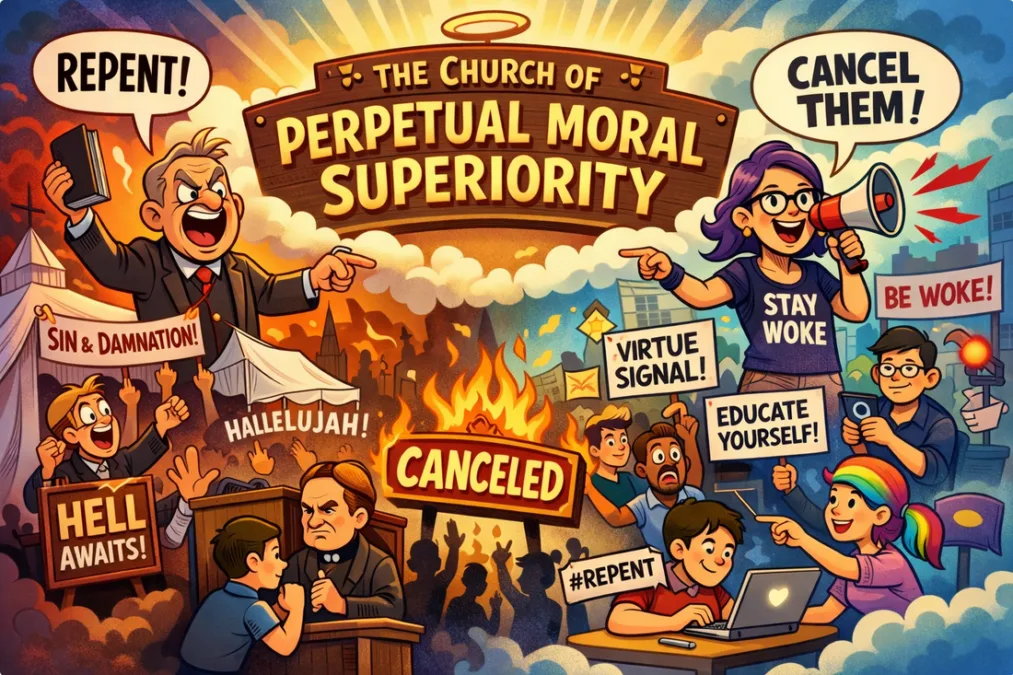
Every era produces its own traveling preachers. In the old days they carried Bibles and pamphlets. Today they carry smartphones and Twitter accounts. The wardrobe changed, the vocabulary changed, but the basic mission remains identical: loudly inform everyone within earshot that they are morally inferior.
They used to call it evangelizing.
Now they call it raising awareness.
Same sermon. Different merch.
The New Revival Tent
In the past, revival tents popped up in dusty fields where preachers warned you about eternal damnation. Today the revival tent is social media, where the sermon warns you about being problematic.
Instead of hellfire, the threat is cancellation.
Instead of sin, the offense is insensitivity.
Instead of salvation, the promise is being on the right side of history.
The ritual is familiar to anyone who has ever watched a preacher work a crowd:
- Identify a villain.
- Announce moral emergency.
- Demand public repentance.
- Accept praise for your courage.
It’s the exact same formula—just with hashtags instead of hymnals.
Confession Time
Traditional religion had confession booths. The new system has public apology posts.
Someone says something mildly dumb on the internet and suddenly the congregation demands repentance. The accused must publish a carefully worded confession acknowledging their “growth journey,” their “learning moment,” and their “commitment to doing better.”
This is basically the modern version of standing in front of the church saying:
“Forgive me, congregation, for I have tweeted.”
The apology is never enough, of course. It rarely is. The point isn’t forgiveness; the point is the ritual humiliation.
Nothing bonds a congregation like watching someone get dragged to the altar.
The Sacred Vocabulary
Evangelists have their own language. Words like sin, redemption, testimony, and salvation.
The modern moral crusader has their own glossary too:
- Problematic
- Do better
- Educate yourself
- Lived experience
- Amplify marginalized voices
It’s basically the same phenomenon linguists see in cults: a shared vocabulary that signals membership in the tribe.
Once you learn the language, you’re part of the congregation. If you question the language, you’re clearly a heretic.
The Ritual of Public Outrage
The old preacher pounded the pulpit and warned about moral decay.
The modern version pounds the keyboard and warns about microaggressions in breakfast cereal commercials.
Both styles rely heavily on theatrical indignation. The preacher’s voice would rise with righteous fury. The modern version types in ALL CAPS and adds three siren emojis.
The goal is identical: demonstrate that your outrage is holier than everyone else’s.
Because nothing proves moral purity like screaming at strangers online.
The Ego in Disguise
Here’s the funny part. Most of these movements claim to be about humility, empathy, and self-reflection.
Yet the performance always revolves around one central character:
Look at how morally enlightened I am.
You’ll notice that the loudest virtue signalers rarely talk about improving their own behavior quietly. Instead, they broadcast it like a peacock displaying its feathers.
“I’m doing the work.”
“I’m holding space.”
“I’m unpacking my privilege.”
If humility were the goal, these declarations would happen privately. But humility doesn’t get likes.
Sanctimony does.
The Endless Self-Flagellation
One strange feature of the new moral religion is how much self-loathing it encourages.
Followers are expected to constantly confess how flawed they are. They must examine their privilege, acknowledge their biases, apologize for things they didn’t personally do, and pledge to do better forever.
It’s a fascinating psychological loop.
The individual simultaneously believes two things:
- I am morally superior to most people.
- I am also deeply sinful and must constantly repent.
If that sounds familiar, it should. Medieval monks used the exact same formula.
The only difference is monks didn’t live-tweet the process.
The Missionary Work
Evangelists knock on doors.
Modern missionaries invade comment sections.
No topic is too small to receive a sermon. You could be discussing pizza toppings and suddenly someone arrives to explain how pepperoni is a symptom of systemic oppression.
These people cannot resist the urge to convert strangers.
Because, just like the preachers before them, they’re not satisfied with living by their own beliefs. They need everyone else to join the congregation.
The Heretic Problem
Every moral movement eventually faces the same problem: what to do with dissenters.
Old religious movements called them heretics.
Modern movements call them problematic voices who must be deplatformed.
The technique is remarkably similar:
- Label the dissenter immoral.
- Encourage the crowd to shun them.
- Declare victory for righteousness.
Nothing reinforces group identity like expelling a heretic.
The Irony Nobody Notices
The most ironic part of the whole spectacle is that many of these activists spend enormous energy mocking religious evangelists.
Yet their behavior mirrors them almost perfectly:
| Old Evangelist | New Evangelist |
|---|---|
| Sin | Problematic behavior |
| Hell | Cancellation |
| Confession | Public apology post |
| Sermon | Viral thread |
| Missionary work | Comment section activism |
It’s basically the same moral theater wearing a different costume.
The Quiet Do-Gooders
Here’s the funny twist.
The people who actually improve the world—volunteers, teachers, nurses, mentors—rarely feel the need to lecture strangers all day about how virtuous they are.
They just do things.
Meanwhile, the loudest moral crusaders seem permanently stuck in a cycle of:
- announcing problems
- scolding strangers
- congratulating themselves
Which might explain why their sermons are constant but their results are often… harder to locate.
The Final Sermon
Every society needs people who care about fairness and justice. That part isn’t the problem.
The problem begins when caring about something turns into a performance of moral superiority.
At that point it stops being compassion and starts looking suspiciously like a revival meeting.
And if you listen closely, you can almost hear the choir warming up.
Can I get an amen?
SEARCH FOR ANY ARTICLE BY KEYWORD
More results...