
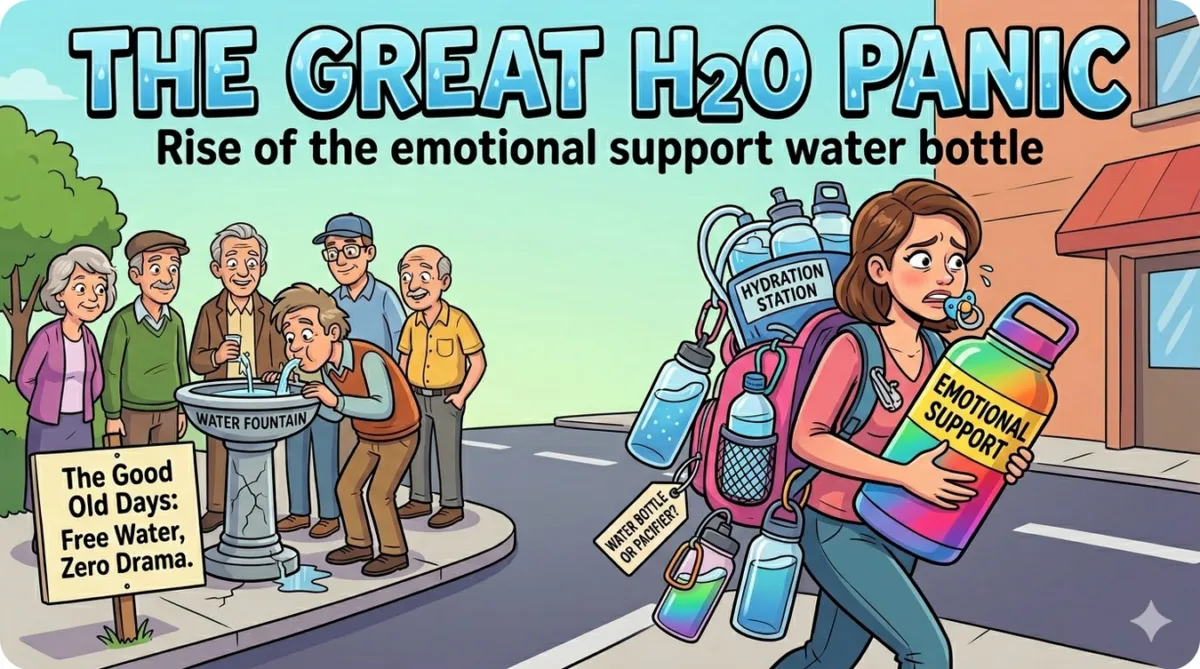
We are over-hydrating, over-coddling, and completely out of our minds , and nobody’s water bottle is going to fix that.
Rise of the Emotional Support Water Bottle
There was a time, not long ago, when humans operated just fine without clutching a personal water reservoir like they were crossing the Sahara on foot. You got thirsty, you found a water fountain, you leaned down like a normal mammal, and you moved on with your life. No color-coordinated bottle. No electrolyte-enhanced Himalayan glacier infusion. Just water. From a pipe. Like champions.
Now? People act like if they go 11 minutes without a sip, their organs will file a formal complaint and shut down operations.
You’ll see them everywhere. Walking into a grocery store with a 40-ounce insulated jug like they’re preparing for a desert expedition, when in reality they’re just picking up frozen pizza and a scented candle. The bottle has a handle, a strap, a backup straw, and probably its own LinkedIn profile. It’s not hydration anymore, it’s a lifestyle accessory with emotional dependencies.
And the way people sip… it’s not even thirst-based. It’s recreational. They’re just sipping because their hand feels empty. It’s the adult version of a toddler dropping a pacifier and going into DEFCON 1. Except now it’s, “Wait, where’s my bottle?? I’m literally dehydrated right now,” as if their body has the survival timeline of a houseplant in direct sunlight.
Let’s be honest about where this came from. This is peak helicopter-parent energy that somehow made it into adulthood. Entire generations raised on scheduled snack times, backup snacks, emergency snacks, and hydration reminders every 12 minutes. Somewhere along the way, “you’ll be fine” got replaced with “are you hydrated enough to emotionally process standing in line at Target?”
We’ve turned basic human resilience into a customizable bottle with a straw lid.
And it doesn’t stop at water. This behavior has expanded into a full ecosystem of “emotional support accessories.” Emotional support coffee. Emotional support hoodie. Emotional support lip balm. People walking around like survival kits with anxiety.
God forbid you leave the house with just… yourself.
There’s always that moment too. Someone realizes they forgot their water bottle. Watch the panic set in. You’d think they just left their child on the roof of the car. “Should I go back? I don’t know if I can make it.” Make it where? The post office? You’re not trekking through the Andes.
Meanwhile, back in the day, kids were outside for six hours straight with nothing but questionable decision-making and maybe a hose if things got serious. And guess what? Everyone survived. No one needed a triple-insulated emotional support thermos to play tag.
And don’t even get me started on the branding. These bottles have become status symbols. “Oh you don’t have this brand? That one doesn’t keep your water cold for 47 hours.” Why would I need my water cold for 47 hours? Am I storing it for the apocalypse or drinking it this afternoon?
We’ve somehow turned hydration into a competitive sport.
There’s also a strange moral superiority baked into it. The constant sippers carry themselves like they’ve unlocked some elite level of human optimization. “I drink a gallon a day.” Congratulations, you’ve achieved the bladder capacity of a hummingbird and now spend half your life locating bathrooms.
At what point do we admit we’ve over-corrected?
Nobody is saying don’t drink water. Relax. We’re not advocating for dehydration like it’s a personality trait. But maybe, just maybe, you don’t need to treat hydration like a continuous IV drip that must be maintained at all times or society collapses.
Maybe you can go… 20 minutes.
Maybe even 30.
Let’s bring back a little bit of casual indifference. A little bit of “I’ll grab some water when I get there.” A little bit of not needing a specialized container with a name, a color theme, and a matching Instagram story.
You’re not a camel. But you’re also not a newborn baby bird waiting for someone to drip water into your mouth every five minutes.
You’re a grown adult.
You’ll survive the walk into the store.
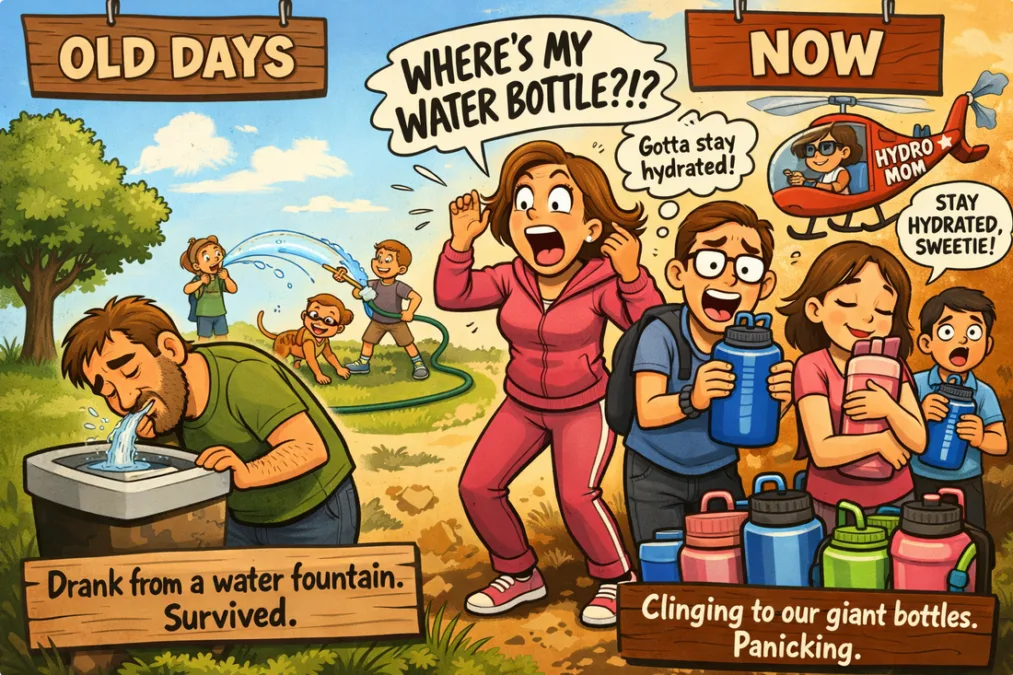
There used to be this magnificent invention. A chrome spigot mounted to a wall. You walked up, you pressed a button, and cold water arced gracefully into your open mouth like a gift from the municipal gods. You drank. You moved on with your life. Nobody took a photo of it. Nobody named it. It did not have a motivational quote printed on the side telling you that you were on the “8 AM” sip. It was called a water fountain, and it was everything.
That era is apparently over. We have collectively decided, as a civilization that once landed on the moon, that the water fountain is no longer sufficient. We now require a 40-ounce, double-walled, vacuum-sealed, pastel-colored, sticker-covered vessel strapped to our person at all times , just in case the crushing, life-threatening emergency of mild thirst descends upon us between the car and the front door of Target.
God forbid it does. God forbid.
A water fountain requires two things: legs and a working mouth. Somehow, this became too much to ask.
Jerry Seinfeld once asked what the deal was with airline food. I am asking what the deal is with grown adults treating water like it’s a limited resource they’ve been airlifted in to personally safeguard. You are going to the grocery store. It is an eleven-minute errand. Your body is 60% water already. You are, biologically speaking, mostly fine.
But try telling that to someone who has left their Stanley at home. The look on their face. The sheer, existential panic. The hollow eyes of a person who has lost something vital, something load-bearing to their sense of self. You’d think they left their firstborn in the Wendy’s parking lot.
The Helicopter Parent–to–Hydration Pipeline
Let’s talk about how we got here, because nothing this absurd happens in a vacuum , or in this case, in a vacuum-insulated tumbler. This is the long, slow legacy of the generation that put helmets on children riding tricycles in the driveway, who replaced dodgeball with “cooperative movement activities,” and who showed up to every soccer game with a bag of orange slices, a folding chair, and a philosophy that discomfort is the enemy of growth.
These are the same people who, upon learning that children sometimes get thirsty at school, did not say “there’s a fountain by the gym” , they sent their kid in with a 64-ounce water jug the size of a fire hydrant and a packet of electrolyte powder, because apparently tap water is now inadequate and their child is training for Ironman Kona.
The child grows up. The child goes to college. The college student buys their own water bottle , possibly a Hydroflask, possibly a Stanley, possibly an Owala, because there are now celebrities of the water bottle world , and carries it everywhere. To class. To brunch. To therapy, where they discuss their water bottle. The circle is complete.
We raised a generation to fear thirst the way previous generations feared famine. These are not the same thing.
The Stanley Cup: Trophy for What, Exactly?
At some point we stopped calling them water bottles and started calling them “tumblers” and “cups,” and they started having colorways and limited drops, and people began lining up outside Target at 6 AM to get the new Valentine’s Day Stanley the way their grandparents lined up for Beatles tickets. Their grandparents were at least lining up for the Beatles.
There are women , and you’ve seen them , who own seventeen Stanley cups. Not because they need seventeen vessels for liquid. Because the coral one hadn’t come out yet when they bought the mauve one, and you simply cannot be expected to hydrate with last season’s colorway. That’s not hydration. That’s a collection. You are not drinking water. You are curating.
The Seinfeld bit writes itself: “What is the deal with having a favorite water bottle? It holds water. It’s water. You’re not developing a relationship with the water. The water doesn’t care about you. The water is going to become urine regardless of the vessel.”
Meanwhile, Our Ancestors Are Absolutely Disgusted
Consider, for a moment, the humans who built the pyramids. The ones who crossed entire continents on foot. The cowboys. The sailors. People who worked twelve-hour days in the sun and got their water from a shared ladle dipped into a communal bucket, which had also been used to water the horses, and nobody thought this was a particularly noteworthy hardship. They just drank the bucket water and kept building the thing.
Now we have people who will not leave the house without their insulated tumbler, and if the tumbler has even a slight odor from yesterday’s water , yesterday’s water , it goes on TikTok as a cleaning tutorial and gets 4.2 million views from other people who also have strong opinions about whether their water tastes “off.”
Water. Tastes. Off. It’s water. It has always been water. That’s the whole thing about water.
Marcus Aurelius ran the Roman Empire without a single electrolyte packet. Let that marinate.
The Broader Epidemic of Manufactured Fragility
The water bottle is merely the most visible symptom of a much larger condition, which is the wholesale rejection of the stoic philosophy in favor of something that might be called Competitive Vulnerability With Good Branding.
We now have weighted blankets for adults , which used to just be called “blankets” or, if you were feeling luxurious, “a second blanket.” We have anxiety rings, fidget cubes, noise-canceling headphones to block out the horror of existing in shared space with other humans, blue-light glasses to protect us from screens we choose to stare at for twelve hours a day, and a supplement stack so elaborate it requires its own calendar app.
We have “quiet quitting,” which is the rebranding of doing your job in a normal way. We have “bare minimum Mondays,” which is apparently a thing people say out loud without irony. We have adults telling each other that they can’t be expected to function without a full eight hours, their magnesium glycinate, their morning walk, their journaling practice, their somatic stretching routine, and , naturally , their emotional support water bottle filled with exactly the right amount of filtered water and maybe a little lemon if they’re feeling adventurous.
The Stoics believed that hardship was not an obstacle to a good life but the actual mechanism of it. Marcus Aurelius ran an empire, fought wars, buried children, and managed to maintain composure. He did not carry a matching set of accessories. He did not have a nighttime routine that takes forty-five minutes. He would look at a modern wellness TikTok and simply close his eyes and walk into the sea.
Things We No Longer Believe We Can Do Without
While we’re here, let’s acknowledge the full portfolio of items that have been promoted from “convenience” to “non-negotiable survival gear” in recent years. We have gone from zero to medically necessary on: ring lights, standing desks, ergonomic mouse pads, a specific brand of pen that makes journaling feel different, blue light glasses, CBD gummies for “taking the edge off” (the edge of what , Tuesday?), and pillows that are engineered with the same seriousness previously reserved for bridge construction.
There are grown people who cannot eat at a restaurant without photographing the meal first, which means the meal must wait, which means the food gets cold, which means they complain the food is cold, which means they leave a three-star review that says “a little cold when it arrived.” You did this. You specifically did this to yourself and to the food.
We carry portable chargers because the idea that our phone might reach 12% battery while we are away from an outlet is treated like a category-five emergency. We carry AirPods so we never have to hear ambient life. We carry our little bottles of water so we never, not for one single moment, have to wonder if water is available nearby. Everything must be on our person, in a cute bag, at all times, or civilization might collapse , or worse, we might experience mild inconvenience.
A Modest Proposal
Here is what I suggest. Not as a doctor, not as a therapist, not as a hydration expert , just as a person who once drank from a garden hose and turned out reasonably fine: leave the house without the water bottle. Just once. Just to see what happens.
You will walk to your car. You will drive to the place. You will do the thing. And if, somewhere in the middle of the thing, you feel slightly thirsty, you will look around and , I promise you this , you will find water. It will be in a fountain, or a vending machine, or a restaurant, or someone’s tap, or a gas station where the cups cost $1.49 and they’re enormous and filled with ice and it’s fine. You will drink the water and continue being alive and you will not have needed to hydrate like you were crossing the Sahara on a mule.
Your ancestors did not carry water. They trusted that water would be approximately where water usually is. They were right. Water is still where water usually is. It didn’t move. Water is fine.
You are fine. Probably. Drink some water, from whatever.
SEARCH FOR ANY ARTICLE BY KEYWORD
More results...