
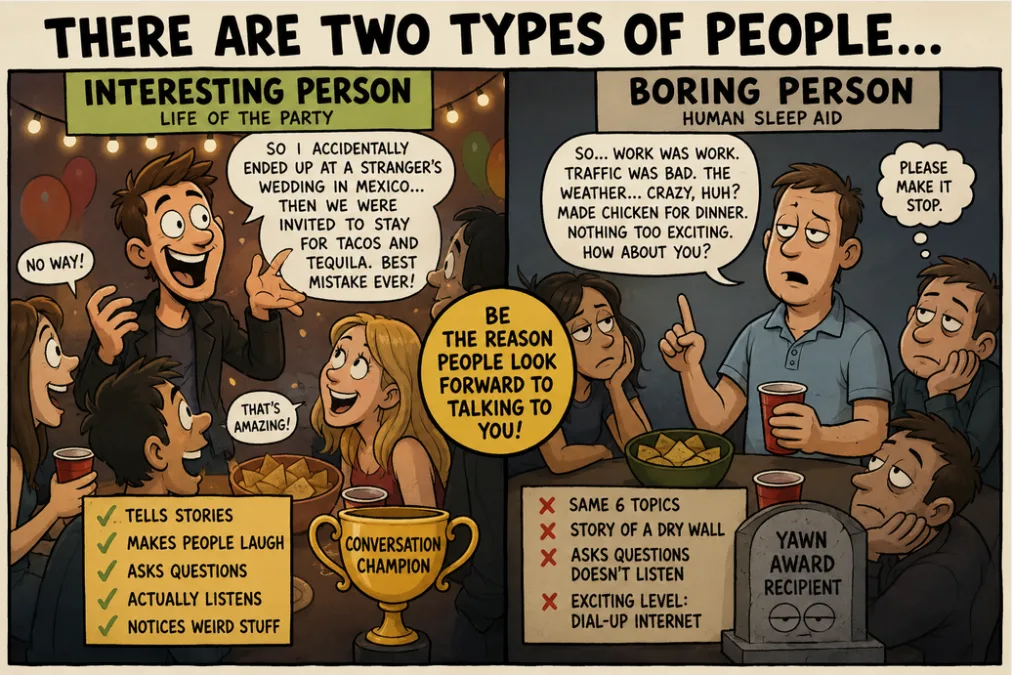
How to be more interesting

How to be more interesting funny cartoon
/* ── Article styles ── */ .roast-wrap { font-family: Georgia, ‘Times New Roman’, serif; max-width: 760px; margin: 0 auto; color: #1a1a1a; line-height: 1.8; } .roast-wrap p { margin: 0 0 1.4em; font-size: 1.05rem; } .roast-wrap h2 { font-family: Georgia, serif; font-size: 1.7rem; font-weight: 700; margin: 2.2em 0 0.6em; border-bottom: 3px solid #1a1a1a; padding-bottom: 0.3em; } .roast-wrap h3 { font-family: Georgia, serif; font-size: 1.2rem; font-weight: 700; margin: 1.8em 0 0.5em; } .roast-lede { font-size: 1.25rem; font-style: italic; color: #444; border-left: 4px solid #e63946; padding-left: 1.2rem; margin: 1.5em 0 2em; line-height: 1.7; } .roast-callout { background: #fff8e1; border: 2px dashed #e6a817; border-radius: 8px; padding: 1.4rem 1.6rem; margin: 2em 0; } .roast-callout p { margin: 0; font-size: 1rem; } .roast-dialogue { background: #f4f4f4; border-left: 4px solid #999; padding: 1rem 1.4rem; margin: 1.4em 0; font-style: italic; border-radius: 0 6px 6px 0; } .roast-dialogue p { margin: 0; font-size: 0.98rem; color: #333; } .roast-list { padding-left: 1.4rem; margin: 0 0 1.4em; } .roast-list li { margin-bottom: 0.55em; font-size: 1rem; } .roast-table-wrap { overflow-x: auto; margin: 1.5em 0 2em; } .roast-table { width: 100%; border-collapse: collapse; font-size: 0.92rem; } .roast-table th { background: #1a1a1a; color: #fff; text-align: left; padding: 10px 14px; font-family: Georgia, serif; } .roast-table td { padding: 10px 14px; border-bottom: 1px solid #e0e0e0; vertical-align: top; } .roast-table tr:nth-child(even) td { background: #f9f9f9; } .roast-table .col-boring { color: #999; font-style: italic; } .roast-step { border-left: 4px solid #1a1a1a; padding-left: 1.2rem; margin: 1.5em 0 0.5em; } .roast-step h3 { margin: 0 0 0.4em; } .roast-footer { background: #1a1a1a; color: #fff; border-radius: 8px; padding: 2rem 2.2rem; margin-top: 3em; } .roast-footer p { color: #e8e8e8; margin: 0 0 0.8em; font-size: 1rem; } .roast-footer p:last-child { margin: 0; } .roast-footer strong { color: #fff; } .tag-boring { display: inline-block; background: #e63946; color: #fff; font-size: 0.75rem; font-weight: 700; text-transform: uppercase; letter-spacing: 0.08em; padding: 3px 9px; border-radius: 4px; margin-right: 6px; vertical-align: middle; } .tag-interesting { display: inline-block; background: #2a9d8f; color: #fff; font-size: 0.75rem; font-weight: 700; text-transform: uppercase; letter-spacing: 0.08em; padding: 3px 9px; border-radius: 4px; margin-right: 6px; vertical-align: middle; } .big-quote { font-size: 1.5rem; font-style: italic; font-weight: 700; color: #1a1a1a; text-align: center; margin: 2.5em auto; max-width: 600px; line-height: 1.4; } .big-quote::before { content: ‘\201C’; font-size: 3rem; color: #e63946; line-height: 0; vertical-align: -0.6rem; margin-right: 4px; } .big-quote::after { content: ‘\201D’; font-size: 3rem; color: #e63946; line-height: 0; vertical-align: -0.6rem; margin-left: 4px; } /* ── Infochart styles ── */ .j-wrap { font-family: Georgia, serif; color: #1a1a1a; max-width: 760px; margin: 3em auto 0; } .j-header { border: 2px solid #1a1a1a; padding: 18px 22px 14px; } .j-journal { font-size: 10px; letter-spacing: 0.18em; text-transform: uppercase; color: #555; margin: 0 0 4px; } .j-title { font-size: 17px; font-weight: 700; line-height: 1.35; margin: 0 0 6px; } .j-authors { font-size: 11px; color: #555; font-style: italic; margin: 0 0 6px; } .j-meta { display: flex; gap: 18px; font-size: 10px; color: #777; border-top: 1px solid #ccc; padding-top: 8px; flex-wrap: wrap; } .j-body { border: 1px solid #ccc; border-top: none; padding: 18px 22px; } .j-section-label { font-size: 10px; letter-spacing: 0.14em; text-transform: uppercase; color: #777; font-family: Arial, sans-serif; margin: 0 0 6px; } .j-abstract { font-size: 12px; line-height: 1.7; color: #222; margin: 0 0 18px; padding-bottom: 14px; border-bottom: 1px solid #e0e0e0; font-style: italic; } .j-abstract strong { font-style: normal; } .j-chart-title { font-size: 12px; font-weight: 700; margin: 16px 0 4px; font-family: Arial, sans-serif; } .j-chart-sub { font-size: 10px; color: #666; margin: 0 0 10px; font-family: Arial, sans-serif; font-style: italic; } .j-fig-note { font-size: 10px; color: #666; margin: 4px 0 18px; font-family: Arial, sans-serif; font-style: italic; border-top: 1px solid #e8e8e8; padding-top: 5px; } .j-divider { border: none; border-top: 1px solid #ddd; margin: 16px 0; } .j-finding-grid { display: grid; grid-template-columns: 1fr 1fr; gap: 10px; margin: 12px 0 18px; } .j-finding-card { border: 1px solid #ccc; padding: 10px 12px; font-family: Arial, sans-serif; } .j-finding-num { font-size: 26px; font-weight: 700; color: #1a1a1a; font-family: Georgia, serif; line-height: 1; } .j-finding-label { font-size: 10px; color: #555; margin-top: 3px; line-height: 1.4; } .j-finding-note { font-size: 9px; color: #999; margin-top: 4px; font-style: italic; } .j-btn-row { display: flex; gap: 8px; flex-wrap: wrap; margin-top: 16px; } .j-btn { font-size: 11px; font-family: Arial, sans-serif; padding: 6px 12px; border: 1px solid #aaa; background: #f9f9f9; cursor: pointer; border-radius: 3px; color: #333; } .j-btn:hover { background: #eee; } .j-btn.bj-active { background: #1a1a1a; color: #fff; border-color: #1a1a1a; } .j-tooltip { font-size: 11px; font-family: Arial, sans-serif; color: #1a1a1a; background: #fffde7; border: 1px solid #e6c817; padding: 6px 10px; border-radius: 3px; margin: 6px 0 0; min-height: 28px; line-height: 1.5; } .j-disclaimer { font-size: 9px; color: #aaa; font-family: Arial, sans-serif; font-style: italic; border-top: 1px solid #e0e0e0; padding-top: 8px; margin-top: 8px; line-height: 1.5; } .j-legend { display: flex; gap: 16px; margin: 6px 0 2px; font-size: 11px; font-family: Arial, sans-serif; color: #333; flex-wrap: wrap; } .j-legend span { display: flex; align-items: center; gap: 4px; } .j-legend-swatch { width: 10px; height: 10px; border-radius: 2px; display: inline-block; }

A comedy roast for the aggressively beige among us — and a genuinely useful guide to doing something about it.

You’ve met this person. Maybe you are this person. They walk into a room and somehow make it quieter. You ask how their weekend was and they respond like they’re reading back a receipt:

“Oh, it was fine. Did some stuff around the house. Went to the store. The new parking lot layout is a little confusing but you get used to it.”

That’s not a conversation. That’s a podcast episode with no topic, no guest, and a four-minute segment about parking.

Some people light up every room they walk into. Others make a five-minute chat feel like a three-hour flight delay in a terminal with one outlet and no Wi-Fi. These people aren’t bad. They’re not mean. They haven’t done anything wrong exactly. They are simply, devastatingly, boring.

This post is for them. It’s a roast. But it’s also an intervention. We say it with love. Mostly.

The Boring Person’s Greatest Hits

There’s a rotation. You learn it after a few interactions. It goes:

  • “Can’t complain.” (They will complain.)
  • “Busy, busy!” (They are not.)
  • “The weather’s been something else lately.”
  • “Gas prices, I tell you.”
  • “Mondays, am I right?”
  • “Anyway.” (Conversation over. Mystery unsolved.)

That’s it. That’s the whole setlist. Every concert, same six songs, no encore.

The Boring Person’s Starter Pack: polo shirt tucked into jeans for no particular reason • says “living the dream” without a single trace of irony • has exactly one hobby: “watching shows” • thinks trying a different salad dressing is getting adventurous • has never once in their life said the words “You know what’s weird?”

Are You the Problem? A Quick Diagnostic

Be honest. If three or more of these describe you, we need to talk.

  • You’ve told the same story about a home appliance repair more than twice.
  • Your go-to humor is forwarding Facebook content featuring small yellow cartoon characters.
  • You ask people questions and visibly start planning your next sentence while they’re still answering.
  • You describe dreams in full chronological detail, including the parts that “don’t make sense.”
  • Every conversation eventually arrives at grocery prices like a train with one destination.
  • You consider “I’m just a simple person” to be a personality trait rather than a warning sign.
  • Your most gripping story from the past six months involves a coupon, a weather event, or both.
  • You’ve used the word “Wellp” to fill a silence in the last 30 days.
You are not a simple person. You are a person who stopped being curious.

Side-by-Side: Interesting People vs. Boring People

The Situation Interesting Boring
At a party Has a story about accidentally attending a stranger’s wedding and staying for the open bar Describes their air fryer in detail. Offers to send you the manual.
On a road trip Turns every weird roadside billboard into a running joke for the whole drive Says “Making good time” every eighteen minutes. Means it sincerely.
Watching a movie Notices callbacks, themes, subtext — turns it into a conversation “Where do I know that actor from?” Asks this four times. Never finds out.
In a silence Comfortable. Observant. Lets it breathe. Panics and says “Wellp.” Stands up. The evening is over.
Meeting someone new Asks what they’re obsessed with lately. Actually listens. Repeats own job title three times as if it will eventually become interesting.
Texting Sends a funny observation, a weird photo, a voice memo that goes off the rails “K.”
Witnessing something bizarre Texts you immediately. Adds running commentary. Has a theory. Reports it later as: “Yeah I ran a few errands, it was kind of a whole thing.”

The Self-Help Section (Yes, We’re Being Serious Now)

Look. Nobody is born boring. People drift into it slowly, like a boat without an anchor. Same routines, same opinions, same complaints, same restaurants, same everything — until one day you look up and realize you’ve become human wallpaper. Tasteful. Inoffensive. Completely ignorable.

The good news: boring is reversible. Here’s how.

1. Develop at least one weird, specific interest

You don’t have to become a Renaissance person. But pick something. Anything. Learn to identify birds by their calls. Take a class in improv or ceramics or lock-picking. Get into old maps. Start collecting something strange. Whatever it is, do it long enough that you have opinions about it — strong, specific, unprompted opinions. Opinions are the currency of interesting people. Generalities are the currency of small talk.

Experiences become stories. Stories become personality. Right now your personality is a waiting room.

2. Notice things out loud

Funny, interesting people aren’t always smarter or more talented. They’re just paying closer attention. They notice the weird sign in the parking lot. They clock the uncomfortable moment at the dinner table. They find the absurd detail in the ordinary situation and say it out loud instead of letting it float away.

A boring person could witness a mime getting into a fistfight outside a Cracker Barrel and describe the day as “kind of a long one.” Don’t be that person. Notice things. Say them.

3. Stop delivering status reports

A conversation is not a deposition. It is not a recap of your calendar. It is not a report on ambient conditions in your area. Good conversations involve emotion, conflict, humor, stakes, a point of view, or a surprising detail. At minimum: one of those things.

The next time someone asks how your weekend was, resist the urge to narrate your errand list. Instead, tell them the one thing that actually happened — the funny moment, the small disaster, the thing you thought about on the drive home that you haven’t been able to shake. That’s the conversation. That’s the whole thing.

4. Ask better questions

Retire these immediately:

  • “Busy day?”
  • “What’s for dinner?”
  • “How’s work?”

Try these instead:

  • “What’s the weirdest thing you’ve seen lately?”
  • “What’s a skill you’d get obsessed with if you actually had the time?”
  • “What’s the last thing you changed your mind about?”
  • “What’s something you believe that most people in your life would disagree with?”

Interesting people create interesting conversations. Boring people wait for interesting conversations to happen to them — and then wonder why they never do.

5. Be genuinely curious about other people

This is the one. This is the whole thing.

Interesting people actually want to know what makes the person across from them tick. Boring people ask questions the way someone checks a box — technically completing the task, already thinking about what to say next, silently hoping you’ll get to the part where they can mention what they had for lunch.

People feel this instantly. Curiosity is contagious. Performed curiosity is insulting. The fix is simple but not easy: care more. Be actually interested. Let what someone tells you genuinely land before you respond.

Why People Become Boring in the First Place

Boring doesn’t usually happen all at once. It’s slow. Comfortable routines become ruts. Safe opinions replace real ones. The restaurant you’ve always gone to wins again. The show you’ve always watched is easier than finding something new. You stop saying yes to things that feel unfamiliar.

And eventually, without drama or announcement, you become the person who talks about mulch prices for four minutes and doesn’t notice when the other person’s eyes go away.

Interesting people resist this by staying mentally alive — keeping one foot outside their comfort zone at all times. Not dramatically. Not expensively. Just persistently. They read something outside their usual genre. They talk to someone they’d normally avoid. They try the weird thing on the menu and have a story about it either way.

They stay curious about life instead of just managing it.

Still not sure if this applies to you? Our research team ran the numbers.

Journal of Conversational Anthropology • Vol. 14, Issue 3 • Peer-Reviewed

Personality Deficit Disorder in the Wild: A Quantitative Analysis of Boring People, Their Habits, and What Happens to Everyone Around Them

Blanderson, T., Greyson, M., Weathertalk, P., & Mulchman, R. • Institute for Advanced Small Talk Studies, Elkton, VA

Received: Aug 2, 2024 Accepted: Aug 3, 2024 Published: June 1, 2026 n = 4,812 subjects

This study examines the behavioral characteristics of individuals classified as Chronically Underwhelming Conversationalists (CUCs). Using a combination of exit interviews, hidden camera footage from holiday parties, and one very long Thanksgiving, researchers identified consistent patterns including unprompted monologues about grocery prices, repeated use of the phrase “living the dream,” and a statistically improbable fixation on weather. Findings suggest that the condition is reversible with intervention, but only if the subject is willing to develop a single personality trait of any kind.


94%
of boring people believe they are “pretty easy to talk to”
The remaining 6% self-identified as “great storytellers.” They were not.
6
average number of conversation topics in total rotation
Weather, traffic, work, dinner, sleep, gas prices. Always in that order.
2.3s
average time before subject redirects conversation back to themselves
Margin of error ±0.1s. Remarkably consistent across demographics.
0
subjects ever reported saying “you know what’s weird?”
Researchers found this deeply, deeply unsurprising.

What boring people talk about vs. what they think they talk about

Hover or tap a bar to see researcher field notes

Actual share What they think they talk about
Hover a bar to see field notes from researchers

Fig. 2: Perceived vs. actual conversation content. “Other” in actual data includes a 14-minute account of a parking lot layout change.


Listener will-to-live index over time (minutes)

Select a conversation type to view projected listener outcome

Fig. 3a: Air fryer scenario. Subject begins with brand preference, escalates to cooking times, reaches preset functions by minute 4. No survivors reported past minute 6.


Projected interestingness score following behavioral interventions

Fig. 4: Interestingness Score improvement (ISI scale, 0–100). Scores above 60 qualify subject for basic human conversation. Above 80 indicates readiness for dinner parties.

* This study was conducted by a fully fictional institution. All data is satirical and generated for humorous purposes. Any resemblance to your coworker Gary is purely coincidental. The Journal of Conversational Anthropology does not exist, though perhaps it should. No boring people were harmed in the making of this infographic, though several were gently avoided at parties.

(function() { var topicNotes = [ ‘Weather: Actual share 31%. Subjects consistently underreported this. One subject described themselves as “not really a weather person” immediately after a 9-minute humidity update.’, ‘Traffic: Subjects who talk about traffic most are statistically least likely to have ever taken a different route.’, ‘Dinner: Includes both “what\’s for dinner” and full post-dinner forensic analysis. Highest in subjects aged 45-60.’, ‘Work: Subjects believe their job is more interesting to others than it is. Researchers took notes. Researchers later lost those notes on purpose.’, ‘Gas prices: 100% of subjects said they don\’t talk about gas prices that much. 100% of subjects talk about gas prices that much.’, ‘Other (actual): Mostly parking anecdotes. Other (perceived): “Interesting stories, philosophy, humor, travel.” Researchers were unable to reproduce these findings in the field.’ ]; var topicLabels = [‘Weather’, ‘Traffic’, ‘Dinner’, ‘Work’, ‘Gas prices’, ‘Other’]; var topicCtx = document.getElementById(‘bj-topicChart’).getContext(‘2d’); new Chart(topicCtx, { type: ‘bar’, data: { labels: topicLabels, datasets: [ { label: ‘Actual %’, data: [31, 22, 18, 14, 11, 4], backgroundColor: ‘#c0392b’, borderColor: ‘#922b21’, borderWidth: 1 }, { label: ‘What they think %’, data: [4, 3, 8, 22, 2, 61], backgroundColor: ‘#2980b9’, borderColor: ‘#1a5276’, borderWidth: 1 } ] }, options: { responsive: true, maintainAspectRatio: false, plugins: { legend: { display: false }, tooltip: { enabled: false } }, scales: { x: { ticks: { font: { size: 10, family: ‘Arial’ } }, grid: { color: ‘rgba(0,0,0,0.07)’ } }, y: { max: 70, ticks: { font: { size: 10, family: ‘Arial’ }, callback: function(v) { return v + ‘%’; } }, grid: { color: ‘rgba(0,0,0,0.07)’ } } }, onHover: function(event, elements) { var tip = document.getElementById(‘bj-topic-tip’); if (elements.length > 0) { tip.textContent = topicNotes[elements[0].index]; } } } }); var scenarios = [ { data: [98, 91, 78, 55, 30, 12, 4], note: ‘Fig. 3a: Air fryer scenario. Subject begins with brand preference, escalates to cooking times, reaches preset functions by minute 4. No survivors reported past minute 6.’ }, { data: [98, 87, 70, 48, 25, 10, 3], note: ‘Fig. 3b: Lawn care update. Starts with general mowing, expands into fertilizer strategy, soil composition, and a 3-minute digression about a neighbor\’s sprinkler system. Subjects unaware listeners have left their bodies.’ }, { data: [98, 80, 55, 28, 10, 2, 1], note: ‘Fig. 3c: Dream description. Fastest decline in all scenarios. “And then it was like my old school but also a Target” triggers complete cognitive shutdown in listeners by minute 3.’ }, { data: [98, 93, 82, 68, 50, 33, 20], note: ‘Fig. 3d: Traffic recap. Slower decline — listeners briefly engage hoping for a point. The point does not come. Engagement collapses at minute 5 when subject introduces alternate route speculation.’ } ]; var survCtx = document.getElementById(‘bj-survivalChart’).getContext(‘2d’); var survChart = new Chart(survCtx, { type: ‘line’, data: { labels: [‘0 min’, ‘1 min’, ‘2 min’, ‘3 min’, ‘4 min’, ‘5 min’, ‘6 min’], datasets: [{ label: ‘Will-to-live index’, data: scenarios[0].data, borderColor: ‘#c0392b’, backgroundColor: ‘rgba(192,57,43,0.08)’, fill: true, tension: 0.35, pointBackgroundColor: ‘#c0392b’, pointRadius: 4 }] }, options: { responsive: true, maintainAspectRatio: false, plugins: { legend: { display: false }, tooltip: { callbacks: { label: function(ctx) { return ‘Will-to-live: ‘ + Math.round(ctx.raw) + ‘/100’; } } } }, scales: { x: { ticks: { font: { size: 10, family: ‘Arial’ } }, grid: { color: ‘rgba(0,0,0,0.07)’ } }, y: { min: 0, max: 100, ticks: { font: { size: 10, family: ‘Arial’ } }, grid: { color: ‘rgba(0,0,0,0.07)’ }, title: { display: true, text: ‘Will-to-live (0-100)’, font: { size: 10, family: ‘Arial’ } } } } } }); document.getElementById(‘bj-scenario-btns’).addEventListener(‘click’, function(e) { if (!e.target.matches(‘.j-btn’)) return; var idx = parseInt(e.target.getAttribute(‘data-scenario’)); document.querySelectorAll(‘#bj-scenario-btns .j-btn’).forEach(function(b) { b.classList.remove(‘bj-active’); }); e.target.classList.add(‘bj-active’); survChart.data.datasets[0].data = scenarios[idx].data; survChart.update(); document.getElementById(‘bj-scenario-note’).textContent = scenarios[idx].note; }); new Chart(document.getElementById(‘bj-recoveryChart’).getContext(‘2d’), { type: ‘bar’, data: { labels: [‘Get off Facebook’, ‘Develop a weird hobby’, ‘Say “you know what\’s weird?”‘, ‘Ask one good question’, ‘Read something unusual’, ‘Stop lawn mower stories’], datasets: [{ label: ‘ISI improvement’, data: [88, 74, 62, 51, 39, 29], backgroundColor: [‘#1a6e55′,’#27806a’,’#2a9d8f’,’#3cb89c’,’#62c9ae’,’#8ddbc3′], borderWidth: 0 }] }, options: { indexAxis: ‘y’, responsive: true, maintainAspectRatio: false, plugins: { legend: { display: false }, tooltip: { callbacks: { label: function(ctx) { return ‘+’ + Math.round(ctx.raw) + ‘ ISI points’; } } } }, scales: { x: { min: 0, max: 100, ticks: { font: { size: 10, family: ‘Arial’ }, callback: function(v) { return ‘+’ + v; } }, grid: { color: ‘rgba(0,0,0,0.07)’ } }, y: { ticks: { font: { size: 10, family: ‘Arial’ } }, grid: { display: false } } } } }); })();