
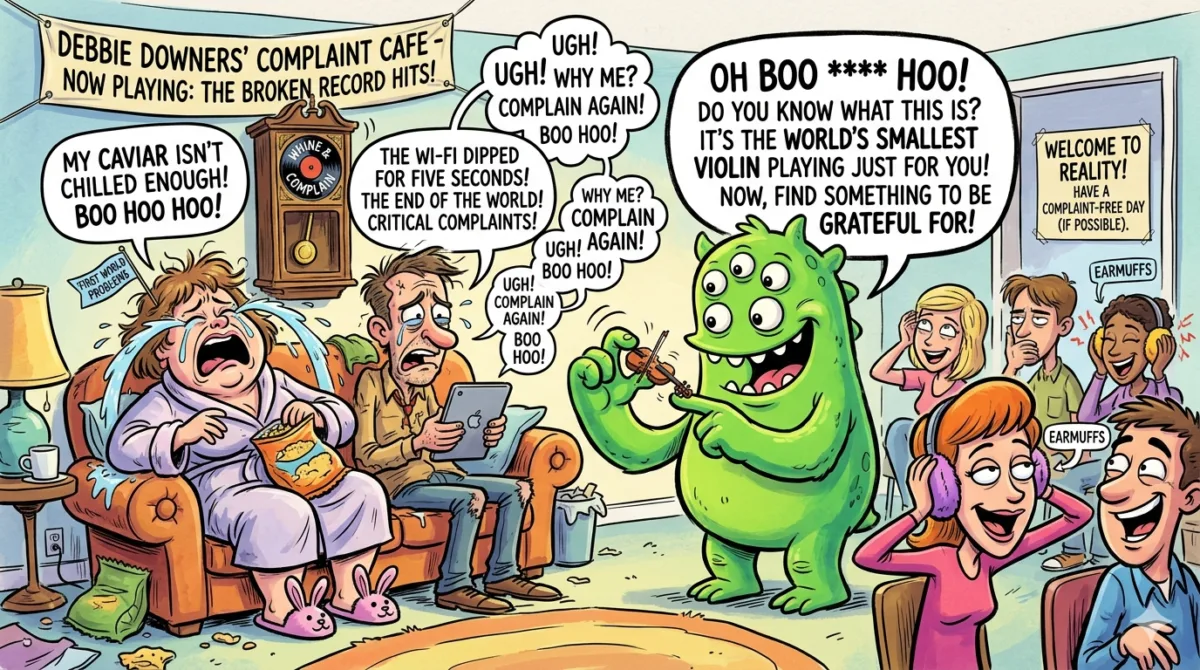
There’s a very specific type of person walking among us. You know the one. You try to have a normal, enjoyable conversation. Maybe you throw out a funny story, a random idea, or even just a harmless “hey, you ever notice…” observation. And they look at you like you just asked them to solve a math equation in ancient Greek.
They don’t want that. They don’t do that. They want complaints. They want gossip. They want a full buffet of negativity served hot and nonstop.
You could say, “I saw the funniest thing happen at the store today…” and before you even finish the sentence, they hit you with the conversational equivalent of a stop sign. Blank face. Slight head tilt. Internal thought clearly visible. “Why are we talking about something enjoyable right now?”
But then something magical happens. Put that same person in a room with another professional whiner, and suddenly they come alive like it’s karaoke night for misery.
“Oh my GOD, did you hear what she did?” “Don’t even get me started…” “No seriously, let me start you off…”
And just like that, they’re off to the races. Nonstop. Rapid-fire complaining. Tag-teaming negativity like it’s an Olympic sport. No fatigue. No boredom. No need for snacks or hydration. Just pure, sustained whining energy that could power a small city.
Meanwhile, you’re sitting there thinking, “So… you DO have conversational stamina. You just reserve it exclusively for complaining.” It’s honestly impressive.
Try to engage them in anything remotely positive and suddenly you’re “too much.” Too enthusiastic. Too curious. Too interested in life. You ask a simple question like, “What’s something cool you’ve been thinking about lately?” and they react like you just handed them a homework assignment due in five minutes.
But ask them, “What’s bothering you?” and they turn into a podcast. Episode one. Episode two. Bonus content. Director’s cut.
No ads. No breaks. Just uninterrupted complaining with a level of detail that suggests they’ve been rehearsing it in the shower.
And here’s the wild part. They genuinely think this is normal. They think you’re the weird one for wanting to laugh, share ideas, tell stories, or just enjoy a conversation that doesn’t feel like a customer service complaint line.
In their mind, you’re exhausting. Which is ironic, because talking to them feels like you’ve been assigned emotional community service.
You try to steer the conversation somewhere lighter. Maybe inject a little humor. Maybe shift gears toward something interesting or creative. Nope. They grab the wheel and yank it right back into the ditch.
“Well yeah, but everything still sucks because…”
Of course it does. It always does. In their world, if something isn’t actively wrong, they’ll go find something that is. Or invent it. Or dig up something from 2007 just to keep the momentum going.
Because silence is dangerous. Silence might allow a positive thought to sneak in. And we can’t have that.
What’s really happening here is simple. These people are not bad at conversation. They’re selectively fluent. They are elite-level communicators when it comes to negativity. World class. Hall of Fame caliber.
But the moment the topic requires curiosity, humor, imagination, or even basic openness, they shut down like a computer running on Windows 95.
And the reason they bond so well with each other is because they’ve found their language. Complaint is their love language. Criticism is their shared hobby. Gossip is their version of storytelling.
Put two of them together and it’s not a conversation. It’s a feedback loop.
“I hate this.” “Same.” “And another thing…” “Yes, continue.”
Hours go by. Nobody learns anything. Nobody grows. But somehow they feel validated, like they just had a meaningful exchange.
Meanwhile, someone who actually tries to bring something positive or interesting to the table gets labeled as “too much” or “trying too hard.” No. They’re just not playing the same game.
And that’s the real takeaway here. If you constantly find yourself bored, drained, or quietly plotting your escape during conversations, it might not be you. You might just be stuck in the Professional Whiners Club.
And if you happen to recognize yourself in this, if every conversation you have revolves around complaining, criticizing, or tearing people down, if the idea of a lighthearted, funny, or curious conversation feels uncomfortable or “annoying,” if you come alive only when there’s something negative to dissect, it might be time for a quick reality check.
Take a look in the mirror. Ask yourself one simple question.
“Would I want to hang out with me?”
If the answer is no, don’t worry. That’s actually good news. Because it means you’ve just unlocked the first positive conversation you’ve had in a while.
So why all the negativity?
1. Negativity is easier and more rewarding (short-term)
Complaining, criticizing, and gossiping give quick social rewards—agreement, bonding, feeling “in the know,” or even a subtle sense of superiority. Talking about ideas, humor, or positive concepts takes more effort and openness. Not everyone is used to that.
2. Comfort zones and insecurity
Abstract ideas, creativity, or even lighthearted humor can feel vulnerable. If someone isn’t confident in their ability to contribute, they may shut down or act disinterested. Criticism, on the other hand, is safer—it doesn’t require them to expose themselves or risk being wrong.
3. Emotional baseline matters
If someone is stressed, burned out, or generally negative, upbeat or curious conversation can actually feel irritating to them. It clashes with their internal state. So instead of engaging, they disengage—or even subtly reject it.
4. Habitual thinking patterns
Some people are just trained—by environment, family, or social circles—to focus on problems, flaws, and other people’s behavior. If that’s been reinforced for years, it becomes their default mode of interacting.
5. Control of the conversation
You noticed something important: they come alive when it’s their topic. That can point to a need for control or validation. When the conversation isn’t centered on their interests (especially complaints), they check out.
What you can do about it:
- Don’t take it personally — their reaction is about their comfort zone, not the value of what you’re saying.
- Adjust expectations — not everyone is going to meet you at the level of curiosity or positivity you enjoy.
- Find your people — some people love ideas, humor, and good conversation. You’ll feel the difference immediately.
- Redirect or disengage — if it turns into constant negativity or gossip, it’s reasonable to change the subject or step away.
In short: you’re running into a mismatch in conversational style and mindset. You’re looking for curiosity, playfulness, and positivity; they’re operating from habit, comfort, or emotional load that leans toward criticism and complaint.
SEARCH FOR ANY ARTICLE BY KEYWORD
More results...