
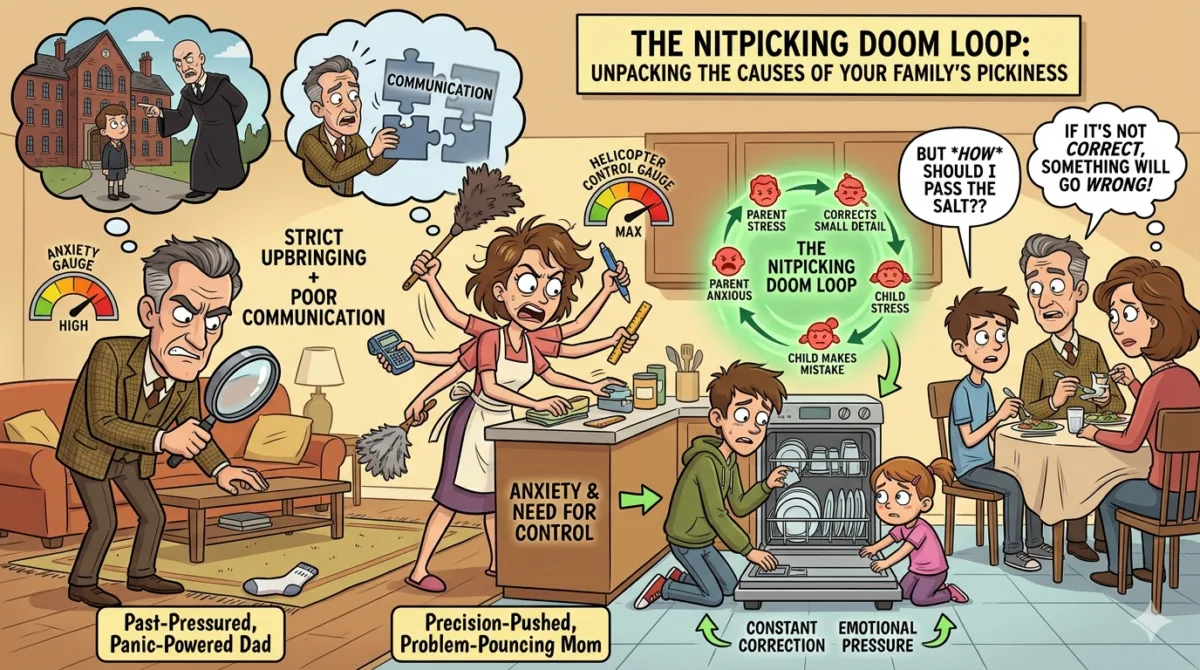
CONTROL FREAKS RAISED BY PICKY PARENTS
We all know the feeling. You’re innocently loading the dishwasher, and suddenly, a shadow falls over you. It’s The Nitpicker. They aren’t just rearranging the plates; they’re rearranging your soul, pointing out that the forks are facing the “wrong” way and that your sponge technique is deeply flawed.
On the surface, a nitpicking family culture looks like a simple case of someone having obnoxiously high standards. But if you look under the hood, it doesn’t just appear out of thin air. It’s actually a “perfect storm” of generational history, unmanaged anxiety, and a complete inability to just use words.
Let’s break down the anatomy of a nitpicking culture and figure out why some families scan for mistakes like it’s a competitive sport.
1. The “Boarding School Survivor” Syndrome
If the elders in a family were raised in strict, traditional environments—think rigid boarding schools or old-school Catholic institutions—they were handed a very specific playbook for life. In those settings, the focus wasn’t exactly on “internal emotional processing.” It was heavily weighted toward obedience, punctuality, and external discipline.
Mistakes weren’t met with a gentle, supportive chat. They were met with public correction, rapid discipline, and a strong emphasis on correctness. When you grow up in a system where scanning for errors is basically a survival skill, you carry that vigilance into adulthood. Without even realizing it, they replicate that authority style. To them, constantly pointing out what’s wrong doesn’t feel like being annoying; it feels like the “proper” way to show care and guide a child.
2. Communication by Sighs, Glares, and Grunts
A massive driver of nitpicking is a fundamental lack of communication skills. When people don’t know how to engage in direct, calm, verbal reasoning, they fall back on the interpretive dance of emotional frustration.
Instead of clearly articulating a standard like:
“Hey, here is how I need this done, and here is why it matters. I trust you to handle it.”
They default to primitive signals:
- A stern, borderline-angry tone of voice.
- Heavy sighs of disappointment.
- Corrective interruptions (“No, just let me do it”).
- Constant, hovering supervision.
Nitpicking becomes a sloppy substitute for a real conversation. They are communicating through emotional tension rather than simple, direct thought patterns.
3. Control is Just Anxiety in a Trench Coat
It’s incredibly easy to look at a helicoptering control freak and think, “Wow, this person just loves power.” But internally, they aren’t experiencing dominance—they are experiencing panic.
For highly anxious people, letting a small mistake slide feels fundamentally unsafe. When something isn’t done exactly right, their instinct is to fix it immediately because uncertainty is physically uncomfortable to them. Their constant hovering and micromanagement is actually a misguided anxiety management strategy. They fixate on the how because it gives them an illusion of control in an unpredictable world. From the inside, they don’t feel controlling; they feel responsible.
4. The Helicopter Doom Loop
When you combine a strict upbringing, poor communication skills, and underlying anxiety, you create a miserable, self-sustaining feedback loop inside the house:
- The Trigger: The parent feels a spike of anxiety over a situation.
- The Reaction: They swoop in to correct a minor detail, using emotional pressure instead of clear words.
- The Fallout: The child (or spouse) feels smothered, gets defensive, and inevitably makes more mistakes because someone is breathing down their neck.
- The Justification: The parent sees the new mistake, their anxiety spikes again, and they think, “Aha! See? They do need my constant supervision!”
The Takeaway
At its core, a persistent nitpicking culture is rarely about the actual details being criticized. It’s about managing stress, defaulting to old-school authority styles, and trying to communicate without the right tools.
Understanding this doesn’t make living with a micromanager any less exhausting, but it does help decode the behavior. It’s entirely possible to be disciplined and hospitable without making everyone miserable—because doing things right ain’t uptight. There is a massive difference between holding high standards and being held hostage by anxiety. Breaking the cycle usually requires one major shift: trading the stern, real-time corrections for clearer, calmer, and much more intentional communication.
SEARCH FOR ANY ARTICLE BY KEYWORD
More results...