
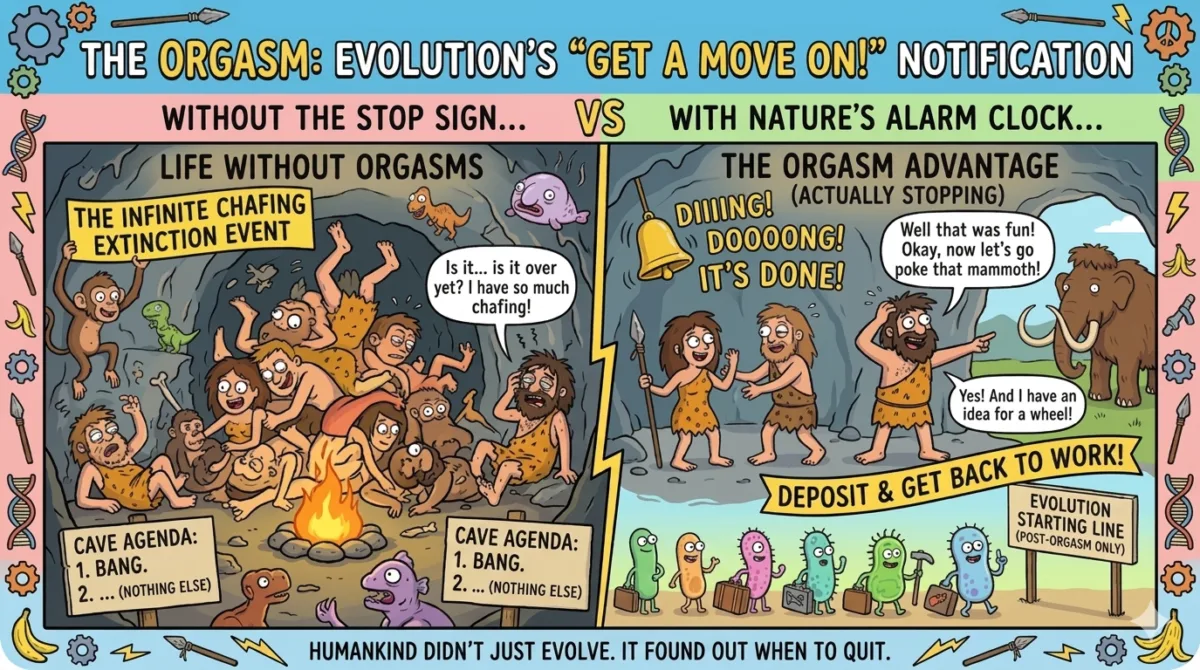
Nature’s Off Button: The Orgasm Theory of Civilization
A rigorous scientific inquiry into why evolution invented pleasure — and why it had to make it stop.
By Dr. Ima Makingthisup, PhD · Journal of Obvious Revelations
Scientists have spent decades asking the wrong question. “Why does the orgasm exist?” they wonder, stroking their chins in expensive university laboratories funded by grants that could have housed several families. The real question, it turns out, is far simpler and considerably more embarrassing:
How do you get animals to stop?
“Without orgasms, humans would never have left the trees. There would be no caves, no agriculture, no civilization — just an endless, slightly chafed, primordial orgy.”
This paper presents the Coital Cessation Hypothesis (CCH): the proposition that orgasms evolved not as a reward for reproduction, but as evolution’s desperate, last-ditch mechanism to get everyone to please, for the love of all that is holy, wrap it up.
Section I: The Problem — Nothing Would Ever Get Done
Imagine, if you will, a world without orgasms. We don’t mean a sad world — we mean a world where the act of intercourse simply continued indefinitely with no natural conclusion, like a conference call that could have been an email.
In this world, our earliest ancestors — let’s call them Proto-Brad and Proto-Karen — would never have stopped. Ever. Not for food. Not for water. Not for the mammoth that just wandered into camp. Not for their children, who are now fending for themselves somewhere in the savanna because Mom and Dad have been “busy” since Tuesday.
The fossil record would be sparse indeed. Not because animals died — they’d be too busy to die — but because no paleontologist would ever have existed to discover the fossils, because paleontologists require civilization, and civilization requires people to occasionally get out of bed.
Section II: A Brief History of Getting It Over With
When did the orgasm emerge? Our research suggests it arose at precisely the moment evolution realized it had a serious productivity problem on its hands.
~3.8 Billion Years Ago — Single-celled organisms reproduce asexually. No sex, no problem. Efficient, loveless, and remarkably productive. These guys literally invented life and never once got distracted.
~1.2 Billion Years Ago — Sexual reproduction emerges. Evolution, in what historians now call “the worst idea that turned out to be the best idea,” decides to mix genetic material. Things immediately start taking longer than they need to.
~1.2 Billion Years Ago + 20 Minutes — Evolution realizes its catastrophic error. The first multi-celled organisms are just… going. The algae are not evolving. The primordial soup is getting cold. Something must be done.
~1.2 Billion Years Ago + 21 Minutes — The orgasm is invented. A dopamine payload so intense and so brief that it essentially reboots the entire nervous system with one message: “Okay! All done! Great job! Please go be somewhere else now.” Productivity resumes immediately.
Today — Humans have built skyscrapers, composed symphonies, split the atom, and sent robots to Mars — all because their ancestors had approximately 7 seconds of dopamine and then had to go do something else.
Section III: The Monkey Problem
Consider our cousins, the primates. Bonobo chimps, famously, use sex for social bonding, conflict resolution, greeting, farewell, mild boredom, and presumably also to celebrate finishing a particularly good banana. They have a robust sexual culture.
They have also not, in 6 million years, built a single highway.
Had our ancestral line not developed a sufficiently powerful neurochemical stop signal, we would still be in the trees. Not metaphorically. Literally. In the trees. Doing that. Chafed, content, and blissfully unaware of agriculture, philosophy, or the concept of pants.
“The orgasm is not the reward. The orgasm is the receipt. It’s evolution’s way of saying: transaction complete, please step away from the terminal.”
Section IV: The Dopamine Exit Ramp — Nature’s Masterstroke
What makes the orgasm particularly elegant as an evolutionary mechanism is its design: it is intense enough to be worth pursuing, brief enough to be truly over, and followed immediately by a neurochemical crash that makes the whole enterprise seem, at least temporarily, like something that can be tabled indefinitely.
The refractory period — that blissful, vacancy-signed stretch of time after the fact — is no accident. It is, we argue, the evolutionary grace period. The window in which our ancestors were neurologically free to think about other things. Things like: fire. Tools. Agriculture. The Pythagorean theorem.
Rome was not built in a day, but it was absolutely built during the refractory period.
We further posit that the entire Renaissance — painting, sculpture, architecture, and the scientific method — was produced by people who had recently finished and were now simply looking for something to do. Michelangelo painted the Sistine Chapel ceiling lying on his back. This is not unrelated.
Conclusion: In Defense of the Off Switch
The orgasm is, when viewed through this lens, one of evolution’s most sophisticated and quietly heroic achievements. Not because it makes reproduction feel good — that’s just marketing — but because it contains within itself the seeds of its own conclusion.
It is the natural world’s only built-in exit strategy. The biological equivalent of “this meeting is now adjourned.” The cosmic signal that it is time to go hunt something, grow something, build something, or at minimum put on a loincloth and think about fire.
Without it, there is no us. Not because there’d be no reproduction — there’d be plenty of that — but because there’d be no one left with enough free time to figure out how to make it through winter.
So the next time you find yourself in that brief, glorious, dopamine-soaked moment of conclusion, take a second to appreciate it for what it truly is: 1.2 billion years of evolution, doing its level best to get you back to work.
† This paper was written entirely during the refractory period. No animals were harmed. Several were mildly inconvenienced.
‡ Funding provided by the Institute for Things That Were Obviously True the Whole Time.
SEARCH FOR ANY ARTICLE BY KEYWORD
More results...