
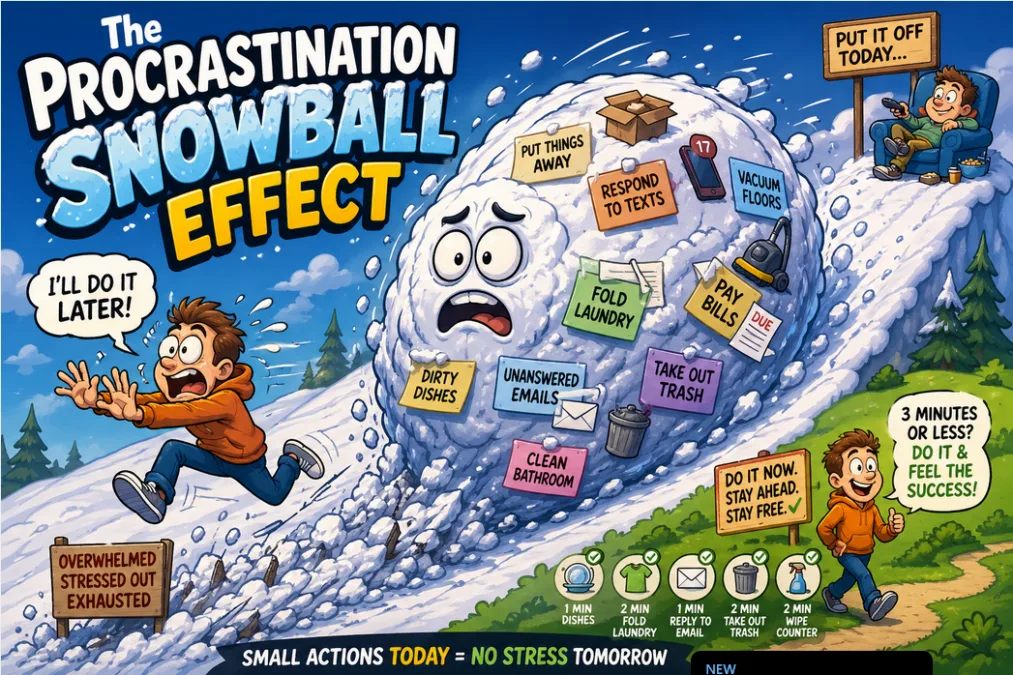
Let’s paint a picture. The dryer buzzes. You think, “I’ll fold that laundry in a minute.” The dishes pile up after dinner. “I’ll deal with those later.” An email comes in that needs a quick reply. “I’ll get to it tomorrow.” A sweater gets tossed on the chair instead of hung up. “I’ll put it away soon.” And on it goes — a hundred tiny moments of kicking the can down the road, each one feeling completely harmless in isolation. Totally reasonable. Barely worth thinking about.
Except that’s exactly the trap.
Because “later” doesn’t come alone. It brings friends. It snowballs. It compounds. And before long, you’re not looking at one load of laundry — you’re looking at three. You’re not avoiding one email — you’re staring down an inbox of 47 unread messages that makes you want to close your laptop and go lie face-down on the couch. Which, ironically, is now covered in clothes that never made it to the closet.
You’re not avoiding stress. You’re manufacturing it — slowly, quietly, and remarkably efficiently.
Here’s the cruel joke at the heart of procrastination: we put things off to avoid the discomfort of doing them. But every single thing we avoid adds a small, invisible weight to our mental load. A low hum of I should really… that never quite goes away. Stack enough of those hums together and you’ve got a constant, low-to-mid level background stress — the kind that makes you feel vaguely overwhelmed on a Tuesday morning without being able to explain exactly why.
And what do stressed, overwhelmed people want to do? Avoid things. Put things off. Rest. Escape. Which piles more things up. Which creates more stress. Which leads to more avoidance. It’s a self-perpetuating, tail-chasing, utterly exhausting loop — and it all started because you didn’t want to fold a few t-shirts.
The Rule That Fixes Most of This
You may have heard of David Allen’s famous “2-Minute Rule” from his landmark book Getting Things Done: if a task takes less than two minutes, do it immediately. It’s a brilliant concept — and it works. We’re going to take it one step further and give you a little more breathing room.
If it takes 3 minutes or less, do it right now. No exceptions.
Not in a minute. Not after this episode. Not tomorrow. Now.
Three minutes. That’s it. That’s the whole rule. It sounds almost insultingly simple — and that’s exactly the point. Because the tasks that quietly destroy your sense of calm aren’t the big ones. You already know the big ones are coming. It’s the small stuff — the 45-second stuff, the 2-minute stuff — that sneaks up on you, multiplies in the dark, and becomes the monster under the bed.
Let’s Talk Numbers (This Gets Uncomfortable)
Below is a completely ordinary collection of daily life tasks. Nothing exotic. Nothing requiring special skills or equipment. Just the regular business of being a person who lives somewhere and owns things. Look at how long each takes when done at the moment — versus what happens when you let them stack up and do them all in one grim, reluctant marathon session every few months.
| Task | Do It Now | Piled Up |
|---|---|---|
| Fold one load of laundry right out of the dryer | ~3 min | ~45 min |
| Put clean clothes away after folding | ~2 min | ~25 min |
| Rinse and load dishes after a meal | ~3 min | ~40 min |
| Wipe down the kitchen counter | ~45 sec | ~10 min |
| Reply to a simple email or text | ~90 sec | ~20 min |
| Hang up a jacket or put shoes away | ~20 sec | ~8 min |
| Take out the trash when it’s full | ~2 min | ~15 min |
| Quick vacuum of one room | ~3 min | ~35 min |
| Wipe bathroom sink & counter | ~60 sec | ~12 min |
| Put away items left on a table or desk | ~90 sec | ~20 min |
| Wipe stovetop after cooking | ~60 sec | ~15 min |
| Sort and recycle today’s mail | ~90 sec | ~18 min |
| Total | ~23 min | ~4+ hrs |
Read that again. Twenty-three minutes spread across an entire day — little bursts you’d barely notice — versus four-plus hours of a joyless, energy-draining catch-up session that you will avoid scheduling for as long as humanly possible, thereby making everything worse.
And that four hours? That’s the optimistic version. That doesn’t count the mental overhead of dreading it, the time spent hunting for things buried under the pile, or the very real possibility that you’ll get halfway through and simply give up and order takeout.
Why “Later” Feels So Reasonable in the Moment
Our brains are wired to seek immediate comfort and defer immediate discomfort — even tiny, trivial discomfort. The problem is that future you is a real person who has to deal with everything present you keeps shoving onto their plate. Future you is not thrilled about this arrangement. Future you is, in fact, starting to get a little resentful.
The 3-Minute Rule works because it short-circuits that wiring. It reframes the question. Instead of “Do I want to do this right now?” (answer: no, obviously), the question becomes “Is this going to take me three minutes or less?” If the answer is yes, the decision is already made. No deliberation. No negotiating with yourself. No “just one more minute of sitting here.” The rule decides for you.
Start Today, Literally Right Now
Look around wherever you are. There is almost certainly something within arm’s reach that would take under three minutes to deal with — a mug that belongs in the kitchen, something that needs to be put away, a message that deserves a quick reply. That thing has probably been sitting there long enough that you’ve stopped seeing it. But it’s there. And it’s quietly adding to the hum.
Go handle it. We’ll wait. Here are some tips…
- The “One-Touch” Rule: If you pick it up, put it where it belongs. Don’t put it in a “transition spot”.
- Narrate Your Win: Tell yourself, “This is a gift of relaxing time to my future self.”
- TV Commercial Break: See how many 3-minute tasks you can kill before the show starts again.
The Bottom Line: Real relaxation isn’t ignoring a dirty dish; it’s sitting on a couch in a room where the dishes are already done. Stop the snowball. Do the three-minute thing. Your future, less-stressed self will thank you.
Welcome back. That’s the whole game. Do that fifty times a day — most of which you’ll barely notice — and the piling up stops. The snowball doesn’t form. The background stress fades. Your home, your inbox, and your brain stay somewhere in the neighborhood of manageable. Not perfect. Not Pinterest-worthy. Just calm.
And calm, it turns out, is the thing you were chasing all along when you kept putting things off. You just took a very long, very scenic, very stressful route to get there.
Three minutes or less. Do it now. That’s the whole rule. You’ve got this — and you’ve got plenty of time.
SEARCH FOR ANY ARTICLE BY KEYWORD
More results...