
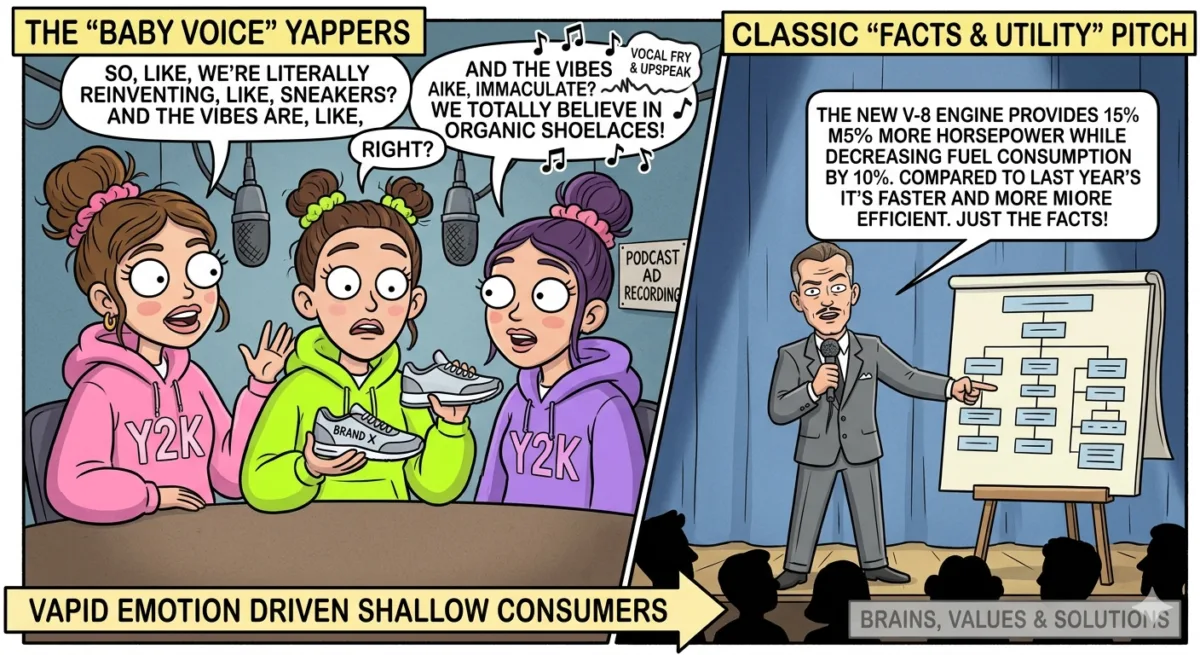
It is the auditory plague of modern marketing: the “Corporate Baby Voice.”
You turn on a podcast, open a video, or listen to a radio spot, and instead of a professional adult explaining a product, you are greeted by an ad agency’s fever dream. It’s a voice delivery dripping with aggressive vocal fry (that gravelly, low-register creak) and chronic upspeak (where every single statement ends in a question? Like they’re asking for permission to finish the sentence?).
It sounds less like a business pitching a legitimate service and more like a group of 13-year-olds sitting at a middle school lunch table yapping about their hydroflasks.
Here is a breakdown of what happens when the helicopter-parented, “everyone gets a participation trophy” generation finally takes the reins of the marketing department.
The Anatomy of the Yap: “Vibes” Over Value
Modern corporate advertising has completely abandoned the concept of utility. It has traded features for feelings, and data for vibes.
The objective is no longer to tell you what the product does, how it is engineered, or why it’s better than the competition. The objective is to make you feel like the product is your bestie. It’s a manifestation of the “touchy-feely” ethos creeping into every corner of the zeitgeist—where vulnerability is weaponized to sell SaaS software and corporate empathy is heavily focus-grouped.
When these ads run, they follow a predictable, meandering script:
“So, like… we realized that managing your taxes is, like, literally exhausting? And we wanted to build a space that just… holds room for your financial wellness? Right? So we made an app… and it’s honestly such a mood.”
They aren’t appealing to logic; they are trying to appeal to an emotion-driven, shallow consumer base that values corporate validation over actual performance. If you ask these ads a direct question—like “What is the computational efficiency?” or “How much money does this save me per quarter?”—the whole illusion shatters.
The Ultimate Contrast: Modern vs. Classic Advertising
To see just how far the advertising industry has fallen, you only have to look at how products used to be sold. Classic advertising assumed the consumer had a brain, an attention span, and a desire for facts. Modern advertising assumes the consumer needs an auditory security blanket.
| Attribute | Classic “Old School” Advertising | Modern “Baby Voice” Advertising |
| The Core Pitch | Just the facts. Detailed specifications, price comparisons, and clear utility. | Vibes and feelings. Empathy statements, emotional validation, and lifestyle alignment. |
| Vocal Delivery | Authoritative, clear mid-Atlantic or deep baritone dictation. Every syllable is punctuated. | Heavy vocal fry and upspeak. Sounds like a continuous, breathless text message read aloud. |
| The Hook | “Here is why our product engineered a better carburetor than Brand X.” | “We’re, like, literally redefining how you think about organic oat milk?” |
| Target Audience | Consumers looking for a solution to a specific, tangible problem. | Vapid, hyper-online consumers looking for a brand to adopt as a personality trait. |
| Sentence Structure | Succinct, declarative sentences. Standard Subject-Verb-Object clarity. | Circular yapping. Relies on filler words (“like,” “literally,” “honestly,” “essentially”) to mask a lack of substance. |
| Business Model | Prove the value upfront to earn a transaction. | Gate the useful features behind a pro tier while using the free tier to cultivate a “community.” |
The Takeaway: Next time you hear an ad that sounds like it was recorded into a smartphone under a blanket by someone who is literally obsessed with a new project-management tool, remember: you aren’t being sold a product. You are being asked to co-sign a marketing major’s existential need for validation.
When Every Commercial Sounds Like a Sleepover Conversation
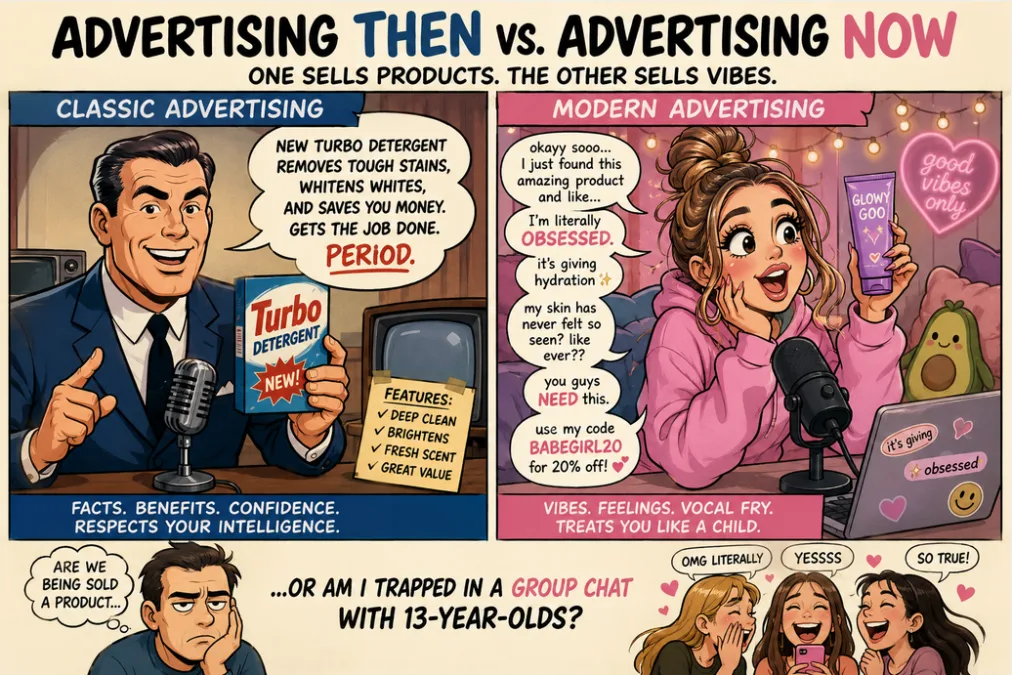
There’s a weird plague spreading through modern advertising right now. Once you notice it, you can never un-hear it.
Every commercial now sounds like a 26-year-old marketing coordinator explaining iced coffee to her roommate while curling her hair.
“Okayyy so like… this skincare brand literally changed my life? I’m obSESSED? It’s giving hydration?”
Meanwhile you still have absolutely no idea what the product actually does.
Modern advertising has somehow evolved backwards into the communication style of a middle school lunch table. Vocal fry. Upspeak. Endless filler words. Baby voice. Artificial sincerity. A tone that says, “Please emotionally validate me while I vaguely gesture toward a product.”
And it’s EVERYWHERE now.
Podcast ads.
TikTok ads.
Car commercials.
Insurance commercials.
Medication commercials.
Mattress commercials.
Ads for banking apps somehow narrated like a Sephora tutorial.
Apparently the entire advertising industry collectively decided that the best spokesperson for every product on Earth should sound like someone describing astrology over iced matcha.
The Modern Commercial Formula
Step 1: Whisper-talk into microphone.
Step 2: Stretch random syllables.
Step 3: Say “literally” every fourteen seconds.
Step 4: Never provide useful information.
Step 5: End with “I’m obsessed.”
That’s it. That’s the campaign.
Meanwhile older ads used to sound like actual adults trying to communicate information to other adults.
“Ford trucks. Built stronger. Better gas mileage. New suspension system. Starting at $24,999.”
DONE.
Thirty seconds. Facts delivered. Nobody sounded emotionally fragile during the process.
Now every ad sounds like the speaker needs reassurance after finishing the sentence.
Modern Ads vs Classic Ads
| Classic Advertising | Modern Advertising |
|---|---|
| “Here’s what the product does.” | “Here’s how the product made me feel emotionally safe.” |
| Deep confident announcer voice | Whisper-fry vocal gymnastics |
| Features and benefits | Vibes and trauma bonding |
| “Improves fuel efficiency.” | “It’s honestly kind of a game changer?” |
| Adults speaking clearly | Permanent teenage sleepover cadence |
| Short and direct | Rambling authenticity theater |
| “Now with 20% more power.” | “Okay but why am I literally obsessed though?” |
| Information-first | Personality-first |
| Authority | Infantilized relatability |
| Sell the product | Sell a parasocial identity |
Who Is This Actually For?
That’s the funny part.
Nobody even seems sure anymore.
Advertising agencies have become trapped inside a giant echo chamber where every creative director talks like a social media intern and every campaign is tested against emotionally overcaffeinated focus groups who describe toothpaste as “problematic.”
The result is ads that sound less like communication and more like someone trying to softly explain crystals to a nervous rescue dog.
Apparently companies are terrified of sounding too direct now.
Directness might offend someone.
Confidence might feel “aggressive.”
Having a strong opinion about your own product might be “toxic.”
So instead everything gets filtered through this strange fake-soft influencer dialect where nobody commits to a statement.
“It’s kiiind of amazing?”
“It’s giving luxury?”
“We’re sooo excited?”
Wonderful.
Can it survive rain?
Does it last longer?
Is it cheaper?
DOES IT DO ANYTHING?
The Podcast Ad Epidemic
Podcast ads might be the worst offenders of all.
Especially when the host suddenly switches into this bizarre fake intimate tone like they’re confessing secrets during a slumber party.
“So you guyyyys… I’ve actually been using this meal delivery service and honestly? I’m obsessed.”
Meanwhile this same person spent the previous 45 minutes screaming about UFO conspiracies and sports gambling.
Nobody believes you’re emotionally transformed by a mattress coupon code.
The modern ad read feels less like persuasion and more like hostage negotiation through vocal fry.
The Infantilization of Everything
There’s also something strange happening culturally where everything has to sound emotionally comforting now.
Commercials used to project competence.
Now they project sensitivity.
A razor commercial no longer says:
“Closest shave possible.”
Now it says:
“You deserve to feel seen.”
WHAT DOES THAT EVEN MEAN.
At some point products stopped being tools and started becoming emotional support blankets.
Bank apps don’t help manage money anymore.
They “empower your journey.”
Laundry detergent isn’t stronger anymore.
It “cares for your fabrics.”
Even pickup truck ads now sound like therapy sessions.
The Helicopter Parent Theory
Honestly, there may be something to the idea that an entire generation raised in hyper-managed emotionally padded environments is now producing marketing campaigns.
Everything has to feel “safe.”
Everything has to feel “relatable.”
Everything has to feel emotionally validating.
Nobody wants to sound authoritative because authority itself became unfashionable.
So instead of:
“This product is superior because X, Y, and Z.”
You get:
“This product and I are like… literally besties?”
Fantastic. Society is thriving.
The Real Irony
The funniest part is that companies think this style sounds authentic.
It doesn’t.
It sounds painfully manufactured.
Like an HR department genetically engineered a human personality in a laboratory after watching 14,000 TikTok videos.
Real people do not naturally speak in endless influencer cadence while discussing probiotics or car insurance.
At this point there’s probably a marketing executive somewhere saying:
“Can we make the spokesperson sound even MORE emotionally exhausted and vaguely Californian?”
Final Thoughts
Nobody is saying ads need to go back to sounding like a 1950s cigarette commercial narrated by a war general.
But maybe there’s a middle ground between:
“BUY THIS NOW, AMERICA”
and
“Okay sooo like… if you’re looking for a vibe?”
Maybe consumers actually would appreciate concise communication again.
You know:
- What the product is
- Why it’s useful
- Why it’s better
- Why it’s worth buying
Crazy concept.
Until then, expect every ad in America to continue sounding like someone explaining tarot cards during a group FaceTime call.
SEARCH FOR ANY ARTICLE BY KEYWORD
More results...