
Medieval Melancholy: Why the Middle Ages Were the Ultimate Vibes Kill
Let’s be honest for a second. We talk a lot about modern burnout. We’ve got therapy, weighted blankets, and SSRIs because we have to look at emails all day. But if you really want to talk about a historical vibe check, we need to talk about Europe in the Middle Ages. Because holy crap, those people must have been profoundly, catastrophically depressed.
Think about the trajectory of human history for a second.
The Good Old Days (Literally)
Back in the Hunter-Gatherer days? Humans were just bee-bopping around the woods. You wake up, you find a bush with some berries, you throw a stick at a mammoth, and you call it a day. You have a great, deep sleep on a bed of moss, wake up, and do it all over again. No rent. No performance reviews. Just pure, unadulterated foraging vibes.
Then, civilizations start scaling up. The Native American tribes had incredible, deeply connected communities. The Greeks were sitting around in wraps, drinking wine, and inventing philosophy. Even the Roman Empire, for all its faults, was actively trying to make life a little easier for the average citizen. They gave you aqueducts! They gave you paved roads! They gave you public baths! They were trying!
And then… the Roman Empire collapses, the curtain falls, and Europe enters the Middle Ages.
Welcome to the Sandbox of Despair
Suddenly, all that quality-of-life stuff? Gone. Instead, the universe decided to turn the misery dial up to an eleven.
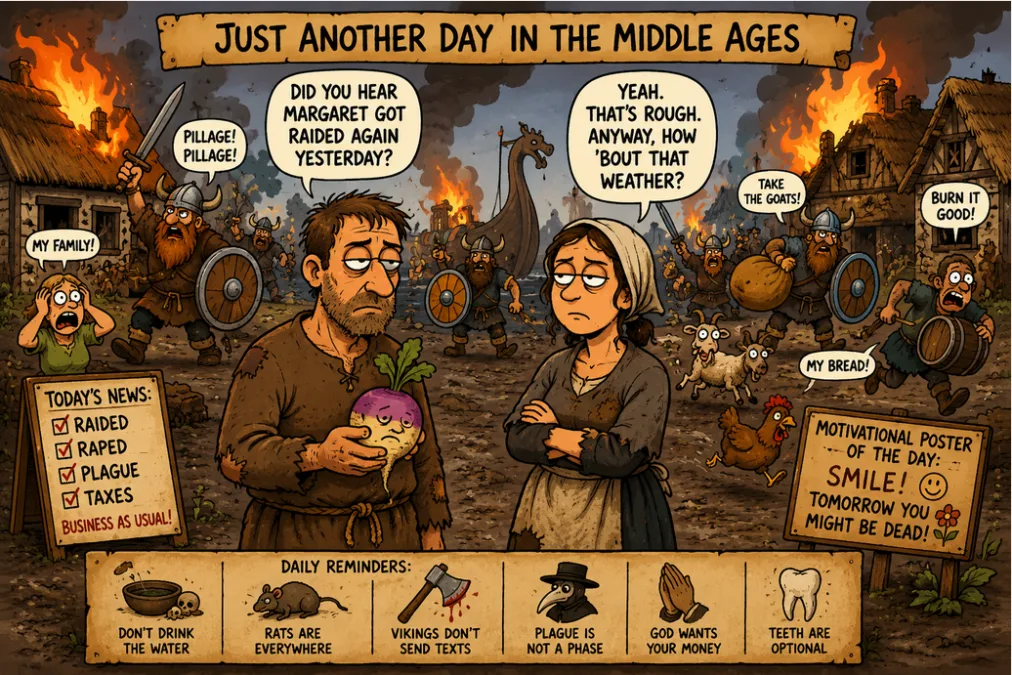
Imagine living in a thatched-roof hut in 900 AD. You don’t have plumbing. Your primary food source is a turnip that looks like a sad rock. And to top it all off, the Vikings just discovered that your coastline exists. They are sailing down from the north every other Tuesday just taking whatever the hell they want, burning your crops, and pillaging the local parish.
The day-to-day small talk in a medieval village must have been the most soul-crushing, casual horror show in human history.
Aethelgard: “Good morrow, Bartholomew! Fair weather we’re having.”
Bartholomew: “Ah, indeed, Aethelgard. Though, didst thou hear? Margaret’s family was entirely slaughtered by northern raiders yesterday, and poor Margaret herself was captured and despoiled for the fifteenth time this season.”
Aethelgard: “Oof. Yikes. What a bummer. Truly a case of the Mondays. Anyway, think it’s gonna rain?”
The Original Seasonal Affective Disorder
There was no “mental health awareness” in 1200 AD. If you felt a deep, existential dread because the Black Plague was liquefying your neighbors, the local priest didn’t tell you to practice mindfulness. He told you that you had “bad blood,” or that you hadn’t whipped yourself hard enough to apologize to God for the weather. Your therapist was a guy named Brother John who smelled like unwashed wool and suggested putting leeches on your eyelids to balance your humors.
If you think your seasonal depression is bad in January, imagine experiencing it while wearing a burlap sack, shivering next to a fire fueled by dried cow dung, knowing that a minor scratch from a rusty nail means you have a 90% chance of meeting Jesus by Friday.
The Middle Ages weren’t just a time period; they were a 1,000-year-long sigh. So the next time your Wi-Fi drops or your oat milk latte isn’t hot enough, just remember: at least a guy named Ragnar isn’t currently stealing your only pig while you casually discuss the forecast.
SEARCH FOR ANY ARTICLE BY KEYWORD
More results...