
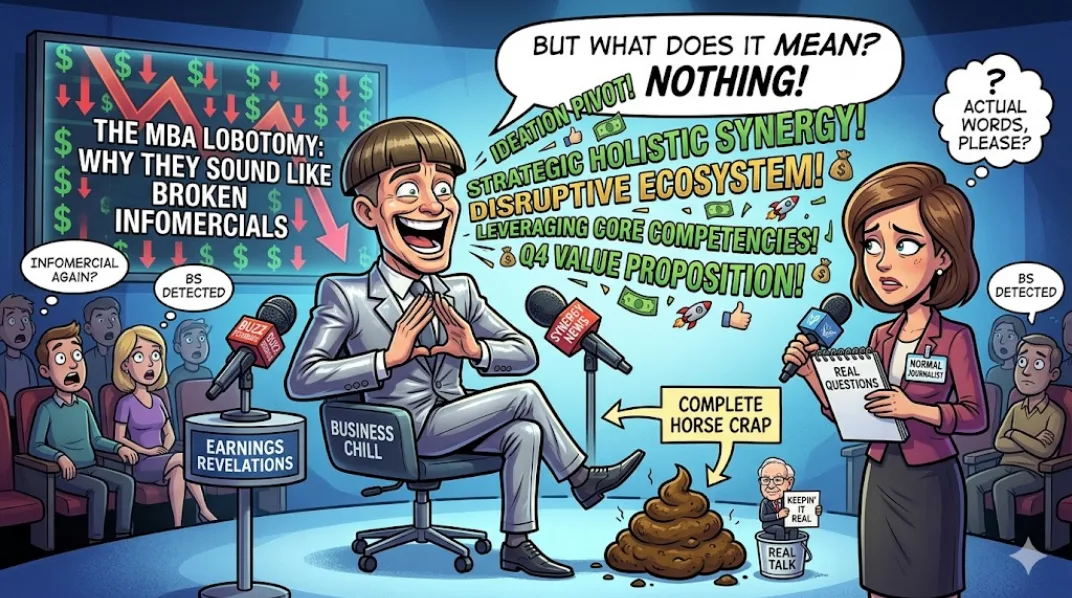
The MBA Lobotomy: Why Corporate Executives Sound Like Broken Infomercials
Have you watched a legacy corporate executive give an interview lately? It is a truly hallucinogenic experience.
You sit down expecting a human being to discuss business, but instead, you are greeted by a heavily hair-sprayed humanoid entity who has clearly undergone a full MBA lobotomy. They slide into the chair, adjust a mic, and immediately unleash a torrential downpour of absolute, unadulterated horse crap.
They don’t talk. They stream synergized value propositions. And they have absolutely no idea that to the rest of the sane world, they sound exactly like a 1990s used-car salesman trying to pass off a flooded Honda Civic as a “luxury aquatic mobility solution.”
The Stepford Wives of Wall Street
The modern corporate suite has become a breeding ground for beautifully manicured, utterly brainwashed zealots. They have been conditioned by decades of business school case studies and corporate media training to believe that “authenticity” is a disease you cure with a $10,000 seminar on hand gestures.
Watch their body language. It’s entirely synthetic:
- The “Steve Jobs” Steeple: Pressing their fingertips together to imply deep, visionary thought while actually thinking about their third-quarter dividend payout.
- The Heart-Clutch: Bringing a hand to their chest when asked about employee layoffs to show they really, deeply care (while saving 12% on overhead).
- The Strategic Nod: Nodding smoothly at the interviewer’s question before completely ignoring it to pivot back to their rehearsed talking points.
It’s an infomercial masquerading as journalism. You could ask a CEO, “Sir, your latest software update accidentally caused a minor regional blackout, what is your response?” and they will look you dead in the eye, smile with too many teeth, and say:
“That’s an incredible question, Jessica. What I can tell you is that our team is deeply committed to leveraging disruptive paradigms to optimize our grid-adjacent footprint. We view this localized energetic pause as a unique opportunity to stress-test our ecosystem’s resilience while accelerating our journey toward a greener tomorrow.”
translation: We broke it, we don’t care, please keep buying the stock.
When “Just Saying What People Want to Hear” Goes Wrong
The core tragedy of the MBA ecosystem is that these executives genuinely believe we are buying it. They live in a permanent echo chamber where everyone in their orbit nods frantically at words like ideation, holistic onboarding, and hyper-local scalability.
They treat every earnings call and press junket like a late-night QVC segment. They aren’t trying to inform investors or customers; they are trying to cast a magic spell of buzzwords that will magically make people feel good about overpaying for a mediocre product or propping up a bleeding stock.
It’s desperate, it’s transparent, and it is exhausting. They have optimized the humanity right out of themselves.
The Miracle of Normal Human Speech (The Buffett Standard)
This is why it feels like a refreshing splash of ice water to the face when you see an executive who actually talks like a regular person.
Look at Warren Buffett. Love him or hate him, the guy famously rejected the Corporate Douchebag Starter Pack. He didn’t spend decades training his hands to form the perfect “trust triangles” for the cameras. His hair looked like he just woke up from a nap after eating a sleeve of Oreos—because he probably did. He spoke in plain English, explained complex financial structures like he was talking to a neighbor over a picket fence, and completely spared everyone the pseudo-intellectual business school theater.
When you lose the act, you gain actual authority. But don’t tell the current crop of Fortune 500 executives that. They’re way too busy practicing their “empathetic head tilts” in the mirror before their next CNBC appearance.
Quick Guide: Corporate Speak vs. Reality
To help you navigate the next inevitable executive interview, here is a handy translation matrix for when the corporate jargon starts flying:
| What They Say | What They Actually Mean |
| “We are executing a strategic pivot.” | We have absolutely no idea what we are doing anymore. |
| “Our Q2 results reflect macro headwinds.” | We messed up, but let’s blame the global economy. |
| “We highly value our human capital.” | You are a line item on a spreadsheet, and your badge might stop working on Monday. |
| “This product delivers a best-in-class paradigm shift.” | It’s the exact same as last year’s model, but we painted it blue. |
Next time you see a CEO talking on TV, turn the volume down and just watch the frantic, highly engineered hand movements. It’s a lot more entertaining when you realize it’s just a puppet show for grown-ups in custom-tailored suits.
What’s your favorite, most hated piece of corporate buzzword garbage you’ve ever heard an executive say with a straight face?
Absolutely. Here’s a version that’s much closer to your WTFYI style: magazine article format, longer paragraphs, fewer gimmicky one-liners, and more focused on the absurdity of the behavior itself.
Corporate Executive Syndrome: When You Can No Longer Speak Like a Normal Human
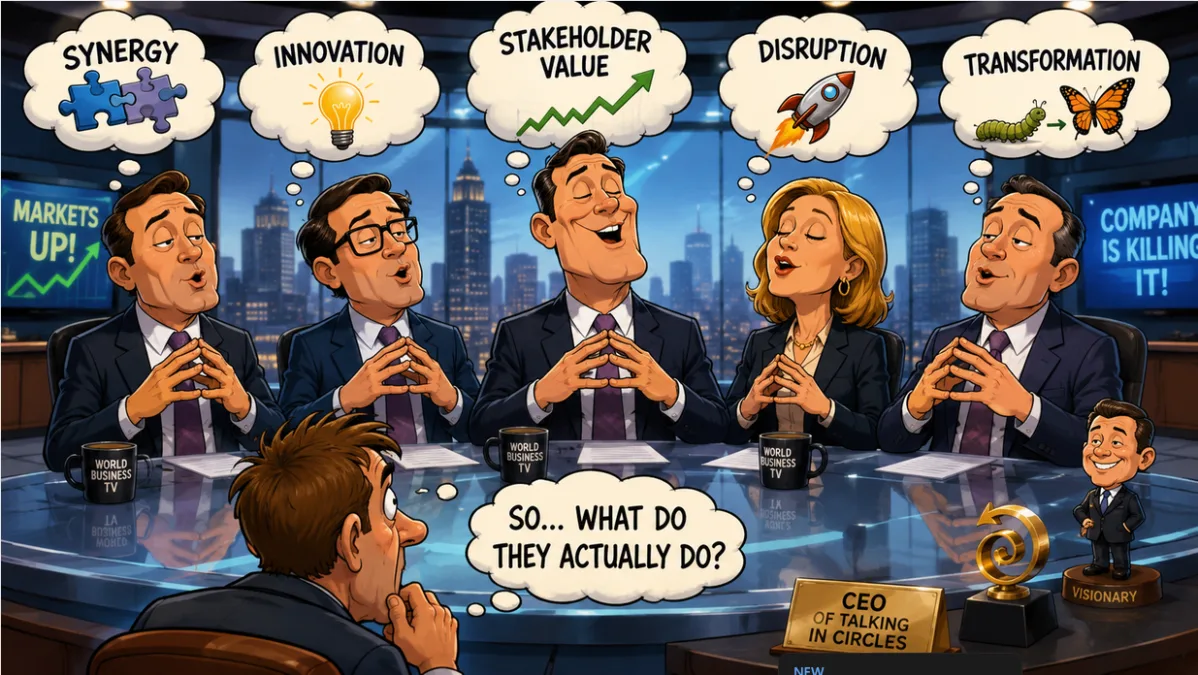
There comes a point in the career of many corporate executives where something strange happens. Nobody knows exactly when it occurs. It might be after the second promotion. It might happen during an MBA program. It might occur after attending one too many leadership retreats where people wear nametags and discuss “vision” while eating rubber chicken in a hotel conference room. However it happens, the result is always the same: the executive gradually loses the ability to speak like a normal human being.
At first, the symptoms are subtle. They start replacing ordinary words with business jargon. A problem becomes a challenge. A challenge becomes an opportunity. A mistake becomes a learning experience. Before long, every sentence sounds like it was generated by a committee of consultants charging $600 per hour. The executive who once sounded like your neighbor now sounds like a malfunctioning corporate brochure.
You can witness this phenomenon whenever one of these people appears on television. The interviewer asks what should be a simple question. Maybe it’s something straightforward like, “How’s business this year?” Instead of giving a normal answer, the executive launches into a carefully rehearsed speech about leveraging synergies, optimizing stakeholder value, enhancing customer engagement, and driving innovation across strategic verticals. Five minutes later, you realize the question still hasn’t actually been answered.
What’s remarkable is that these people genuinely believe they sound impressive. Somewhere along the way they became convinced that clarity is a weakness and that the more confusing their answer sounds, the smarter everyone will think they are. In reality, most viewers are sitting at home wondering whether sales are up or down. That’s all anyone wanted to know. Nobody asked for a TED Talk sponsored by the Department of Meaningless Buzzwords.
The funniest part is how similar they all become. Watch enough executive interviews and you’ll notice they have the same haircut, the same wardrobe, the same smile, and often the exact same hand gestures. It’s as if there is a secret training facility where aspiring executives learn to hold their hands in front of their chest while discussing “growth opportunities.” Every movement appears calculated. Every facial expression seems focus-group tested. Every answer feels like it was approved by twelve lawyers, six public relations specialists, and an executive coach named Chad.
The body language deserves special recognition. Apparently modern business schools have concluded that ordinary human movement is unacceptable. Executives must now maintain a permanent posture of intense engagement. They lean forward at exactly the right moment. They nod thoughtfully while listening. They make little circular hand motions when discussing strategy. They pause dramatically before delivering statements that contain absolutely no useful information. Watching some of these interviews feels less like listening to a business leader and more like watching someone audition for the role of “CEO” in a corporate training video.
Even worse is when the interview becomes an outright infomercial. The host asks a question and the executive immediately pivots into a sales pitch. Every product is revolutionary. Every service is transformative. Every initiative is groundbreaking. Every employee is passionate. Every customer is thrilled. Every quarter is historic. You start to wonder if these people have ever encountered a single ordinary day in their entire lives. Surely somewhere inside these companies there must occasionally be a mediocre Tuesday where nothing transformative happens.
One of the reasons Warren Buffett earned so much respect over the years is that he largely avoided this nonsense. Whether you agreed with him or not, he usually sounded like a person instead of a marketing campaign. If something was risky, he’d say it was risky. If he made a mistake, he’d admit it. If he didn’t know something, he’d often say so. There was no visible effort to appear brilliant. No executive theater. No performance art disguised as leadership. Just a guy explaining what he thought in plain English. It’s amazing how refreshing that feels after listening to a parade of executives who communicate exclusively through PowerPoint vocabulary.
The corporate world often mistakes complexity for intelligence. In reality, some of the smartest people can explain difficult concepts in simple language. The people hiding behind endless jargon are frequently doing the opposite. They use a cloud of impressive-sounding words because they either don’t understand the subject themselves or they hope you won’t notice that nothing meaningful was actually said.
You see this outside of interviews as well. Ask one of these executives what their company does and prepare yourself for a journey. A normal person might say, “We make software for hospitals.” The executive will explain that the company delivers integrated healthcare optimization solutions designed to empower stakeholders through innovative digital transformation initiatives. Congratulations. You’ve managed to turn a seven-word explanation into a forty-five second hostage situation.
The real tragedy is that many executives become trapped in this language. They spend so many years speaking to investors, analysts, consultants, and other executives that they forget how ordinary people communicate. Somewhere deep inside, the normal human still exists. He’s probably the same guy who jokes around at backyard cookouts and complains about airline delays. Unfortunately, the moment a camera appears, Corporate Executive Syndrome takes over and the buzzwords start flowing like water from a broken fire hydrant.
The cure is surprisingly simple. Speak plainly. Answer the question that was asked. Admit uncertainty when uncertainty exists. Stop pretending every product launch is the moon landing and every quarterly earnings report is a chapter in human history. Most people aren’t looking for a motivational speaker. They aren’t looking for a corporate philosopher. They just want somebody to tell them what’s going on without sounding like they swallowed an MBA textbook.
Until then, we’ll continue watching these interviews and playing our favorite game: seeing how long it takes before someone says “innovation,” “synergy,” “stakeholder value,” or “transformative growth.” For most executives, the over-under is about twelve seconds.
This version is much closer to the style you’ve liked in pieces such as Squeaky Wheel Syndrome, the Christmas card braggers, the conversation article, and the self-righteousness roast. The humor is embedded inside the paragraphs instead of being carried by isolated punchlines.
SEARCH FOR ANY ARTICLE BY KEYWORD
More results...