
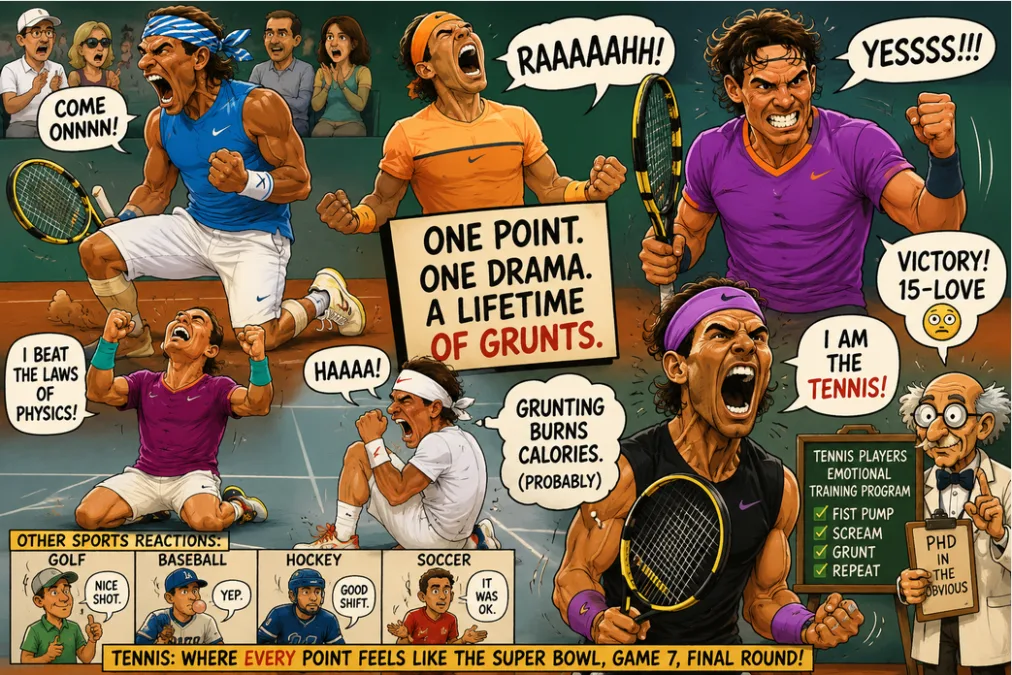
Quiet Please: Why Is Tennis Suddenly a Shakespearean Tragedy?
There was a time when tennis was a polite, civilized affair. You wore crisp whites, you politely clapped your wooden racket, and if you won a point, you casually strolled back to the baseline like you’d just successfully parallel-parked a sedan.
Not anymore. Watch a modern tennis match today and you’d swear you’re witnessing a chaotic blend of a dynamic delivery room, an elite military combat zone, and a community theater production of Hamlet.
The Labor Ward Baseline
Let’s start with the noises. What is with the aggressive, deep-chested groaning every time a player makes contact with the ball? It is no longer a sport; it is an audible medical emergency.
They aren’t just hitting a fuzzy green ball over a net; they sound like they are trying to lift a broken-down tractor out of a muddy ditch. You get the high-pitched “EEEE-YAHHH!” that cuts through the stadium like a buzzsaw, followed immediately by the opponent’s guttural, breathless “UGH-HUHHH.”
If you close your eyes, it sounds less like a world-class athletic competition and more like two people furiously trying to pass a massive kidney stone across a lawn.
The 15-Love Life-or-Death Fist Pump
And then comes the melodrama.
You win one single point in the first set. It’s 15-Love. The match has been alive for exactly ninety seconds. But instead of walking back to serve, the player drops into a deep crouch, locks eyes with their coach in the stands, veins popping out of their neck, and violently pumps their fist like they’ve just cured a major disease.
The Emotional Math of Modern Tennis:
Winning 1 Point = Slaying a fire-breathing dragon, avenging your ancestors, and surviving a shipwreck.
It is incredibly over-the-top. You have to play roughly a hundred more points to actually win this thing! Pace yourself! If you are exploding with raw, unbridled adrenaline because your opponent accidentally hit the ball into the tape of the net on point two, what do you have left for the trophy presentation? Complete emotional collapse?
Who Invented This Madness?
Where did this start? You can trace the ancestral roots of the dramatic sports pose straight back to 1980s professional wrestling. Long before tennis players were staring down their boxes, Hulk Hogan was cupping his hand to his ear, begging 50,000 screaming fans to fuel his comeback.
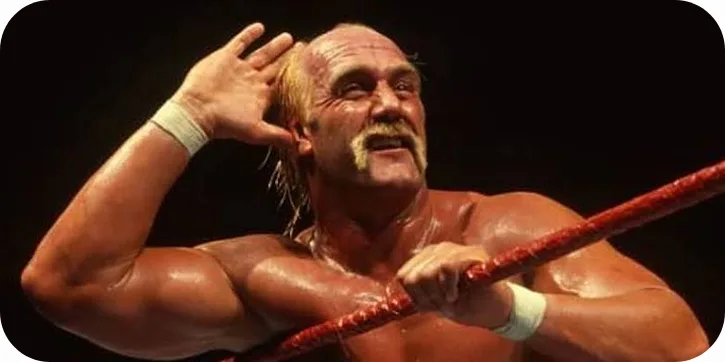
But wrestling is supposed to be theater. How did it infect the country club?
Enter the kooky wave of 1990s and 2000s sports psychologists. Somewhere along the line, a guy with a clip-board and a degree from an unaccredited online university convinced a generation of teenage prodigies that “vocalizations maximize core engagement” and “visible self-assertion micro-intimidates the adversary.”
Translation: “If you scream like a banshee and aggressively flex your forearm at a 19-year-old from Switzerland, they’ll get scared and hit it out of bounds.” And because tennis players are notoriously superstitious weirdos who will bounce a ball exactly seven times or refuse to step on a white line, they swallowed the advice whole. Now, we are stuck with an entire tour of people who can’t hit a forehand without announcing it to the neighboring zip code.
The Spectacle Scale: Melodrama vs. Sanity
It’s not just tennis, of course. Modern sports have generally devolved into a giant display of self-puffery. Football players make a standard tackle on 2nd and 8—while down by 24 points—and immediately jump up to do a choreographed hip-hop routine for the crowd.
Let’s look at how the worst offenders stack up against the sports that managed to keep their dignity intact:
| The Melodramatic Hall of Fame (Worst Offenders) | The Normal Behavior Sanctuary (Still Watchable) |
| Tennis: Screaming at 120 decibels for a routine volley; relentless fist-pumping at 15-all. | Golf: Generally quiet. Tiger Woods used the fist pump, but he saved it for historic, tournament-winning 40-foot putts. Imagine if every golfer screamed like a birthing mammal on a standard tee shot? It’d be unplayable. |
| NFL Football: End-zone salsa dances, backflips, and flexes to celebrate a play that ultimately didn’t stop a first down. | Baseball: You hit a 450-foot home run? You jog the bases. Sure, there’s a little bat-flip now and then, but you don’t see a shortstop doing the Macarena after a routine throw to first. |
| Soccer: The legendary “wounded soldier” act. A blade of grass brushes a player’s shin, and they roll around like they’ve been hit by an invisible sniper, only to leap up and sprint full speed ten seconds later. | NHL Hockey: You score a goal while skating 25 mph with knives on your feet while people try to smash you into a wall. You hug your buddies, high-five the bench, and get back to work. |
Ultimately, we have to blame ourselves. We want the drama, we want the narrative, and we want the spectacle. But please, if any future tennis stars are reading this: just hit the ball, take a deep breath, and leave the theatrical labor pains at home.
Tennis Grunting, Fist Pumping, and the Olympic Sport of Acting Like You Just Saved Humanity
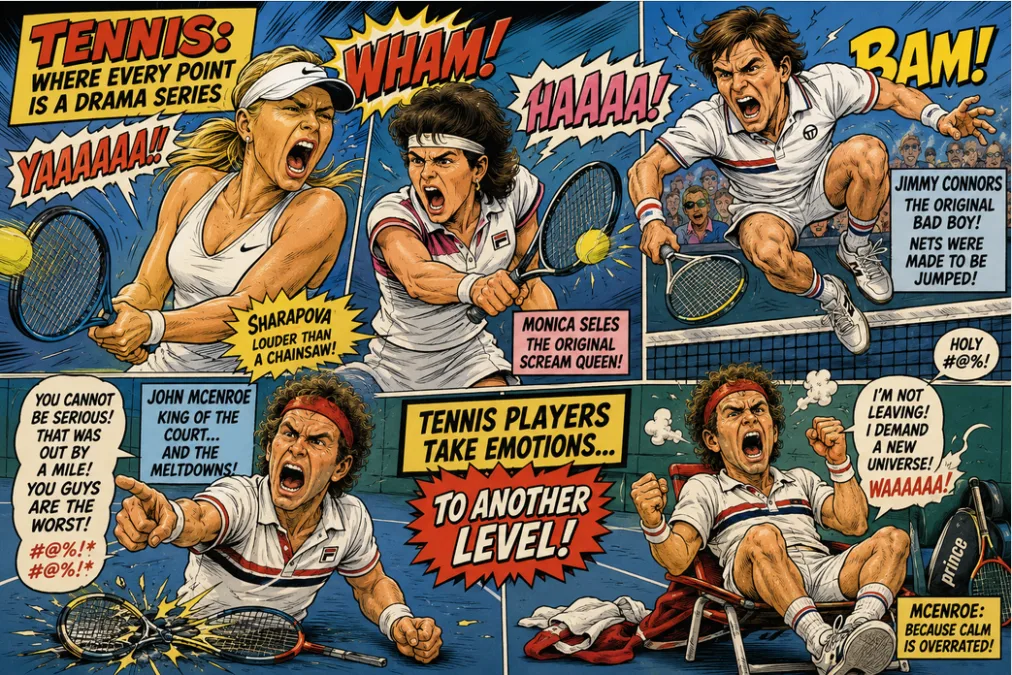
There are few sounds in sports more confusing to outsiders than the noise produced during a professional tennis match.
THWACK.
“AAAAAAHHHHH!”
THWACK.
“COME ON!!!”
THWACK.
“YESSSSSS!!!”
If you had never seen tennis before and someone played you the audio without context, you would assume either (a) someone was giving birth in a gymnasium, or (b) an exorcism had broken out at a country club.
But no. It’s just two extremely athletic millionaires hitting a fuzzy yellow ball back and forth over a net.
And reacting to every point as if they had just personally stormed the beaches of Normandy.
The One-Point World Championship
Let’s be honest: tennis players are spectacular athletes. The endurance, skill, speed, and mental toughness required to compete at the highest level are almost incomprehensible.
That said, the emotional response after winning a single point can occasionally seem a bit… disproportionate.
Player wins one point in the first game of the first set.
Reaction:
- Fist pump.
- Roar toward the heavens.
- Intense stare into opponent’s soul.
- Yelling “COME ON!” at nobody in particular.
- Chest pounding.
- Extended conversation with self.
Sir, the score is currently 15-love.
You are not William Wallace. You have not liberated Scotland. You successfully returned a second serve.
Meanwhile, in baseball, a guy might hit a 430-foot home run and jog around the bases looking mildly inconvenienced.
In hockey, players routinely lose teeth and simply continue existing.
In golf, most players react to a magnificent shot by narrowing their eyes slightly and whispering, “Hmm. That’ll play.”
The contrast is remarkable.
So Where Did All This Drama Come From?
Surprisingly, tennis wasn’t always like this.
For decades, tennis culture was essentially “British aristocrats politely perspiring.”
Players wore white, kept their emotions restrained, and behaved as though showing excitement might violate several international treaties.
Then sports psychology arrived.
Beginning in the 1970s and exploding during the 1980s and 1990s, psychologists and performance coaches started emphasizing “positive self-talk,” “emotional momentum,” and “confidence rituals.”
The theory made sense.
Tennis is uniquely brutal mentally. There are no teammates to hide behind. No substitutions. No timeouts every thirty seconds. Just you, your thoughts, and an opponent actively trying to destroy your self-esteem.
Psychologists discovered that visible displays—fist pumps, vocal affirmations, aggressive body language—could actually improve confidence and interrupt negative thought spirals.
Unfortunately, as often happens when humans discover something useful, we immediately overdid it.
A modest fist pump became:
“YEEEEAAAHHHH! LET’S GOOOOOO!”
after winning a point because the other player accidentally hit the net cord.
Sports psychology accidentally created an entire generation of highly conditioned emotional support humans who spend three hours loudly convincing themselves that they are, in fact, still good at tennis.
The Grunting Epidemic
And then there is the grunting.
Nobody truly knows where it started.
Some experts argue that exhaling forcefully during exertion increases power and helps regulate breathing.
Reasonable.
Others suggest grunting enhances rhythm and timing.
Also reasonable.
Professional tennis players heard these theories and apparently concluded:
“If a little exhalation helps, sounding like a wounded wildebeest should make me unbeatable.”
Modern tennis broadcasts occasionally resemble wildlife documentaries.
“Here we observe the North American Baseline Screamer attempting to intimidate its rival through prolonged vocal displays.”
Scientists have debated whether loud grunting distracts opponents.
Fans have debated whether muting the television should count as a medical necessity.
Entire matches have been won and lost while spectators wondered whether emergency services should be contacted.
The Mount Rushmore of Sports Melodrama
Gold Medal: Professional Wrestling
Nothing else comes close.
Every modern athletic celebration owes some debt to professional wrestling. Long before social media, performers like Hulk Hogan were pointing dramatically at crowds, cupping ears, flexing, posing, and transforming athletic competition into theater.
When Hulk raised his hand to his ear and asked the crowd for noise, sports collectively said:
“You know what? We should all do that.”
Humanity has never fully recovered.
Silver Medal: Tennis
No teammates. Maximum pressure. Endless self-dialogue.
Result: emotional fireworks after every successful forehand.
Bronze Medal: American Football
Modern touchdown celebrations increasingly resemble Broadway auditions.
One player catches a seven-yard pass in the second quarter and suddenly twelve teammates are performing synchronized choreography.
Honorable Mention: Soccer
The dramatic collapse after minimal contact deserves its own separate article, doctoral thesis, and perhaps congressional investigation.
Sports With Surprisingly Normal Humans
Hockey
People crash into walls at 20 miles per hour, occasionally bleed, and then quietly skate to the bench.
Disturbingly well-adjusted.
Baseball
Players may sit silently for three hours, chew sunflower seeds, and nod occasionally.
A home run celebration often consists of: “Nice job.”
Golf
Golf remains perhaps the last refuge of emotional restraint.
Imagine if tennis behavior migrated to golf.
Golfer sinks a six-foot putt for par.
“AAAAAAHHHHH! COME ONNNNN!”
Massive fist pump.
Sprints around the green.
Crowd loses consciousness.
Thankfully, civilization has prevented this outcome.
Mostly.
Cricket
People can spend literal days playing a match without appearing emotionally unstable.
Remarkable discipline.
Maybe We Secretly Love the Drama
Here’s the uncomfortable truth.
As ridiculous as all the grunting, roaring, fist pumping, and self-motivation rituals can seem, fans clearly enjoy at least some of it.
Why?
Because emotion is contagious.
It’s one reason Tiger Woods transformed golf from “televised lawn maintenance” into must-watch entertainment. His famous fist pumps gave viewers permission to care.
Sports are stories. Stories need emotion.
Without passion, athletic competition becomes little more than highly efficient exercise.
So yes, tennis players sometimes behave as though every point determines the fate of civilization.
Yes, the grunting occasionally sounds medically concerning.
And yes, watching someone scream triumphantly after winning the opening point of a first-round match can feel a touch melodramatic.
But perhaps that’s exactly why we keep watching.
Humans love drama.
Even when it’s happening at Wimbledon over a ball covered in fluorescent fuzz.
If you’d like, I can also create a matching 16:9 featured image concept featuring exaggerated tennis players screaming and fist-pumping while athletes from other sports stand nearby looking utterly confused.
SEARCH FOR ANY ARTICLE BY KEYWORD
More results...