
Top 10 Reasons USPS Still Can’t Figure It Out
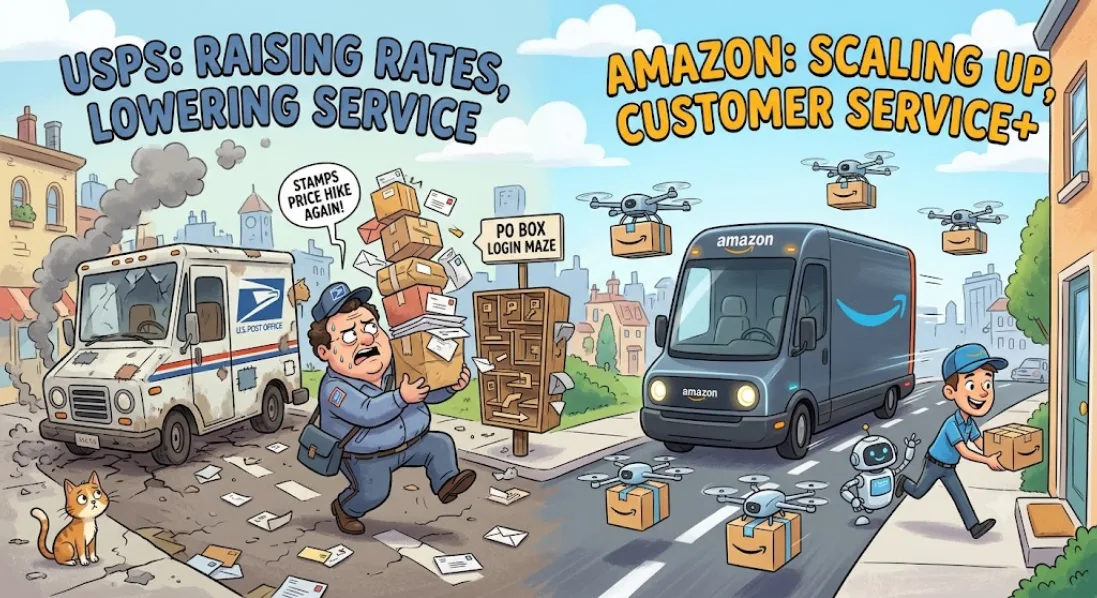
There are few organizations in America that inspire the same mixture of nostalgia, confusion, frustration, and mild existential dread as the United States Postal Service.
On paper, USPS should be one of the greatest organizations ever created. Their entire business model is essentially: “Take a thing from one side of the country and somehow get it to the other side of the country.” That’s it. That’s the whole job. They don’t have to convince you to buy anything, invent new technology, or create social media algorithms that destroy civilization. They just have to move envelopes and boxes from Point A to Point B.
And yet somehow, year after year, the organization manages to lose money, raise prices, reduce service quality, and create customer experiences that feel like they were designed by a committee of escaped DMV employees.
Meanwhile, companies like Amazon have spent the last twenty years perfecting the art of delivering products so efficiently that you can order a bag of gummy bears at 11:47 PM and a man in a reflective vest will somehow materialize outside your front door at 6:15 AM with a smile and a package photo.
So naturally, USPS’s solution to its ongoing struggles has been to do what every struggling organization does when it runs out of ideas: raise prices again. At this point, stamps cost so much that mailing a birthday card feels like making a small investment in municipal bonds.
To better understand this phenomenon, the WTFYI Institute of Postal Frustration conducted a rigorous scientific study involving internet comments, conversations overheard in post office lines, social media complaints, and one guy yelling in a parking lot outside a distribution center. The results were revealing.
Exclusive WTFYI Research: Why Customers Hate USPS
| Complaint | Percentage of Respondents |
|---|---|
| Couldn’t find what they needed on the website | 31% |
| Package tracking made no sense | 24% |
| Waited in line longer than expected | 18% |
| Received a “delivery attempted” notice while at home | 15% |
| PO Box/account management frustration | 8% |
| Other (mostly profanity) | 4% |
The margin of error is ±100%, which is still somehow more accurate than some USPS delivery estimates. With that out of the way, let’s examine the top ten reasons why the USPS continues to struggle while private companies keep running circles around it.
10. Their Website Was Apparently Designed During The Cold War
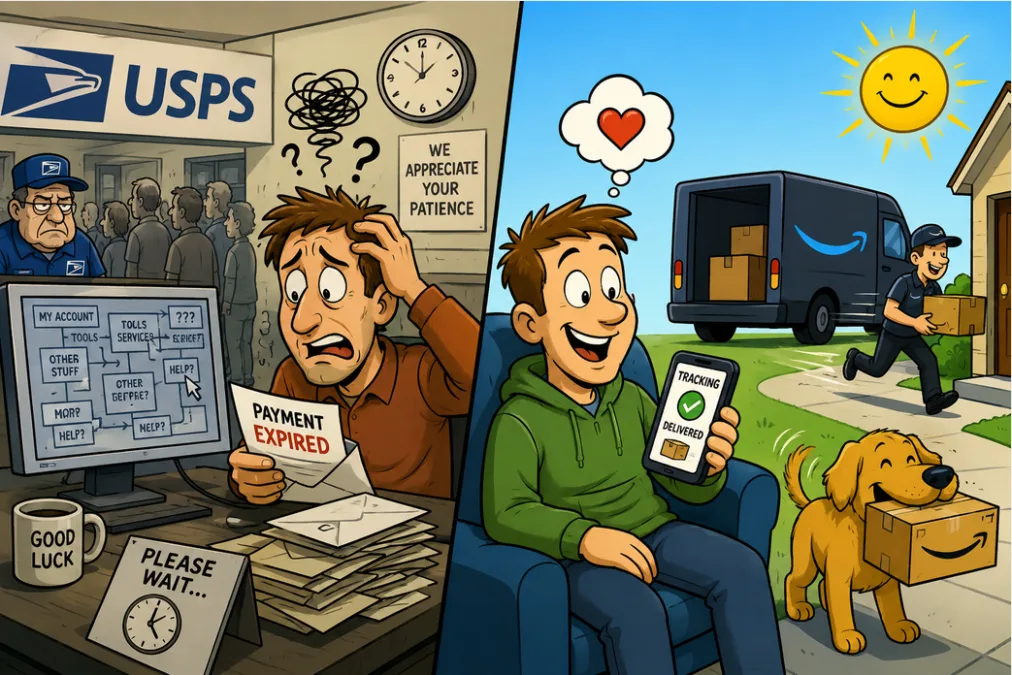
Recently, we received an email from USPS informing us that the payment method for our PO Box was about to expire. Simple enough, right? Log into your account, update the card, and continue living your life.
Instead, what followed was a twenty-minute digital scavenger hunt that felt less like managing a mailbox and more like trying to escape an ancient Egyptian tomb. First, you have to locate where your PO Boxes are listed. Then you discover that your payment methods aren’t where the payment methods are supposed to be. Then you click another menu. Then another. Then another.
Eventually, you start questioning whether you actually own a PO Box at all. By comparison, Amazon can tell you the exact GPS coordinates of a package currently sitting in a warehouse three states away while simultaneously recommending six products you didn’t know existed but now absolutely need. USPS can’t find the credit card you already gave them.
9. They Treat Rate Increases Like A Hobby
Every few months, Americans receive the same announcement: “Due to rising operational costs, USPS will be implementing another price adjustment.” At this point, “price adjustment” should simply be the official USPS mascot.
Imagine if Netflix increased subscription prices every three months while simultaneously reducing the number of shows available. Imagine if Costco raised the price of hot dogs every quarter while making them smaller. Imagine if airlines charged more while flying slower. Actually, bad example. Airlines already figured that business model out.
A Brief History Of USPS Problem Solving
According to our historical research department, USPS problem-solving strategies have evolved remarkably little over time. In 1775, the strategy was “We should create a postal service.” By 1860, the strategy became “Let’s expand westward.” Around 1950, the strategy shifted to “Let’s modernize operations.”
Unfortunately, sometime around 1995, the organization appears to have adopted the position that the internet probably wasn’t going to affect their business model very much. By 2005, they acknowledged that perhaps the internet had, in fact, affected their business model. By 2015, they had settled on a more sustainable long-term strategy: raising prices.
By 2020, the strategy had evolved into “Let’s raise them again.” By 2025, the question reportedly being asked in executive meetings was, “Have we considered raising them one more time?” By 2026, this proposal was reportedly receiving standing ovations.
8. Nobody Has Ever Described USPS Customer Service As “Outstanding”
Think about the last time someone enthusiastically recommended USPS customer service. Take your time. We’ll wait.
The reason this exercise takes so long is that people don’t tell stories about amazing experiences at the post office. They tell survival stories. They say things like, “I only waited 47 minutes,” “They only lost one package,” or “The employee only sighed heavily at me twice.” This is not the kind of word-of-mouth marketing strategy that creates customer loyalty.
7. Their Tracking System Sometimes Feels Philosophical
Private carriers provide updates like, “Your package is currently on vehicle #2847, driven by Steve, who stopped for coffee at 8:13 AM.” USPS tracking updates, meanwhile, look more like fortune cookies.
“In Transit.” “Arriving Late.” “Moving Through Network.” What network? Where? Which direction? Are we talking about physical space or emotional space?
Sometimes packages appear to enter a quantum state where they simultaneously exist everywhere and nowhere until suddenly arriving three weeks later looking like they survived the Oregon Trail.
6. The PO Box Experience Is Weirdly Complicated
Renting a PO Box sounds simple. You pay money. You receive a box.
Instead, it feels like applying for security clearance at a nuclear facility. Then, after finally acquiring your PO Box, you discover that managing it online requires navigating a user interface that appears to have been assembled by combining three separate websites from 1998.
Need to update your payment method? Good luck, adventurer.
5. They Somehow Make Waiting In Line Feel Longer Than Actual Time
Scientists should study post office lines. Ten minutes at Starbucks feels like ten minutes. Ten minutes waiting for an Amazon return feels like ten minutes.
Ten minutes inside a post office feels like you’ve watched an entire Ken Burns documentary about the American Civil War. Nobody understands why this happens. Perhaps time itself bends around postal facilities.
4. They Keep Acting Shocked That People Send Less Mail
Every year, someone at USPS announces that traditional mail volume is declining. Really?
You mean people stopped mailing handwritten letters after the invention of email, text messaging, cloud storage, social media, electronic billing, online banking, electronic signatures, and literally the entire internet? What a shocking and unforeseeable development.
This is like Blockbuster executives acting surprised that customers stopped renting VHS tapes.
3. The Private Sector Keeps Embarrassing Them
Amazon built one of the most sophisticated logistics networks in human history. FedEx tracks packages with military precision. UPS drivers have become so efficient that they optimize routes to avoid unnecessary left turns.
Meanwhile, USPS is still occasionally leaving notices informing you that they attempted delivery while you were literally sitting ten feet from the front door all day. Nothing destroys customer confidence faster than discovering that your delivery attempt apparently occurred in a parallel universe.
What USPS Could Learn From Amazon
Amazon knows where your package is. Amazon knows when your package will arrive. Amazon knows what you bought five years ago. Amazon knows what you’ll probably buy next week. Amazon probably knows your preferred paper towel brand and your favorite flavor of beef jerky.
USPS knows that at some point, somewhere, a package existed and would appreciate your continued patience.
2. They’ve Become The Human Embodiment Of “Good Enough”
The problem isn’t that USPS completely fails. The problem is that it succeeds just enough to avoid being forced to fundamentally improve.
Mail eventually arrives. Packages eventually appear. Systems eventually function. Everything eventually happens. The word “eventually” is doing an extraordinary amount of heavy lifting in those sentences.
1. They Forgot They’re Supposed To Be Competing
The fundamental problem facing USPS may simply be that it behaves like an organization that doesn’t truly believe it has competitors. Modern customers compare every experience against every other experience.
If Amazon can provide real-time tracking, easy account management, simple returns, transparent billing, and exceptional customer support, then customers naturally wonder why renewing a PO Box feels like trying to solve an escape room designed by accountants.
The customer doesn’t care that one organization is public and another is private. The customer only knows that one company somehow delivered a phone charger, dog treats, vitamins, and a lawn chair to their house in eight hours, while the other sent an email saying their payment method was expiring and then hid the place to update it.
USPS Corporate Strategy Meeting (Leaked Transcript)
According to sources familiar with the matter, a recent USPS strategy meeting began with an executive cautiously pointing out that customers found the website confusing and difficult to navigate.
Rather than discussing ways to simplify the customer experience, another executive reportedly suggested moving all of the menus to different locations so customers could experience an entirely new type of confusion. This proposal was allegedly met with enthusiastic approval.
When someone eventually asked whether the organization should improve customer service, modernize the website, or simplify account management, the discussion quickly pivoted to the possibility of another rate increase. According to attendees, this idea generated thunderous applause and the meeting was adjourned early due to excessive self-congratulation.
Customer Service Satisfaction Rankings
| Experience | Satisfaction Rating |
|---|---|
| Getting a package from Amazon | 9.4/10 |
| Buying hot dogs at Costco | 9.2/10 |
| Returning an item at Target | 8.7/10 |
| Going to the dentist | 6.1/10 |
| Filing taxes | 4.9/10 |
| Sitting in airport security | 4.3/10 |
| Explaining your Wi-Fi problem to your parents | 3.7/10 |
| Finding your USPS PO Box payment method online | 0.8/10 |
To provide context, our researchers compared several common American experiences by customer satisfaction. The results suggest that Americans would rather explain Wi-Fi problems to their parents over the phone than attempt to locate USPS account settings online.
The Official USPS Customer Journey™
The typical USPS online customer journey follows a remarkably consistent pattern. First, the customer receives an email reminding them to update their payment information and feels optimistic.
Then they log into the USPS website, become confused, click through seven unrelated menu options, question their own intelligence, and eventually search Google for “where the hell are USPS payment settings.”
This inevitably leads to a Reddit thread from 2019 where everyone appears to be experiencing the exact same problem. At this point, many customers briefly consider abandoning modern society and becoming lighthouse keepers before eventually figuring it out or simply allowing the payment method to expire and hoping for the best.
Self-Help Guide: Are You Ready To Visit The Post Office?
Before entering your local post office, experts recommend eating a full meal, charging your phone, bringing government-issued identification, bringing backup identification, clearing your afternoon schedule, lowering all expectations, practicing controlled breathing exercises, remembering that anger solves nothing, and remembering that neither does optimism.
Scientific Conclusion
The real mystery isn’t why USPS struggles. The real mystery is how an organization responsible for transporting billions of pieces of mail every year can simultaneously perform one of the greatest logistical achievements in human history while making customers feel like they’re trying to renew a medieval fishing license through a fax machine.
And honestly, that’s kind of impressive.
Final Delivery Attempt
To be fair, USPS employees perform an incredibly difficult job. Delivering mail to hundreds of millions of addresses across a country this large is a logistical miracle.
But that’s exactly what makes the frustration so maddening. The infrastructure exists. The people exist. The mission is straightforward. Yet somehow, the organization continues operating like it’s perpetually surprised that customers expect convenience in the year 2026.
Perhaps the greatest irony of all is that the USPS slogan promises that neither snow, rain, heat, nor gloom of night will stay these couriers from the swift completion of their duties. Unfortunately, nobody mentioned anything about outdated websites, hidden payment menus, endless rate increases, or trying to locate your own PO Box account settings.
Those obstacles, apparently, remain undefeated.
The “Return to Sender” Business Model: Why the USPS is America’s Favorite Inefficiency Simulator
We’ve all received that ominous email. The one warning you that your PO Box payment method is about to expire. It sounds simple: log on, update the card, and get back to your life.
Instead, you enter the USPS website—a digital labyrinth seemingly designed by a government committee whose sole objective was to hide your own data from you. You click through five layers of nested menus, finally locate the PO Box section, click “Stored Payment Methods,” and… nothing. A blank screen. The digital equivalent of a postal worker staring blankly at you from behind a bulletproof glass partition while holding a “Next Window Please” sign.
It makes you wonder: how is it that Amazon can predict you need toilet paper before you even wipe, drone-deliver a package to your exact coordinates within two hours, and keep costs down, while the United States Postal Service is out here playing hide-and-seek with your billing info and hiking stamp prices every six months?
Kevin Costner made the post office look like a post-apocalyptic heroic saga in The Postman. But let’s face it: we live in a world where Seinfeld got it right. Newman wasn’t just a sitcom villain; he was a prophetic archetype of systemic, rain-or-shine inefficiency.
If you’ve ever wondered why the USPS is constantly on the brink of financial collapse despite having a literal government-sanctioned monopoly on your mailbox, here are the top 10 reasons the USPS stinks—and how they might actually join us in the 21st century.
The Top 10 Ways the USPS Stinks (and How to Fix It)
1. The Website is a Digital Bermuda Triangle
The Stink: Finding your active PO Box or updating a credit card on USPS.com requires a map, a compass, and a blood sacrifice. The UI feels like it was coded in 1998 and abandoned.
The Fix: Fire whatever committee designed the portal and hire a single college intern who understands how a “My Account” tab works. If I own a box, it should be on the dashboard, not buried under a mountain of government sub-menus.
2. The Constant “Stamp Inflation”
The Stink: The USPS raises stamp prices faster than a tech startup changes its terms of service. They’re trying to solve a multi-billion dollar deficit by charging you an extra three cents to mail a birthday card to your grandma.
The Fix: Stop treating price hikes like a cheat code for poor budgeting. Scale the business, optimize delivery routes with actual modern logistics tech, and stop making the consumer pay for organizational bloat.
3. The “Next Window Please” Customer Service Philosophy
The Stink: Walk into a local branch and you are instantly hit with a specific, heavy energy. It’s the vibe of people who know it is mathematically impossible for them to be fired. Lines stretch out the door while three workers handle a single roll of tape like it’s a bomb disposal unit.
The Fix: Implement standard private-sector performance metrics. If Amazon fulfillment workers are tracked by the second, postal workers can at least be incentivized to acknowledge human presence with eye contact.
4. Missing the Parcel Boom
The Stink: E-commerce exploded, and instead of capturing the market, USPS became the “last mile” mule for Amazon and UPS. They take the least profitable, most exhausting part of the delivery chain because their own infrastructure couldn’t compete for the premium logistics contracts.
The Fix: Build a dedicated, competitive package network that doesn’t rely on piggybacking off companies that are actively eating their lunch.
5. The Ghost Tracking Numbers
The Stink: “Status: In Transit to Next Facility.” For four days. Which facility? Is it in this state? Is it on a truck? Has it been eaten by Newman? Nobody knows. USPS tracking is more of a philosophical suggestion than a data point.
The Fix: GPS tracking exists. If a food delivery app can show me a tiny car turning left on 5th Street with my burrito, the federal government should be able to tell me which county my tax documents are currently sitting in.
6. The “Junk Mail” Life Support Machine
The Stink: The only reason the USPS survives is because they are paid pennies to stuff your physical mailbox with local supermarket coupons and credit card offers you never asked for. They are essentially a state-funded recycling middleman.
The Fix: Let people opt-out of junk mail digitally. Charge advertisers a premium to target the people who actually want physical mail, and stop wasting fuel carrying paper trash across the country.
7. The Pre-Funding Pension Nightmare
The Stink: While Congress finally offered some relief with the Postal Service Reform Act a few years back, the USPS spent decades crippled by a bizarre legislative mandate to pre-fund retirement health benefits 75 years into the future. No actual business operates this way.
The Fix: Clean up the rest of the legacy bureaucratic accounting. Run the post office like an independent corporate entity—not a political football that Congress can micromanage into the ground.
8. Golden Hour Operating Hours
The Stink: Most branches are open strictly from 9:00 AM to 4:30 PM, and closed on Sundays. In other words, they are exclusively open during the exact hours that the working population is also at work and unable to visit.
The Fix: Stagger shifts. Open late on Tuesdays and Thursdays; close on Mondays instead. Match the hours to when actual human beings need to mail packages.
9. The Ancient Fleet
The Stink: The iconic white Grumman LLV mail trucks are literally catching fire on the side of the road because they’ve been driven past their expiration dates by decades. They have no air conditioning, terrible gas mileage, and zero modern safety features.
The Fix: Accelerate the rollout of the Next Generation Delivery Vehicles (NGDVs). If you’re going to overspend, overspend on vehicles that don’t double as a convection oven for the driver and the mail.
10. The Monopolistic Comfort Zone
The Stink: Because the law dictates that only the USPS can put things in your mailbox, they have zero competitive pressure to innovate. Monopoly breeds complacency, and complacency breeds a website that won’t let you update your visa card.
The Fix: Open up the mailbox. Let private carriers compete for letter mail. Watch how fast the USPS fixes its payment portal when they realize FedEx can deliver a letter straight to the door for a competitive price.
SEARCH FOR ANY ARTICLE BY KEYWORD
More results...