
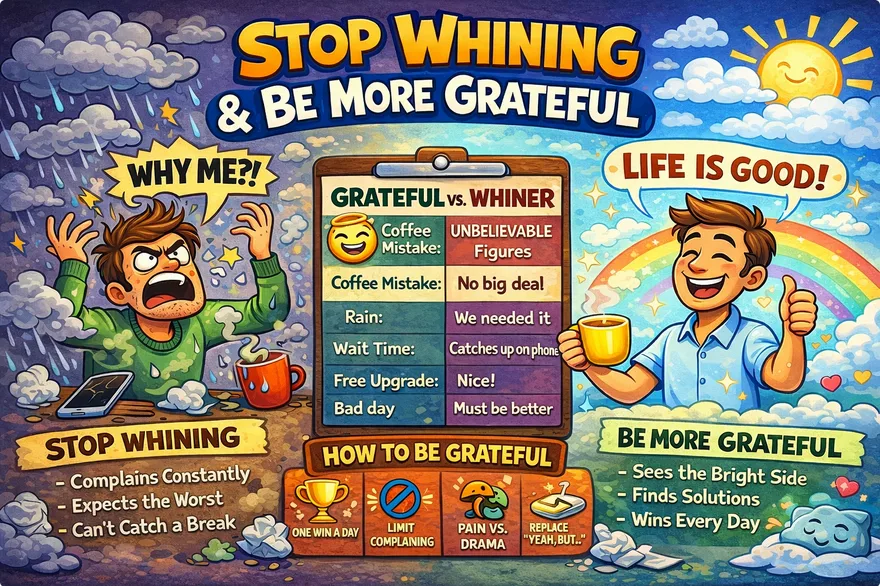
Simple to follow easy to understand user guide for tips on how to stop complaining.
How to Quit Complaining and Get Your Joy Back
Remember when the world felt a little lighter? When a rainy day was just a rainy day, and a delayed train was an excuse to daydream instead of drafting a mental lawsuit against the transit authority?
At some point, many of us slip into a stealthy habit: chronic complaining. Often, it sneaks up on us because of our environment, such as a new job with a cynical breakroom culture, a group chat fueled by mutual griping, or just the gradual accumulation of daily stress. Before you know it, complaining becomes your default conversational setting.
The good news? If you were not born complaining, you do not have to stay stuck in it. Here is your fun, easy-to-read guide to breaking the habit and reclaiming your positive energy.
Phase 1: Catch Yourself in the Act
The first step to stopping a bad habit is noticing when you are doing it. Complaining is sneaky because it often feels like bonding or problem-solving, but usually, it is just spinning your wheels.
- The “Venting vs. Ranting” Check: Ask yourself: Is this conversation moving toward a solution, or are we just admiring the problem? If there is no action plan, it is a complaint.
- Notice the Physical Cue: Pay attention to how your body feels when you complain. Your shoulders tighten, your jaw clenches, and your energy drops. Your body knows complaining is a drag long before your brain admits it.
Phase 2: Trace the Roots
Why did you start complaining so much in the first place? Understanding the trigger helps you disarm it.
- The Contagion Effect: Negativity is notoriously catching. If you started hanging out with chronic pessimists, their worldview likely rubbed off on you like glitter from a craft project.
- The “Connection” Trap: Sometimes we complain because we think it is the easiest way to make friends or find common ground, such as bonding over bad traffic. Look for healthier ways to connect, like sharing what you are excited about.
Phase 3: Your 4-Step Action Plan to Quiet the Grumbles
Breaking the cycle does not require a monk-like vow of absolute silence. It just takes a few playful resets.
- Swap Complaints for Gratitude: Every time you catch yourself starting a sentence with a negative observation, instantly pivot to naming one specific thing you appreciate. It trains your brain to look for the upside.
- The 24-Hour No-Complaint Challenge: Try going just one full day without complaining about the weather, traffic, or your to-do list. When you slip up, simply reset the clock. You will be amazed at how many times you open your mouth just to grumble.
- Turn Gripes into Goals: If you find yourself complaining about a situation, channel that energy into fixing it or accepting it. Turn a messy room into a quick 15-minute tidying session.
- Curate Your Crew: Spend more time with people who inspire you, dream big, and focus on solutions. Positivity is just as contagious as negativity, so choose your contagion wisely.
The Takeaway
Life is too short to spend it narrating everything that is annoying you. By shifting your focus from what is going wrong to what you can control, or simply choosing to appreciate the current moment, you will get your lightness back.
What is one small trigger or habit you would like to tackle first in your journey to complain less?
How to break the habit of complaining
Have you ever caught yourself complaining and suddenly thought, “Wow, I complain a lot”? Maybe you remember a time when you weren’t like this. You handled annoying people, traffic, bad weather, slow service, difficult coworkers, and life’s little inconveniences without turning each one into a full-blown commentary. Then, somewhere along the way, something changed. Perhaps you started spending more time around people who complained constantly. Maybe life became more stressful, or you discovered that complaining was an easy way to connect with other people. Whatever happened, the important thing to remember is that if complaining became a habit, it can become a habit in the other direction, too.
The goal isn’t to become one of those relentlessly cheerful people who insists everything is wonderful while the building is clearly on fire. Complaining isn’t always bad. Sometimes something genuinely needs to be said. Sometimes you need to tell a friend that you’ve had a terrible day. Sometimes a problem needs to be identified before it can be fixed. The trouble begins when complaining becomes your default response to ordinary life. You spill your coffee, you complain. Someone cuts you off in traffic, you complain. Your boss sends an email, you complain. The weather changes, you complain. Someone is chewing too loudly, and suddenly you’ve got a three-act tragedy on your hands.
How Did You Become a Complainer?
Most people don’t wake up one morning and decide to become chronic complainers. Habits tend to develop gradually. You may have gone through a stressful period when complaining became a way of releasing tension. You may have been surrounded by people who constantly criticized everything and gradually picked up their conversational style. You may have discovered that complaining creates an immediate sense of connection. One person says, “This traffic is ridiculous,” another responds, “It gets worse every morning,” and suddenly everyone is participating in a group therapy session that nobody actually scheduled.
Our surroundings can influence us more than we realize. If the people around you spend a lot of time discussing what’s wrong with their jobs, relationships, neighbors, politicians, weather, restaurants, customers, spouses, children, or absolutely anything else that crosses their path, it can begin to feel normal. You start contributing your own complaints simply because that’s how the conversation works. Eventually, you may find yourself complaining even when you’re alone. At that point, the habit has become less about the people around you and more about the way your own mind has learned to process everyday experiences.
The good news is that habits can be interrupted. You don’t have to figure out exactly when you became a complainer or identify the one person who caused it. You simply need to start noticing what you’re doing.
Become a Complaint Detective
For the next few days, listen to yourself. Don’t try to stop complaining yet. Just pay attention. Notice the little phrases that come automatically: “This always happens to me,” “People are so annoying,” “I can’t stand this,” “Why does nobody ever…?” or “Of course this would happen.” You might be surprised by how often these phrases appear in an ordinary day.
The purpose isn’t to criticize yourself. You’re gathering information. Maybe you discover that you complain mostly when you’re tired. Maybe it’s during your commute. Maybe one particular person brings it out of you. Maybe you complain when you’re hungry, stressed, bored, or overwhelmed. Once you know your triggers, you can start changing the pattern. It’s much easier to interrupt a habit when you can see it coming.
Ask One Simple Question
Once you’ve noticed the habit, try asking yourself one question whenever you begin complaining: “Is there something I can do about this?” If the answer is yes, you’ve just discovered something more useful than complaining. Take the action. If your house is cluttered, clean one room. If you keep getting interrupted, have a conversation about it. If your schedule is overwhelming, look for something you can remove. If you’re unhappy with a situation you have some control over, figure out the smallest step you can take.
Of course, plenty of things can’t be changed. Traffic is traffic. The weather is the weather. A restaurant may be unexpectedly crowded. Someone may be rude. Your flight may be delayed. The cashier may be moving at a pace that suggests time itself has stopped. In those moments, you can ask a slightly different question: “Can I accept this without making it worse?” You don’t have to enjoy the situation. You simply don’t have to spend the next twenty minutes adding emotional fuel to it.
Turn Complaints Into Information
One of the most useful tricks is to separate the actual problem from the commentary you’ve added to it. Instead of saying, “This place is always a complete disaster,” try, “This place is crowded today.” Instead of, “My coworker is driving me absolutely crazy,” try, “We’re having trouble communicating about this project.” Instead of, “Nothing ever works around here,” try, “This particular thing isn’t working.”
That may sound like a small change, but it matters. A complaint often contains a fact wrapped in a large amount of emotional decoration. When you remove the decoration, you can see the actual problem more clearly. Once you can see the problem clearly, you have a much better chance of deciding what to do about it.
Pay Attention to Your Company
Take an honest look at the conversations you have every day. Are you surrounded by people who constantly complain? Do certain conversations reliably turn into criticism sessions? Do you and your friends spend an hour discussing everything that’s wrong with the world and then wonder why you feel drained afterward?
You don’t necessarily need to distance yourself from anyone. Instead, experiment with changing the pattern. When someone starts a familiar complaint cycle, resist the urge to automatically add your own complaint. Ask a question, introduce another subject, or simply listen without piling on. You may discover that the conversation moves on surprisingly quickly when you stop feeding it.
And remember that you can enjoy someone’s company without adopting all of their habits. You don’t have to become the human equivalent of a rain cloud simply because someone you care about has had a bad day.
Find Out What’s Underneath the Complaint
Sometimes complaining is not really about the thing we’re complaining about. You’re irritated about the dishes, but perhaps you’re actually exhausted. You’re furious about an email, but perhaps you’re already overwhelmed. You’re complaining about everyone around you, but perhaps what you really need is some quiet time.
The next time you notice yourself getting particularly negative, ask, “What am I actually feeling?” You may discover that you’re tired, disappointed, anxious, lonely, frustrated, or simply overloaded. That information is far more useful than another rant. Once you understand what’s underneath the complaint, you can address the real issue instead of repeatedly complaining about whatever happens to be in front of you.
Give Yourself a Better Rule
Rather than making a vague promise to “stop complaining,” try adopting a simple rule: every complaint gets paired with something useful. That might be a solution, a request, an action, or a lesson. If you say, “My schedule is ridiculous,” follow it with, “I need to stop saying yes to everything.” If you say, “This person keeps interrupting me,” follow it with, “I need to tell them I’d like to finish my thought.” If you say, “My house is always a mess,” follow it with, “I’m going to spend fifteen minutes cleaning before dinner.”
This doesn’t mean every complaint needs an elaborate solution. Sometimes the useful response is simply acceptance. The point is to train yourself to move beyond the complaint. Instead of stopping at “This is annoying,” your brain begins asking, “Now what?”
Don’t Make Quitting Complaining Another Thing to Complain About
There is a funny trap here. You decide you’re going to complain less, then you complain because you’re complaining too much. You get annoyed with yourself for being negative, which gives you something else to be negative about. Before long, you’ve created an entire complaint ecosystem.
Don’t do that. You’re changing a habit, not taking a personality test. You’re going to slip. You’re going to have bad days. You’re going to go on an unnecessary rant about someone who parked badly, and halfway through you’ll realize what you’re doing. That’s actually progress. The old version of the habit might have continued without you noticing. Now you’re catching it.
Simply stop, laugh at yourself if you can, and move on. You don’t need to be perfect. You just need to become a little more aware and a little less automatic.
Try a Seven-Day Complaint Reset
If you want to make this practical, try a seven-day experiment. During the first day, simply notice how often you complain. On the second day, pay attention to your triggers. On the third, notice whether certain people or environments seem to bring out the habit. On the fourth, practice turning complaints into simple factual observations. On the fifth, take action on the complaints you can actually do something about. On the sixth, experiment with redirecting conversations that turn into complaint marathons. On the seventh, look back and ask yourself whether you feel any different.
You may find that the biggest benefit isn’t that everyone else suddenly finds you more pleasant. It may be that you feel better inside your own head. When you spend less time rehearsing everything that’s wrong, you create more mental space for noticing what’s interesting, funny, beautiful, enjoyable, or simply worth your attention.
Maybe You Don’t Need to Become Someone New
If you remember a time when you complained less, don’t look back at that version of yourself with embarrassment or nostalgia. Maybe that person simply hadn’t developed the habit yet. Maybe life was different. Maybe your circumstances changed. Maybe you changed because of the people around you. That’s okay.
The encouraging part is that you don’t have to become an entirely new person. You may simply need to stop practicing a behavior that has become automatic. The calmer, more curious, less reactive version of yourself may not be gone. It may just be buried underneath a few years of accumulated habits.
So the next time you feel a complaint coming on, pause for a moment. Ask yourself whether you want to solve the problem, accept the situation, or simply keep talking about how annoyed you are. That tiny pause creates a space between what happened and how you respond to it.
And that space is where change begins.
You don’t have to stop noticing what’s wrong with the world. You just don’t have to make every little thing that’s wrong with the world your personal assignment for the day.
SEARCH FOR ANY ARTICLE BY KEYWORD
More results...