
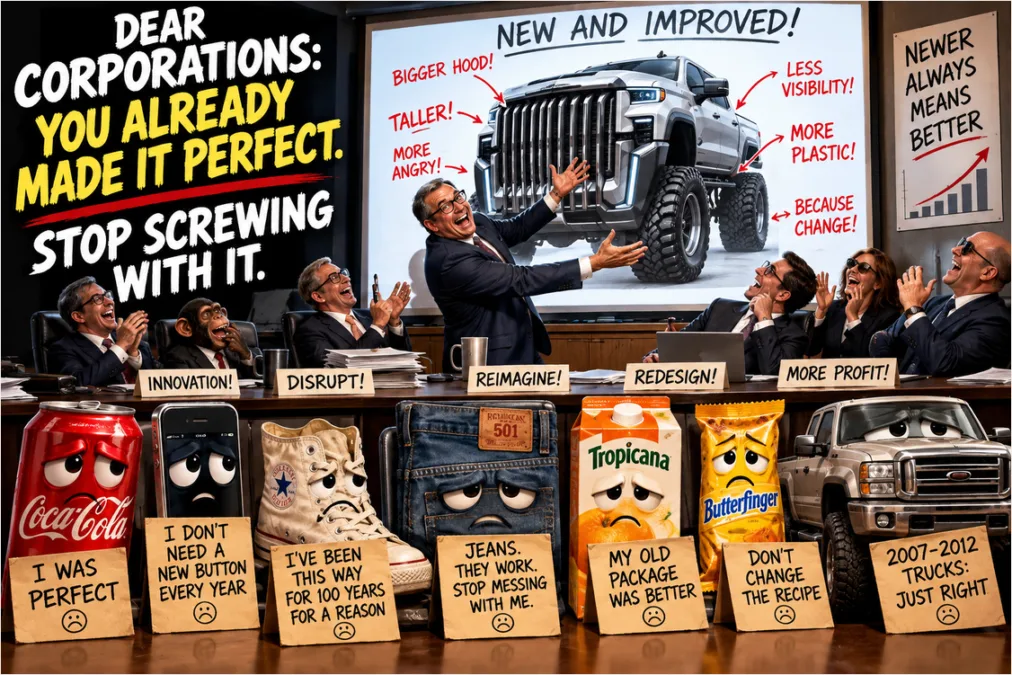
Dear Corporations: You Already Made It Perfect. Stop Screwing With It.
There is apparently a terrifying sentence that can never be spoken inside a corporate boardroom: “You know what? This product is basically perfect. Let’s just keep making it.” Such a statement would presumably cause seventeen vice presidents of Brand Innovation to burst into flames.
Somewhere along the way, modern capitalism developed a strange allergy to the concept of finished. Nothing can simply be excellent. Nothing can reach maturity. Nothing can settle into that wonderful stage where engineers have removed the problems, designers have nailed the proportions, customers love the thing, and everybody goes home happy. Instead, it needs to be reimagined, reinvented, refreshed, disrupted, or blessed with a bold new design language.
And that is usually the moment when somebody takes a perfectly handsome truck, telephone, sneaker, candy bar, software interface, logo, or pair of jeans and turns it into something that looks like it was designed during a three-day corporate retreat by people who haven’t personally purchased the product in fifteen years.
The Corporate Inability to Leave Well Enough Alone
Imagine Leonardo da Vinci finishing the Mona Lisa and then receiving an email from management: “Great work, Leo. Strong initial response. However, Consumer Insights feels Mona is getting a little stale. For Q3 we’d like bigger eyes, a more aggressive jawline, and perhaps a neon-green background. Research indicates younger consumers respond positively to green.”
That’s basically modern product development.
There is nothing wrong with improving technology. Make the engine more efficient. Make the phone faster. Improve the battery. Strengthen the material. Reduce manufacturing waste. Improve safety. Make replacement parts cheaper. Improve the camera. Fix the software. Make the shoe more durable. Wonderful.
But if you’ve stumbled onto a design people absolutely love, WHY ARE YOU STILL REDESIGNING THE DAMN THING? A beautiful shape does not expire because the calendar changed.
Exhibit A: The American Pickup Truck Becomes an Angry Refrigerator
Pickup trucks are perhaps the greatest example of the disease. Look at plenty of pickups from roughly the late 2000s and early 2010s. They looked substantial without looking ridiculous. You could immediately tell they were trucks. They had presence. The hood did not appear to be located on the second floor.
Then apparently every automotive design department received the same memo: MAKE TRUCK ANGRY. So the grilles got bigger. The noses got taller. The hoods got higher. The front ends became increasingly vertical. Headlights acquired angry eyebrows. Eventually some trucks began looking less like transportation and more like the plastic vehicle a six-year-old would use to invade the sandbox. Apparently the design brief became: “What if a Tonka truck got really into CrossFit?”
And here’s where the joke gets less funny. Research from the Insurance Institute for Highway Safety found that pickups, SUVs, and vans with hood heights above 40 inches were about 45 percent more likely to cause fatalities in pedestrian crashes than low, sloped vehicles in the comparison group. IIHS researchers have specifically identified tall, blunt front ends as a safety concern.
So we managed the remarkable achievement of creating a styling trend that can be both uglier and more hazardous. Congratulations, everyone.
Exhibit B: New Coke — Perhaps the Greatest “Dude, Leave It Alone” Story Ever Told
In 1985, Coca-Cola decided to change the formula of Coca-Cola after 99 years. This was not some halfhearted experiment, either. The company had done enormous amounts of research and taste testing. The new formula performed well in blind tests.
There was only one small problem: people didn’t want Coca-Cola’s laboratory-approved theoretical improvement. They wanted Coca-Cola.
The reaction was spectacular. Consumers complained, protested, and hoarded the original product. Coca-Cola says its consumer hotline eventually received around 1,500 calls per day, versus about 400 before the change. Just 79 days after introducing the new formula, the company announced the return of the original as Coca-Cola Classic.
It remains one of history’s finest demonstrations of something corporations repeatedly forget: your customers may understand what they love about your product better than your marketing department understands what they ought to love about it.
Exhibit C: Tropicana Redesigns Orange Juice Into Generic Hospital Supplies
In 2009, Tropicana redesigned the packaging of its Pure Premium orange juice. The familiar orange-with-a-straw imagery disappeared in favor of minimalist packaging. Very sophisticated. Very contemporary. Very “we paid an agency a tremendous amount of money to make orange juice harder to recognize from twelve feet away.”
Then something fascinating happened: sales tanked. A published analysis found sales of the Pure Premium line fell about 20 percent during the redesign period compared with the previous year and estimated the packaging change cost Tropicana approximately $27 million. The company returned to the previous packaging.
Twenty-seven million dollars is an expensive way of discovering that customers liked knowing which orange juice was Tropicana.
Exhibit D: Gap Discovers Helvetica
Then there was Gap. Gap had an instantly recognizable blue-box logo. In 2010, the company replaced it with a new design featuring plain lettering and a little blue square. The Internet reacted approximately as though Gap had replaced its logo with a screenshot from Microsoft PowerPoint.
The backlash arrived immediately. Thousands of critical comments appeared online, parody versions spread across the Internet, and Gap abandoned the redesign within about a week and restored its familiar logo.
That entire adventure could have been avoided with one employee raising his hand during the presentation and asking, “Why?” Not “What demographic does this activate?” Not “How does this position the brand?” Just: Why are we doing this?
That should be a mandatory question in every product meeting.
Exhibit E: Don’t Lay a Finger on the Recipe
Another wonderful corporate phrase is “NEW AND IMPROVED RECIPE!” There are few combinations of words more capable of terrifying somebody who has purchased the same food for twenty years.
Butterfinger was reformulated after the brand changed ownership. The new version was promoted as an improvement, but a very vocal contingent of longtime customers wanted the old recipe back, including thousands who signed a petition calling for its return.
Does that prove everybody hates the new Butterfinger? Of course not. But it demonstrates something corporations chronically underestimate: consistency itself can be a product feature. If somebody has been buying your candy bar since eighth grade, perhaps don’t treat the flavor as an inconvenient legacy codebase.
Now Let’s Talk About the Companies That Understood the Assignment
Fortunately, some products demonstrate a much smarter philosophy: evolve the machine while preserving the identity.
Perhaps the greatest example is the Porsche 911. Look at an early 911 and a current one. Obviously they’re different. Decades of engineering separate them. Engines changed. Safety changed. Electronics changed. Manufacturing changed. Aerodynamics changed. Performance became almost absurd.
And yet it’s still obviously a Porsche 911. Porsche has continually developed the technology while preserving the fundamental shape and recognizable design characteristics established by the original. That is evolution. You don’t preserve every screw from 1963. You preserve the idea.
Jeep Mostly Understands This Too
The Jeep Wrangler provides another excellent example. Modern Wranglers have infinitely more technology and comfort than their ancestors, but Jeep has deliberately preserved the visual vocabulary: round headlights, seven-slot grille, exposed hinges, trapezoidal wheel openings, removable doors, and the upright utilitarian stance.
Nobody needs to read the badge. You see it and think: Jeep. That’s branding. If your product is recognizable from fifty yards away without seeing the logo, congratulations. You won. Stop trying to win again.
The Chuck Taylor: A Shoe That Doesn’t Need to Become a Spaceship
The Chuck Taylor All Star from Converse is another beautiful case. Its ancestry stretches back more than a century. The basketball world that originally produced it has transformed beyond recognition, yet the basic canvas-high-top-and-rubber-toe identity remains unmistakable.
Converse can change colors, materials, collaborations, and editions without deciding every four years that the Chuck Taylor suddenly needs seventeen air vents and a heel shaped like a stealth bomber. You know why? Because people like the freaking shoe.
Levi’s 501: Congratulations, You Invented Jeans. You May Stop Now.
Then there is the Levi’s 501. Its lineage goes back to the nineteenth century. The company has obviously produced countless variations, fabrics, washes, and related fits, but the recognizable 501 remains a straight-fit, five-pocket, button-fly jean descended from the original.
Imagine if Levi’s treated jeans like smartphones: 501 GEN 7 PRO MAX. Now with asymmetrical pockets! Button fly moved to the left ankle! Subscription required for belt loops!
No. They’re jeans. They work.
Phones Should Learn This Lesson Too
Smartphones have an especially bizarre relationship with annual novelty because manufacturers operate in a market where new models are expected constantly. But once you’ve arrived at an excellent physical form, there’s nothing inherently embarrassing about refining it for years.
Keep the dimensions people like. Keep the ergonomics. Improve battery life, cameras, repairability, processors, durability, thermal management, and software support. Reduce weight where possible. You do not need to move buttons around simply so somebody watching the launch presentation can gasp, “THE BUTTON IS OVER THERE NOW.”
Innovation should solve problems. Novelty merely proves that something changed. Those are not remotely the same thing.
Fashion May Be the Worst Offender of All
Clothing and footwear companies routinely create a nearly perfect product, build a devoted customer following, and then discontinue it. Why? Because apparently the consumer finding exactly the shirt, pants, jacket, or shoe they want and purchasing another one every few years is regarded as some sort of catastrophic failure.
So you return to the store and ask for another pair of those shoes you’ve been buying for eight years. Sorry, those were discontinued. Why? They updated the line. Does the replacement fit the same? No. Is the sole the same? No. Same materials? No. Does it look the same? No. So what exactly makes it the same shoe? The name.
Fantastic.
Don’t Confuse Change With Progress
This isn’t merely a product-design problem. It’s philosophical.
Modern consumer culture has trained us to believe that newer automatically means better, and corporations have every incentive to reinforce that belief. Your three-year-old phone works perfectly? But this one has a titanium adjective. Your truck is reliable? But the new grille is eleven percent angrier. Your sneakers are comfortable? Sorry, they’re discontinued. Your television works? Look at this one. It has AI. Your refrigerator keeps food cold? What are you, Amish?
There is something profoundly empty about a civilization that cannot allow anything to simply become good enough to keep.
Craftsmanship traditionally aimed toward refinement. You practiced something repeatedly until you became excellent at it. Modern consumerism often demands perpetual replacement instead. Those are completely different philosophies. One says, “Make something worth keeping.” The other says, “Make something people will feel embarrassed about keeping.”
And the second philosophy produces a tremendous amount of money, waste, dissatisfaction, and perfectly functional stuff sitting in landfills.
Corporations: You Are Allowed to Be Successful Without Constantly Chasing More
Here’s another idea that seems almost revolutionary in modern business: a company does not necessarily need to grow at an insane rate forever.
If you make an excellent product, pay employees well, maintain healthy finances, provide excellent customer service, keep prices reasonable, invest responsibly, maintain the company through inflation and changing economic conditions, and produce something customers enthusiastically purchase for decades, that is success.
You don’t necessarily need to double, then double again, then enter twelve unrelated markets, create a subscription service, acquire six companies, fire 8,000 people because the impossible growth projections from three years ago didn’t happen, and then announce an “exciting corporate transformation” before hiring consultants to explain why everyone is miserable.
There are legitimate reasons businesses seek growth: investment requirements, competition, rising costs, research expenditures, and economies of scale among them. But the idea that a healthy company producing healthy returns must constantly chase spectacular expansion can create incentives to sacrifice durability, continuity, employee stability, and customer loyalty for short-term novelty.
Eventually you’re not improving the product anymore. You’re feeding the machine.
Here’s the Business Plan
It really isn’t complicated. Develop a great product. Listen to customers. Fix the problems. Refine the design. Improve the manufacturing. Get the price right. Treat employees well. Provide spectacular customer service. Take market share. Build loyalty. And then comes the revolutionary part: keep making the thing people love.
Upgrade the technology underneath it when necessary. Improve materials when genuinely beneficial. Improve safety and efficiency. Make thoughtful changes when an actual problem needs solving. But stop whoring out perfectly good products just so the annual shareholder presentation can contain the phrase “exciting new direction.”
Sometimes the exciting new direction should be straight ahead.
Perfection Doesn’t Have a Model Year
The deepest problem with change-for-the-sake-of-change is that it denies the possibility that human beings can ever actually get something right. But sometimes we do.
Sometimes someone designs a chair that looks beautiful for 100 years. Sometimes somebody designs a sports car whose silhouette survives generations. Sometimes somebody makes a pair of jeans that people still want a century later. Sometimes somebody gets the recipe right, the proportions right, or the functionality right. Sometimes somebody makes a tool so simple and effective that redesigning it would merely give future designers an opportunity to screw it up.
That isn’t stagnation. That’s achievement.
The goal of design shouldn’t be to ensure that designers always have something to redesign. The goal should be to eventually design something so damn good that the next generation looks at it and says, “Don’t touch it.”
Improve what’s underneath. Make it safer. Make it stronger. Make it cheaper to manufacture without making it cheap. Make it last longer. Give the employees who build it a good life. Give the customers who buy it a fair deal. Make a healthy profit.
And then have the maturity, confidence, and self-awareness to recognize something modern consumer culture desperately needs to relearn: don’t confuse change with progress. New is not automatically better. And when you’ve genuinely created something great, sometimes the smartest innovation imaginable is having the courage to leave the damn thing alone.
SEARCH FOR ANY ARTICLE BY KEYWORD
More results...