
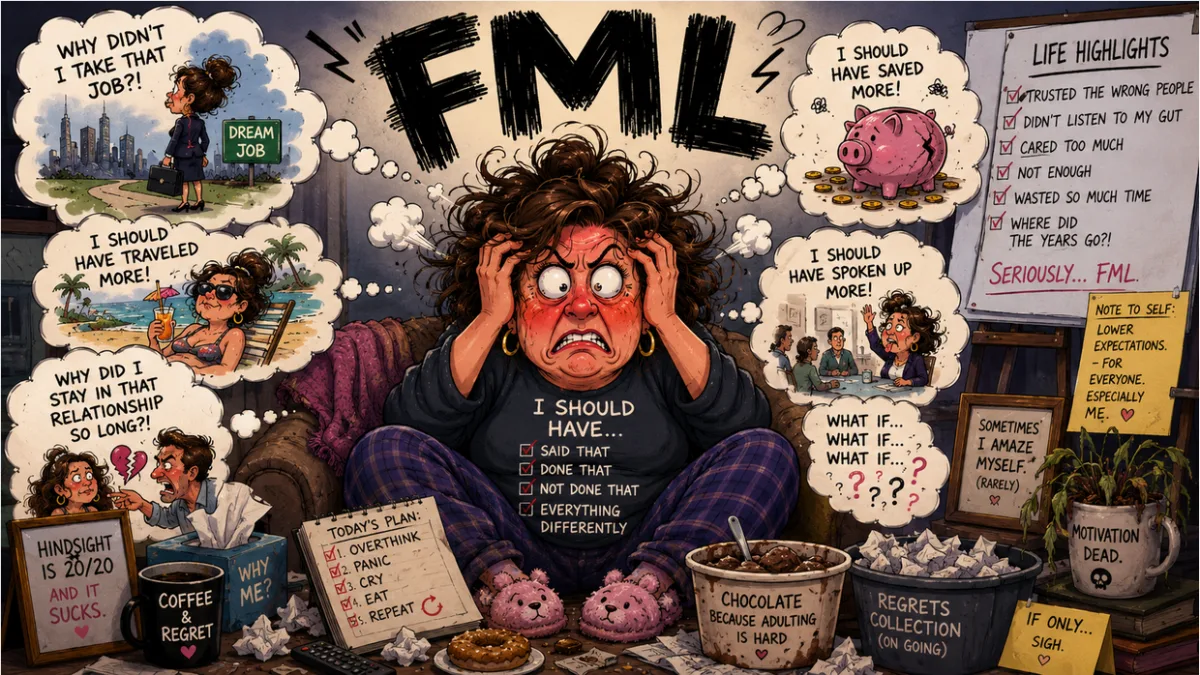
There’s a particular kind of exhausting that comes from someone who has decided, somewhere deep down, that the world is against them. Not because it’s true, but because it’s easier than the alternative. The alternative being: looking in the mirror without flinching.
This isn’t about people who are having a hard time. Hard times are real and everyone deserves grace. This is about the ones who have made hard times a permanent address, and who charge everyone around them rent for the privilege of staying nearby. You know who you are. The people around you definitely do.
The following is a field guide. Not to fix you, because that’s not how this works, but to name what everyone else is seeing clearly, maybe laugh at it a little, and if any of it lands closer to home than expected, to sit with that honestly.
- Every friendship that ended was the other person’s fault, and you have the evidence to prove it.
- You can describe your own suffering in real time while actively causing it.
- Compliments land on you as attacks in disguise.
- You call cruelty honesty, and then call honesty a personality.
- You have been going through something for so long it has become your permanent state of residence.
- Any room with good news in it will have less good news once you have spoken.
- Apologizing is not in your vocabulary, but cataloguing wrongs done to you goes back at least a decade.
- Every conversation eventually becomes about you, and you never notice the turn.
- You quietly undermine the people around you not from cruelty but from the fear that their confidence will expose your own emptiness.
- You will read all of this and forward it to someone else.
The tragedy isn’t that you’re difficult. It’s that you’re in pain you have never learned to look at directly, so it leaks sideways onto everyone in range. The comedy is that you are completely convinced you’re one of the good ones. Both things are true at the same time, and neither one is anyone else’s problem to solve. The only move the people around you have left is to stop standing in the spray and calling it loyalty.
The data behind being impossible to be around
Four charts. Zero flattering conclusions. Hover everything — the real editorial is in the tooltips.
Hours spent per week vs. productive outcome (%)
Each dot is an activity. Size indicates emotional energy consumed. Hover for the full picture.
Self-awareness score by situation (0 = none, 100 = functional adult)
Click a bar to expand. The gap between “reading about someone else” and “during an argument” is the whole diagnosis.
Personality radar: self-perception vs. observed reality
Purple is how she sees herself. Coral is what everyone in the room actually experiences. Hover each axis.
Grievance portfolio: age vs. emotional carrying cost
Each bubble is a grievance. Size = how often it gets brought up. X = years ago. Y = carrying cost. Hover for the incident report.
You already know something is wrong or you wouldn’t still be reading. That’s actually the hardest part, and you just did it without realizing. The following isn’t a kindness tour. It’s the shortest distance between where you are and somewhere better.
- Stop talking for one full day and just listen to what the people around you are actually saying. Not to respond. Not to find the angle where you’re the wronged party. Just listen like you paid for a ticket to their life and you’re there to watch.
- Write down the last five relationships that fell apart and find the one thing they all had in common. If you’re doing this honestly, it won’t take long.
- The next time you feel the urge to correct someone, undermine something, or add a “well actually,” close your mouth and ask yourself what you’re afraid of. Answer that question instead.
- Find one person you have wronged and apologize without a single “but” in the sentence. No context, no footnotes, no explanation of what they did first. Just the apology, standing alone, undefended.
- Get a therapist you haven’t already decided is wrong about you.
- When something good happens to someone near you, practice saying congratulations and meaning it for at least thirty seconds before the resentment shows up. Extend that window every week.
- Stop curating your own victimhood. Every time you catch yourself building a case against someone, ask whether you are collecting evidence or collecting excuses.
- Sit alone without your phone for twenty minutes and notice what feeling comes up. That feeling is the one running the show. It has been for years. It deserves your attention more than anyone around you does.
- Let one thing be someone else’s fault without telling anyone about it. Just absorb it, privately, and move on. Notice that you survived.
- Read number ten and resist the urge to send this list to someone you think needs it more. That impulse is the whole problem in a single reflex. You are the someone. You have always been the someone. And the genuinely good news, maybe the only good news in any of this, is that someone can change.
SEARCH FOR ANY ARTICLE BY KEYWORD
More results...