
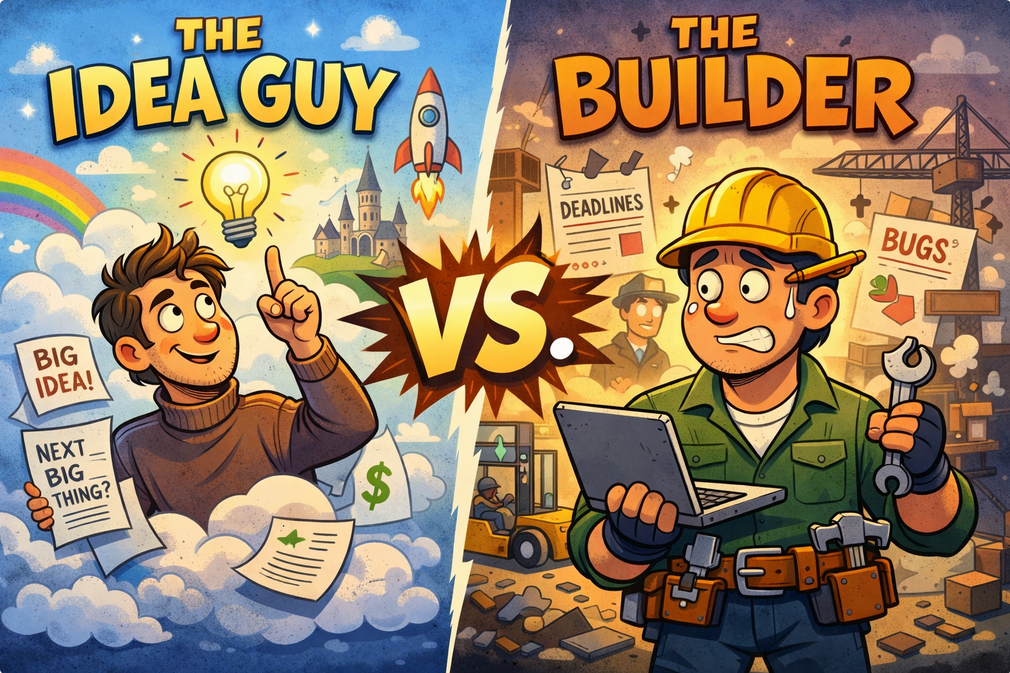
Can you have success with out a good idea?
Introduction: The Shower Principle
We have all been there. It’s 7:15 AM on a Tuesday. You are standing under hot water, half-awake, contemplating the profound mysteries of shampoo ingredients. Suddenly, lightning strikes your soapy cranium.
Eureka!
It’s brilliant. It’s revolutionary. It’s an app that connects lonely artisanal cheese makers with people who enjoy interpretive dance. It’s “Tinder for Turophiles.” You step out of the shower, shivering not just from the cold air, but from the sheer magnitude of your own genius. In that fleeting moment, the idea is perfect. It has no flaws, no overhead costs, no difficult HR meetings, and no bugs in the code. It exists in the platonic realm of pure potential.
You are convinced this idea is worth billions. You are practically already ordering the custom upholstery for your Gulfstream jet.
Fast forward six months. You have precisely zero dollars, a half-written business plan on a stained napkin, and you’ve alienated your cousin Darryl by asking him to “code the whole thing for free for 5% equity.”
Welcome to the eternal battleground: The Idea versus The Execution. It’s the oldest cage match in human history. On one side, we have the dazzling, sexy Vision. On the other, we have the grunt work, the logistics, the emails—the Execution.
Which one is worth more? Are they equal partners in the dance of reality? Or is one merely a parasite living off the other’s glory? Let’s deeply explore this toxic codependent relationship, because frankly, if you want your cheese-dance app to exist, you need to understand why ideas are cheap and execution is excruciatingly expensive.
Act I: The Cult of the Idea (Ooh, Shiny!)
Society loves the “Idea Guy.” We worship at the altar of the visionary. We love the story of Newton getting bonked by an apple, or Archimedes streaking through Syracuse shouting about buoyancy. We love these moments because they feel like magic. They suggest that success is just one good brainwave away.
Having an idea feels fantastic. It delivers a massive hit of dopamine to the brain. It’s intellectually intoxicating because an unexecuted idea is untainted by failure. It’s Schrodinger’s Cat, but instead of a dead feline, the box contains a billion-dollar company that definitely works.
We tend to assign immense value to the inception point. We think the person who said, “Hey, what if we put a man on the moon?” did 50% of the work.
They did not. They did approximately 0.00001% of the work.
To illustrate the perceived value versus actual value of ideas, let’s consult a highly scientific chart.
CHART A: The Idea Value Hierarchy
| The Idea Level | Examples | Actual Value ($) | Perceived Value by the Thinker |
| Level 1: The Stoner Thought | “Dude, what if dogs could talk, but only about politics?” | -$5.00 (cost of snacks) | “This will change philosophy forever.” |
| Level 2: The Minor Convenience | “A coffee cup that never spills.” | $0 (Already patented 50 times) | “I need to call Shark Tank.” |
| Level 3: The Genuine Insight | “A decentralized digital currency.” (Pre-Bitcoin) | Potential Billions | “Sounds neat, might post on a forum later.” |
| Level 4: The World Shifter | “Let’s conquer most of known Europe.” (Napoleon’s shower thought) | Incalculable | “Tuesday’s looking busy.” |
The problem isn’t having ideas; humans are idea-generating machines. Our brains naturally synthesize information into new concepts. The problem is the massive, gaping delusion that having the idea constitutes doing something.
If ideas were currency, the guy holding up the bar at 2 AM talking about his screenplay involving cyborg ninjas would be Jeff Bezos.
Act II: Execution, The Unsexy Beast of Burden
If the Idea is a sleek Ferrari sitting on a showroom floor, Execution is the mechanic covered in grease, swearing at a stripped bolt at 3 AM, trying to make the engine actually turn over.
Execution is everything that happens after you say “Eureka.” It is the relentless, boring, soul-crushing grind of dragging a metaphysical concept into the physical world. It is vastly harder, more expensive, and less rewarding in the short term than having an idea.
Why is execution worth so much more? Because of friction. The real world hates your idea. The real world has regulations, physics, competitors, supply chain shortages, and human beings who don’t show up for work on Mondays.
Let’s look at some modern titans to understand this.
Case Study: Elon Musk vs. The Guy on Reddit
Go to any technology subreddit and you will find thousands of people with “better ideas” than Elon Musk. “Why doesn’t he just make a car that runs on saltwater?” they type furiously.
Elon Musk’s value isn’t that he thought, “Electric cars should be cool” or “Let’s go to Mars.” Sci-fi writers have had those ideas for a century. Musk’s value lies in his terrifying, almost pathological capacity for execution.1
The “idea” of Tesla is simple. The execution involves building massive sterile factories (Gigafactories), inventing new battery chemistries, navigating international trade laws, programming autopilot AI, and convincing people to pre-order a Cybertruck that looks like a low-polygon video game render from 1996.
The idea is one sentence. The execution is millions of man-hours and billions of dollars burnt on the altar of logistics.
Case Study: Jeff Bezos and The “Everything Store”
Jeff Bezos didn’t invent selling things. He didn’t invent the internet. His idea was, essentially, “Sears catalog, but online.”
If he had stopped there, he’d be a footnote. The value of Amazon wasn’t the website; it was the execution of the most complex logistics network in human history. It’s the warehouses, the robots, the Prime delivery jets, and the ruthlessly efficient supply chain that can get a replacement spatula to your door in four hours.
The idea is the menu; execution is cooking the meal for 300 million people simultaneously without giving anyone food poisoning.
Act III: The Historical Smackdown and The Multiplier Effect
To really understand the relationship, we need to look at history. History is littered with visionaries who couldn’t execute, and executors who had no vision.
The Power of “Team Execution”
The prompt mentioned figures like Napoleon or Joan of Arc. Let’s utilize them.
Joan of Arc had an incredible Vision (Idea): “God wants France to kick out the English.” It was a powerful, unifying brand message. But a teenage peasant girl with a banner doesn’t win the Hundred Years’ War alone. The Execution required convincing seasoned generals to follow her, raising morale among the troops, and the actual tactical maneuvering of armies. The Idea provided the spark; the army provided the fuel.
Napoleon was perhaps the ultimate marriage of the two. He had grand strategic Ideas about rewriting the map of Europe. But his true genius was in execution: logistical reforms, the Corps d’Armée system, artillery standardization, and the ability to move massive amounts of men faster than anyone else.2
As the prompt rightly noted, “anything beyond vision is the execution.” Building a team is execution. Convincing people to die for your idea (or just work late on a Friday for it) is the hardest execution skill of all. If you have a great idea but cannot articulate it, inspire others, hire the right people, and manage them, your idea will die alone in your basement.
The “Pet Rock” Anomaly: Execution Overcoming a Terrible Idea
Sometimes, execution is so flawless it doesn’t matter that the idea is objectively stupid.
In the 1970s, Gary Dahl had an idea: sell rocks as pets.3
Idea Value: Zero. It’s a rock. They are outside on the ground for free.
Execution Value: Genius.
Dahl didn’t sell rocks; he executed a masterclass in marketing and packaging. The rocks came in a custom cardboard carrier with breathing holes and a witty 32-page instruction manual on caring for the rock. It was a joke perfectly executed as a product. He became a millionaire.
The Pet Rock proves that A+ execution of a C- idea will always beat C- execution of an A+ idea.
The Dangerous Dependence
So, are they equal? No. But can you have one without the other?
Idea without Execution = A Hallucination.
This is the “wantrepreneur.” They have notebooks full of schemes but have never registered a domain name. They are spiritually fulfilling, perhaps, but practically useless.
Execution without Idea = A Treadmill to Nowhere.
This is bureaucracy in its purest form. It’s working incredibly hard, following all the rules, optimizing every process, but having absolutely no clue why you are doing it or where you are going. It’s efficiently rearranging deck chairs on the Titanic.
You need the North Star (Idea) to know where to sail, but you need the crew to row the damn boat (Execution).
Conclusion: The Final Calculus
We need to stop thinking of Idea and Execution as addition (Idea + Execution = Success). It doesn’t work like that.
It is multiplication.
Idea (Scale of 1-10) x Execution (Scale of 1-10) = Reality Value
If your idea is a brilliant 10 (Tinder for Cheese Lovers), but your execution is a pathetic 1 (you and cousin Darryl fighting over equity), your result is 10.
If your idea is a mediocre 4 (Selling books online), but your execution is a relentless Bezos-level 10, your result is 40.
If you have no idea (0), no amount of execution matters. If you have zero execution, the greatest idea in the universe is worth exactly zero.
So, which is worth more?
In a vacuum, the Idea is prettier. It’s the poets and the dreamers. But in the cold, hard marketplace of reality, Execution is the currency that actually spends.
Execution is worth more because it is scarcer. It is harder to find someone willing to grind for ten years than it is to find someone with a “cool thought” in the shower.
The next time you have a brilliant idea, enjoy the dopamine hit for about five minutes. Then, grab a shovel. The dirt isn’t going to move itself.
Somewhere right now, a person is leaning back in a chair, staring heroically into the middle distance, thinking:
“I have an idea.”
And somewhere else, another person is hunched over a laptop at 1:47 a.m., wrestling with a spreadsheet, muttering:
“I hate this idea, whoever had it, and everything it stands for.”
These two people are natural enemies. Like cats and vacuum cleaners. Like project managers and the phrase “should be quick.” Like the idea guy and the person who has to actually do it.
So which is worth more: the idea or the execution?
The annoying answer is: you need both.
The useful answer is: they’re not equal in most real-world situations—and the “value” shifts depending on context.
Let’s break this down with logic, examples, and a few historical case studies (because nothing says “business lesson” like a Roman emperor getting stabbed by his friends).
First: Define the Two (Before They Start a Fight)
An idea
- A concept, insight, or vision about what should exist
- Often cheap to generate
- Often vague (“It’s like Uber… but for dogs.”)
- Can be brilliant and still useless if it can’t be built, delivered, or adopted
Execution
- The process of turning the idea into reality
- Involves planning, building, iterating, selling, distributing, managing
- Expensive, time-consuming, and usually mildly humiliating
- Includes recruiting and leading people—because most meaningful execution is team execution
Here’s the simplest truth:
An idea without execution is a daydream.
Execution without an idea is busywork.
But only one of those tends to get a product shipped.
A Quick (Painfully Honest) Value Chart
Below is a rough “value weight” that applies in a lot of real scenarios:
| Scenario | Idea Value | Execution Value | Why |
|---|---|---|---|
| Common business concept (already known) | 10% | 90% | Everyone has the idea; few can ship it well |
| Novel breakthrough (new science/tech) | 50% | 50% | The insight matters, but it still must be developed |
| High competition market | 5% | 95% | Speed, operations, marketing, and distribution win |
| Creative work (book/film/game) | 30% | 70% | Premise matters; craft and delivery matter more |
| War/politics/empires | 20% | 80% | Strategy matters; logistics and leadership decide outcomes |
This isn’t “official math.” It’s “how reality tends to behave after it stops laughing at your PowerPoint.”
The Big Misunderstanding: People Confuse “Idea” With “Vision”
When people say “the idea matters most,” they often mean vision:
- a clear direction
- a strong reason it should exist
- a narrative people can rally around
- a coherent set of priorities
Vision is not just an idea. Vision is an idea that has already done some push-ups.
And here’s the kicker:
Vision is part of execution.
Because once you’re leading other humans, the job becomes: clarity, alignment, motivation, tradeoffs, and momentum.
A “visionary” who can’t execute is basically a poet with a deadline phobia.
The Ugly Secret: Ideas Are Abundant. Execution Is Scarce.
Ideas feel rare because they feel like lightning bolts. Execution feels common because it looks like “work.”
But if you’ve ever tried to finish something big, you know:
- Execution requires consistency when you’re bored
- Decisions when you’re uncertain
- Persistence when you’re getting ignored
- Humility when your first version stinks
- Leadership when the team disagrees
Ideas are exciting. Execution is character.
This is why so many people have “million-dollar ideas” and exactly zero million-dollar outcomes.
Because the world doesn’t pay for “potential.”
It pays for delivered value.
Case Study #1: The Roman Empire — Vision Meets Administration (and Also Stabbing)
Rome didn’t become Rome because someone stood up and said, “Hear me out: roads.”
It became Rome because it combined:
- strategic vision (expansion, integration, law)
- systems execution (roads, legions, taxation, governance, logistics)
The Romans were basically the original “operations people,” except their quarterly business reviews were fought with spears.
A useful takeaway:
Empires aren’t built on good ideas. They’re built on repeatable systems.
Plenty of civilizations had big dreams. Rome had:
- standardized methods
- disciplined organization
- incentives
- enforcement
And yes, they also had corruption and chaos. But even their chaos was organized chaos.
Conclusion: Rome shows that once an idea scales, execution becomes governance. And governance is execution wearing a crown.
Case Study #2: Napoleon — Genius Strategy, Impossible Logistics
Napoleon is a great example of the execution paradox:
- He had visionary strategy.
- He had tactical brilliance.
- He could inspire and command.
But history also reminds us:
Even great leadership can be humbled by logistics.
Campaigns don’t fail because someone lacked a “big idea.”
They fail because supply lines, weather, timing, morale, and local realities don’t care about your brilliance.
Execution isn’t just doing the thing. It’s doing the thing in the real world, where the real world keeps moving your goalposts.
Conclusion: Strategy matters, but execution is where reality votes—and reality always votes.
Case Study #3: Joan of Arc — The Power of an Idea as a Social Engine
Joan of Arc is fascinating because she demonstrates something many business people forget:
Sometimes the “idea” isn’t a product idea—it’s a belief that organizes people.
She became a symbol that galvanized morale and identity. That’s not manufacturing. That’s not logistics. That’s meaning.
And meaning can be an execution multiplier because:
- it aligns people quickly
- it increases sacrifice and courage
- it reduces internal conflict (“we’re doing this for that”)
A strong idea can function like fuel. It doesn’t drive the car by itself. But without fuel, you’re just sitting in a nice vehicle making engine noises with your mouth.
Conclusion: Ideas can be disproportionately powerful when they mobilize humans at scale.
Case Study #4: Bad Ideas, Horrifically Executed (Yes, This Happens)
History also gives us examples where the “idea” was rotten, and execution made it catastrophically real.
The point here isn’t to linger on darkness—it’s to acknowledge a hard truth:
Execution is morally neutral. It amplifies whatever it serves.
A terrible idea with strong execution becomes a disaster.
A great idea with weak execution becomes a tragedy of wasted potential.
Conclusion: Don’t worship execution blindly. Execution is a force multiplier. Choose what it multiplies.
Modern Business: Bezos, Musk, and the “It’s Not Just the Idea” Reality
Jeff Bezos (Amazon)
Amazon wasn’t “books online” forever. That idea alone isn’t the empire.
Amazon is a case study in:
- logistics
- customer obsession
- infrastructure investment
- relentless iteration
- long-term execution despite short-term pain
Lots of people had e-commerce ideas. Amazon built the machine.
Elon Musk (Tesla/SpaceX)
Love him or hate him, Musk’s track record illustrates a specific blend:
- bold vision that attracts talent, capital, attention
- unusually high tolerance for risk and criticism
- intense execution culture (deadlines, engineering focus)
- ability to recruit teams capable of doing the impossible parts
He’s not “just an idea guy.” He’s a high-pressure execution environment with a megaphone.
Conclusion: These figures show that “vision” is often inseparable from execution, because rallying talent and capital is execution.
Why People Overvalue Ideas (Psychologically)
People defend ideas because ideas feel like identity:
- “If my idea is valuable, I am valuable.”
- “If execution matters more, then I might have to do hard things.”
- “If execution matters more, then my procrastination has a face.”
Also: ideas are fun. Execution contains phrases like:
- “quality assurance”
- “compliance”
- “refund policy”
- “edge cases”
Ideas are fireworks. Execution is plumbing.
And society has always been weirdly ungrateful to plumbers until something leaks.
The “Can You Have One Without the Other?” Question
Can you have an idea without execution?
Yes. It’s called:
- a thought
- a concept
- a pitch
- a napkin sketch
- a startup that raised a seed round and then disappeared quietly into the fog
Can you have execution without an idea?
Yes. It’s called:
- “we’re busy”
- “we shipped something nobody wanted”
- “we optimized the wrong metric like absolute champions”
Execution without an idea is motion without direction. That’s not progress. That’s cardio.
A reality-based conclusion:
- You can possess either one alone.
- You cannot create outcomes reliably without both.
So Which Is Worth More?
Here’s the real answer:
Ideas are valuable when they are:
- rare (non-obvious)
- timely
- clearly defined
- tied to a real need
- defensible (hard to copy or deeply insightful)
Execution is valuable when it is:
- consistent
- fast enough
- high-quality
- adaptable (handles feedback)
- scalable (works beyond heroic effort)
- aligned (team knows what matters)
But if you force me to choose in most real markets:
Execution is usually worth more.
Because:
- Most ideas have substitutes
- Most markets reward delivery, not dreaming
- The “same idea” done better wins
However…
The best outcomes come from the right pairing:
- a compelling idea/vision
- executed by people who can actually ship and iterate
The Balanced Take: A Practical “Reality Recipe”
If you want the sweet spot, aim for this:
- Start with a clear idea
Not “an app,” but a real outcome and audience. - Translate it into a testable plan
If it can’t be tested, it’s not ready. - Execute a small version fast
Not perfect. Real. - Let reality adjust your idea
The market is the co-author. - Scale what works and kill what doesn’t
Execution includes ruthless prioritization.
And here’s the punchline nobody likes:
Execution is not a phase. It’s the whole game.
Even “having the idea” is part of execution once you treat it seriously.
Final Conclusion (The One You Can Tape to Your Monitor)
- Ideas start the fire.
- Execution keeps it burning.
- Teams turn it into a furnace.
- Systems turn it into an engine.
If you want to win in the real world, don’t choose “idea” or “execution.”
Choose:
- a clear vision
- disciplined follow-through
- a team that can build
- the humility to iterate
Because the world doesn’t reward the person who says, “We should build a bridge.”
It rewards the person who builds it…
and makes sure it doesn’t collapse the first time someone drives a truck across it.
Perfect — here are two clean add-on sections you can drop directly at the end of the article. They keep the same humorous, slightly brutal tone and reinforce the main argument without rehashing it.
Top 10: “Idea Guy” vs. “Builder” (A Completely Scientific Comparison)
Disclaimer: If this list makes you uncomfortable, congratulations — it’s working.
1. The Opening Line
- Idea Guy: “Okay, so hear me out…”
- Builder: “Here’s what shipped last week.”
2. Relationship With Reality
- Idea Guy: Lives in the future, refuses to visit the present.
- Builder: Lives in the present, occasionally visits the future with a helmet on.
3. Favorite Medium
- Idea Guy: Whiteboards, napkins, vibes.
- Builder: Checklists, tickets, commits, invoices.
4. Reaction to Problems
- Idea Guy: “That shouldn’t be hard.”
- Builder: Quietly adds three more weeks to the timeline and cancels a weekend.
5. Risk Tolerance
- Idea Guy: Loves risk — as long as someone else takes it.
- Builder: Takes risk, mitigates risk, documents risk, still loses sleep.
6. Relationship With Feedback
- Idea Guy: “They just don’t get the idea.”
- Builder: “Okay, users hate this part. Kill it.”
7. Meetings
- Idea Guy: Wants more meetings to “align.”
- Builder: Wants fewer meetings so alignment can actually happen.
8. Ownership
- Idea Guy: “We should do this.”
- Builder: “I’ll own it.”
9. Shipping Philosophy
- Idea Guy: “Let’s wait until it’s perfect.”
- Builder: “Let’s ship it ugly and fix it fast.”
10. Legacy
- Idea Guy: “I had that idea years ago.”
- Builder: “Here’s the thing that exists.”
Final score:
Ideas are plentiful. Builders are employable.
The Brutally Honest Self-Check Quiz
Are You an Idea Person, a Builder, or a Dangerous Hybrid?
Answer quickly. No overthinking. That would already be a data point.
1. When someone criticizes your idea, your first reaction is:
- A) Defend the idea passionately
- B) Ask what specifically didn’t work
- C) Secretly rewrite the idea in your head and tell no one
2. You’re most energized by:
- A) Brainstorming sessions
- B) Finishing something
- C) Starting something new before finishing the last thing
3. Your relationship with deadlines is best described as:
- A) “They’re flexible, spiritually”
- B) “They are law”
- C) “I respect them but often accidentally disrespect them”
4. When a project fails, you tend to say:
- A) “The vision was right, the execution was wrong”
- B) “We learned something — what do we fix?”
- C) “Next project will be better” (immediately starts next project)
5. Your browser currently has:
- A) Open docs with names like Startup Ideas v7 Final Final
- B) Tabs related to bugs, logs, invoices, or deployment
- C) Both, and you are tired
Results (Loosely Interpreted, Like All Personality Tests)
- Mostly A’s — The Idea Guy™
You generate sparks. That’s good. Now learn how to build a fireplace so the house doesn’t burn down or freeze. - Mostly B’s — The Builder
You make things real. You are under-celebrated, over-relied upon, and absolutely essential. Guard your time and choose ideas carefully. - Mostly C’s — The Hybrid (Most Dangerous in a Good Way)
You have ideas and finish things… sometimes. With structure and discipline, you’re the person who actually changes outcomes.
One Final Thought (Because You Scrolled This Far)
The world is not short on ideas.
It is short on:
- people who follow through
- people who adapt instead of defend
- people who can lead others through uncertainty
If you want your ideas to matter, don’t just protect them.
Build them. Break them. Fix them. Ship them.
That’s how ideas stop being opinions and start becoming reality.