
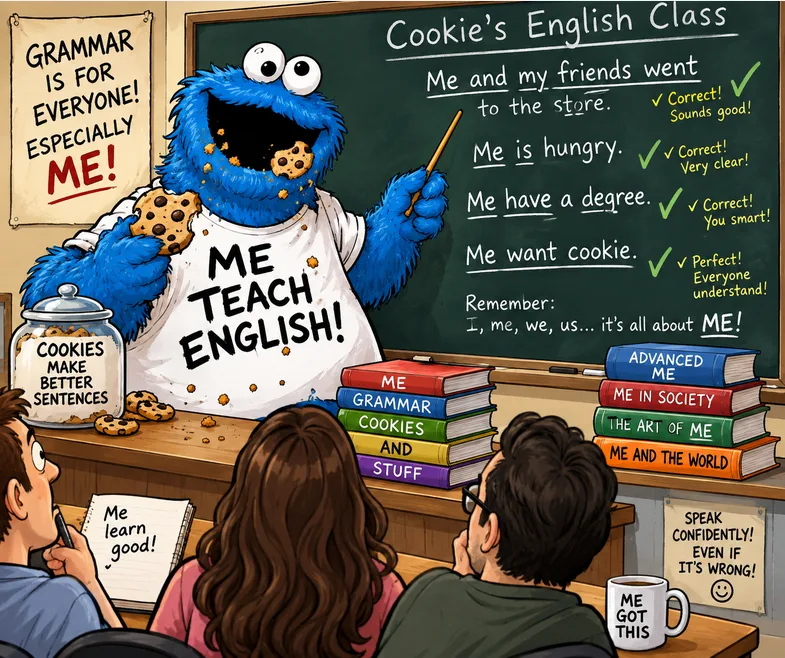
There is a very specific species of person who opens every sentence with “Me and my [girlfriend/dog/business partner/therapist]…” and somehow, against all odds, this is the same person who will casually mention they’re “rereading Infinite Jest for fun.” The same person who owns a tote bag from an independent bookstore in a city they don’t live in. The same person whose LinkedIn headline includes the word “storyteller.”
And yet. Me and my girlfriend went to the store. Every time. Like clockwork. Like the grammar rules they learned in fourth grade got flagged as “content they’d already engaged with” and swiped away.
Here’s the beautiful irony: these are not people who don’t know better. These are people who definitely know better, who would absolutely correct someone else’s “your” vs. “you’re” in a group chat without being asked, who peaked at a spelling bee in 2009 — and who will still, without fail, put themselves grammatically first and objectively wrong in the same breath. “Me and my girlfriend.” Me. First. Wrong. Confident.
It’s not ignorance. It’s vibes-based grammar. They’ve done the mental math — “my girlfriend and I” sounds like a permission slip, “me and my girlfriend” sounds like a Netflix documentary about to happen — and vibes won. Every single time.
And the tragedy is it’s spreading. It’s not a regional quirk anymore, it’s not a class marker, it’s a lifestyle brand. Podcast bros say it. Substack essayists who write 4,000 words about “attention” say it. People say it who have literally, unironically, used the word “gaslighting” correctly in a sentence — and then immediately said “me and my roommate got gaslit by our landlord.” The self-awareness has a two-word blind spot and it’s the first two words of the sentence.
Somewhere, a 9th grade English teacher is still alive, still teaching, and has no idea her life’s work is being casually dismantled by adults who own French presses.
Do You Have Main-Character “Me” Syndrome?
Take this highly scientific grammar personality test. By “highly scientific,” we mean we just made it up.
Me and My Educated Friends: The Grammar Crime Nobody Seems Embarrassed About Anymore
There is a linguistic phenomenon spreading across America. It does not discriminate by age, income, education, profession, or number of unread books prominently displayed behind you during Zoom calls. You hear it at restaurants. You hear it at work. You hear it on podcasts. You hear it from people who describe themselves as “avid readers.” And increasingly, you hear it from people with actual college degrees.
“Me and my girlfriend went to the store.” Ah, yes. Me went to the store. Apparently Cookie Monster is teaching English now.
The Five-Second Test That Somehow Became Too Difficult
There is an incredibly complicated linguistic technique for determining whether you should say “My girlfriend and I went to the store” or “Me and my girlfriend went to the store.” Ready? Remove the other person.
“My girlfriend and I went to the store” becomes “I went to the store.” Perfectly normal. “Me and my girlfriend went to the store” becomes “Me went to the store.” Congratulations. You are now a caveman shopping for paper towels. ME GO STORE. ME BUY MILK. ME HAVE MASTER’S DEGREE. And yet somehow this tiny grammatical speed bump has defeated an astonishing number of otherwise functional adults.
The Best Part Is How Confidently They Do It
Nobody whispers it. Nobody catches themselves halfway through. Nobody says, “Me and—sorry—Jennifer and I…” No. They barrel straight through. “Me and Brad were discussing macroeconomics…” Were you? Because suddenly I’m considerably more interested in Brad’s position.
“Me and my colleagues have been analyzing the geopolitical implications…” Fantastic. Perhaps after the geopolitical implications, me can analyze pronouns. There is something uniquely entertaining about hearing a person spend fifteen minutes discussing monetary policy, artificial intelligence, international relations, or the decline of Western civilization before casually dropping “Me and Steve were talking about that.” You were doing so well.
But They’re Well Read!
This is what makes the whole thing beautiful. These aren’t necessarily people who don’t know any better. Some of them have bookshelves that require structural reinforcement. They’ve read Dostoevsky. They’ve read Orwell. They’ve read books about people who have read Dostoevsky and Orwell. They casually use words like “nuance,” “paradigm,” “epistemological,” and “problematic.”
Then, without warning, “Me and Sarah watched a documentary last night.” Outstanding. Nothing complements The Brothers Karamazov quite like the sentence construction of a four-year-old demanding Goldfish crackers. You can almost picture the résumé: master’s degree, published author, lifelong learner, voracious reader, keynote speaker, thought leader. Me also go Costco on Saturday.
Perhaps “I” Has Become Too Formal
Maybe that’s the problem. Maybe “I” simply sounds suspiciously proper now. “Daniel and I attended the conference.” Whoa there, Professor Oxford. Put down the monocle. Nobody said this was Buckingham Palace.
Apparently we’re supposed to loosen things up and say, “Me and Dan went.” Much better. Maybe next year we’ll streamline things further: “Me and Dan go thing.” By 2035: “Me Dan conference.” Language evolves!
Ah Yes, the “Language Evolves” Defense
Whenever somebody points out grammar, eventually a linguistic freedom fighter arrives to announce that “language evolves.” Correct. It does. That doesn’t mean every grammatical face-plant automatically becomes sophisticated linguistic evolution.
Language evolving gave us useful new words, changed pronunciations, new idioms, slang, and entirely new ways of communicating. That’s how living languages work. But sometimes language evolves, and sometimes me just don’t talk good. Both things can be true.
Calling every grammatical mistake “language evolution” is like backing your car into a mailbox and announcing that you’re experimenting with alternative parking. Technically, something changed. That doesn’t necessarily mean civilization advanced.
The Reverse Crime
Of course, there’s an equally entertaining group on the opposite side. These people learned somewhere around sixth grade that saying “Jennifer and I” sounds sophisticated, so they use it everywhere. “My boss gave the assignment to Jennifer and I.” Take Jennifer away and you get, “My boss gave the assignment to I.” Excellent. We have overcorrected so violently that the ambulance has flipped over.
These people don’t understand the rule either. They’ve simply discovered that “and I” sounds expensive, so they sprinkle it onto sentences like freshly grated Parmesan. “Here is a photo of Susan and I.” “This opportunity was given to Michael and I.” “Please contact Rebecca or I.” Somewhere, an English teacher quietly closes the blinds.
This is arguably even more impressive because you’ve managed to take the correct grammatical rule, misunderstand it completely, and then confidently deploy the incorrect version because you believe it makes you sound educated. That’s not ignorance. That’s premium ignorance with leather seats.
The Intellectual Version Is Particularly Magnificent
There is a special category reserved for people who combine questionable grammar with an extremely high opinion of their own intellect. You know the type. Every conversation is a TED Talk nobody purchased tickets for. They don’t have opinions; they have perspectives. They don’t disagree with you; they find your premise intellectually unserious. They don’t read books; they “engage with literature.”
They’ll explain that your argument lacks nuance, that society has failed to appreciate the complexity of the issue, and that most people simply haven’t examined the underlying philosophical framework. Then they’ll finish with, “That’s what me and my wife have been saying for years.” And there it is: the verbal banana peel. Twenty minutes climbing the mountain of intellectual superiority, only to step directly onto ME AND MY WIFE and tumble all the way back down.
The WTFYI Pronoun Survival Guide
Fortunately, WTFYI is here to provide an advanced linguistic system normally available only to professors, editors, professional writers, and children who paid attention for approximately eleven minutes in elementary school. Remove the other person.
Would you say “I went to the store”? Then say “Jennifer and I went to the store.” Would you say “He gave the tickets to me”? Then say “He gave the tickets to Jennifer and me.” That’s basically it.
You do not need a degree. You do not need Grammarly. You do not need artificial intelligence. You don’t even need to know what the terms subjective pronoun and objective pronoun mean. Just temporarily eliminate Jennifer. Jennifer understands. She has sacrificed herself for grammar.
Me Think We Done Here
Nobody expects everyone to speak perfect textbook English every second of every day. People talk casually. People use slang. People stumble over words. People change sentences halfway through. That’s normal human speech.
But there is something undeniably funny about watching “me and…” become increasingly common among people who simultaneously take enormous pride in being articulate, educated, sophisticated communicators, especially when the fix requires approximately three seconds of thought.
So the next time you’re preparing to announce, “Me and Jennifer went…,” perform the Jennifer Test. Remove Jennifer. “Me went…” If you suddenly sound like you should be holding a wooden club and pointing excitedly at fire, congratulations: you found the problem.
Put Jennifer back. “Jennifer and I went…” Look at that. Civilization restored. Jennifer saved. Pronouns functioning normally. And me couldn’t be prouder of you.
SEARCH FOR ANY ARTICLE BY KEYWORD
More results...