
The Great Offense-a-Thon: A Roast of the Perpetually Peeved

Hey there…
- Are You Part of the Outrage Olympics?
- Triggered? Your Childhood Called, It Wants Its Feelings Back.
- Offended? Bless Your Heart.
Let’s be real, folks. In an age where even a misplaced comma can launch a thousand ships of fury, it’s time to talk about the chronically offended. You know the type. Their natural habitat is the comment section, their national anthem is a sigh of exasperated indignation, and their favorite hobby is finding new ways to feel personally victimized by a gently worded suggestion.
We’ve all encountered them: the person who turns a casual joke into a federal case, the one who takes “no sugar, please” as a personal assault on their life choices, or the individual who interprets a differing opinion as a declaration of war. It’s an exhausting performance, really. And frankly, it’s time we pulled back the curtain on this particular brand of emotional gymnastics.
From Play-Doh to Perpetual Outrage: How it happens.
So, where does this exquisite sensitivity come from? While some might blame the internet (and honestly, it’s a co-conspirator), the roots often run deeper. We’re talking about the early days, folks. The formative years.
Imagine little Timmy. Every time Timmy cried, he got a cookie. Every time Timmy was upset, the world stopped. His parents, bless their cotton socks, thought they were fostering emotional intelligence. What they actually created was a tiny tyrant who learned that expressing distress (or even manufactured distress) was a reliable way to manipulate his environment. Fast forward a few decades, and Timmy is now “Tim,” meticulously scanning his social media feed for anything that could possibly be construed as a slight, ready to deploy a digital tantrum faster than you can say “safe space.”
Then there’s Brenda. Brenda’s parents were “free-range.” Which, in their case, meant they didn’t really pay attention unless Brenda was doing something really disruptive. Brenda learned that the only way to get noticed, to feel valued, was to create a scene. Today, Brenda is an adult who believes that if she’s not loudly protesting something, anything, she simply doesn’t exist. Her outrage isn’t about the issue; it’s about the spotlight.
The truth is, for many who are easily offended, it’s less about the “offense” itself and more about an ingrained pattern of seeking validation, control, or attention. It’s a deeply rooted emotional architecture built on perceived fragility, rather than genuine harm.
Everyday Offense: A Tale of Two People
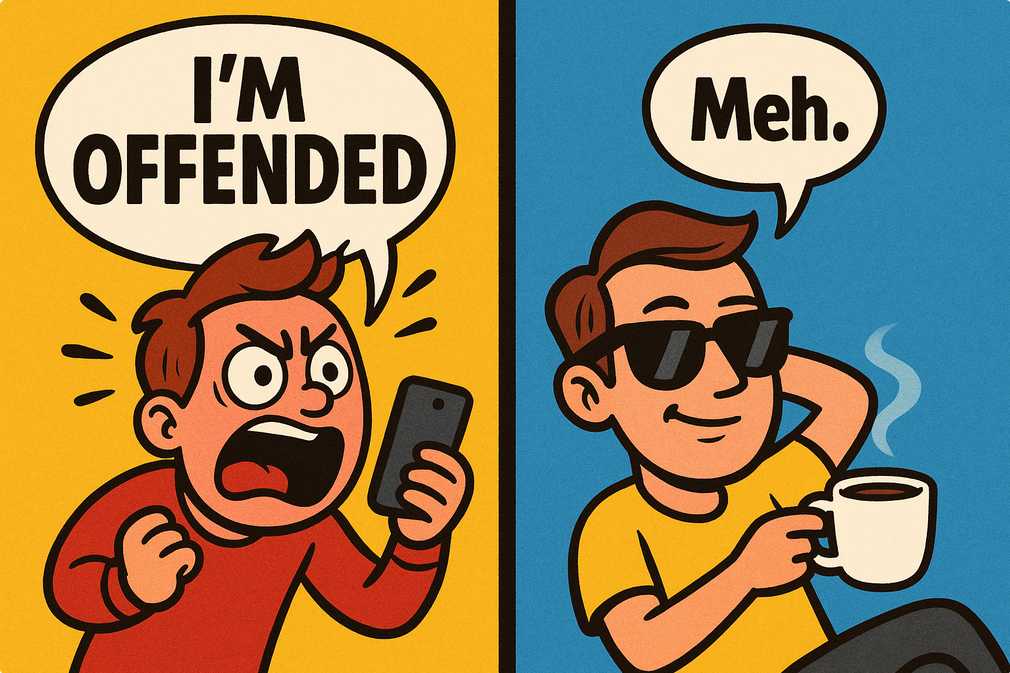
Let’s illustrate with some highly scientific examples:
Scenario 1: The Coffee Shop Catastrophe
- The Easily Offended: Sarah orders a latte. The barista, in a rush, accidentally gives her a cappuccino. Sarah’s eyes narrow. “Excuse me!” she huffs, “I specifically asked for a latte. Do you know how offensive it is to assume what I want? This is a complete disregard for my preferences and frankly, an insult to my intelligence!” She demands a refund, a free replacement, and probably writes a scathing Yelp review about the “disrespectful coffee establishment.”
- The Normal, Laid-Back Person: Mark orders a latte. The barista gives him a cappuccino. Mark glances at it, shrugs, and thinks, “Eh, close enough. It’s still coffee.” He might politely say, “Oh, I actually asked for a latte, but this is fine too!” Or, more likely, he just drinks the cappuccino and moves on with his day, realizing that minor mishaps happen and it’s not the end of the world.
Scenario 2: The Innocent Office Joke
- The Easily Offended: David tells a lighthearted joke about Monday mornings. It’s a classic, harmless “I hate Mondays” type of joke. Rebecca, who identifies as a “morning person” and also someone who has a deep, personal connection to Garfield, suddenly feels a surge of indignation. “That’s incredibly insensitive, David,” she declares, “Some of us actually enjoy Mondays. Your generalization is harmful and creates a hostile work environment for morning enthusiasts!” She then files a formal complaint with HR.
- The Normal, Laid-Back Person: David tells the same joke. Mike, a morning person who also enjoys Garfield, chuckles. “Tell me about it!” he says, or perhaps, “Speak for yourself, I love Mondays!” and everyone shares a laugh. The world continues to spin.
See the difference? One person interprets everything as a personal slight, while the other understands that most of life is not, in fact, out to get them.
Top 10 Things People Who Are Easily Offended Are Offended By (Probably)
- The weather: Too hot, too cold, too sunny (UV rays!), too cloudy (depressing!).
- Unsolicited advice: Even if it’s “Don’t touch the hot stove.”
- Solicited advice: “You think you know better than me?!”
- Opinions that aren’t theirs: Clearly a direct attack on their intellectual superiority.
- Silence: “Are you mad at me? What are you thinking? Why aren’t you speaking?”
- Being told “Calm down”: The absolute ultimate offense, guaranteed to escalate the situation by 1000%.
- Humor they don’t understand: “I don’t get it, therefore it must be offensive.”
- The existence of different cultures/beliefs: “Their way isn’t my way, so it’s wrong!”
- Constructive criticism: Often confused with a character assassination attempt.
- The fact that this list exists: (they’re probably already drafting their nasty email).
Level Up Your Emotional Game: From Fragile to Fearless
Alright, enough roasting. While it’s fun to poke fun, there’s a serious side to all this. Constantly being offended is genuinely exhausting, both for the person experiencing it and for everyone around them. If you find yourself frequently triggered, or you know someone who does, here are some helpful tips to build a thicker skin and a more peaceful existence:
- Self-Awareness is Your Superpower: Start by observing your reactions. When do you feel offended? What triggers it? Is it really about the external event, or is there an internal narrative playing? Journaling can be incredibly insightful here.
- Challenge Your Assumptions: Most people aren’t actively trying to offend you. They’re often just living their lives. Before you react, ask yourself: “Is there another interpretation of this situation?” “Am I projecting my own insecurities onto this?”
- Practice Empathy (Gasp!): Try to see things from another person’s perspective. What might have been their intention? Even if their delivery was clumsy, was their core message malicious?
- Develop a “So What?” Muscle: For minor offenses, practice the art of letting go. Ask yourself, “Will this matter in an hour? A day? A week?” If the answer is no, then a simple “So what?” can save you a lot of emotional energy.
- Boundary Setting, Not Boundary Building: Instead of building walls of offense, learn to set healthy boundaries. “I’m not comfortable discussing X topic” is far more effective and less confrontational than an outrage spiral.
- Seek Professional Guidance: If you find yourself consistently overwhelmed by feelings of offense, or if past experiences make you unusually sensitive, consider talking to a therapist or counselor. They can help you unpack those deeper patterns and develop healthier coping mechanisms. Resources like Psychology Today’s “Find a Therapist” tool can be a great starting point.
- Learn Active Listening & Communication Skills: Often, feeling offended stems from misunderstandings. Improving your ability to truly listen and clearly articulate your needs can prevent many “offenses” from even happening. Websites like MindTools offer excellent resources on active listening.
- Cultivate a Sense of Humor: Laughter is truly the best medicine. Learning to laugh at yourself, at minor inconveniences, and at the absurdity of life can be a game-changer.
Ultimately, the goal isn’t to become an emotionless robot. It’s about developing resilience, understanding your own emotional landscape, and choosing your battles wisely. The world isn’t always going to cater to your every feeling, and that’s okay. Learning to navigate it with grace, a sense of humor, and a little less outrage will make you, and everyone around you, a whole lot happier.
The “Thick Skin” Library: Top 10 Books for the Perpetually Pierced
If you’re tired of being a human raw nerve—or you’re tired of walking on eggshells around one—here is the definitive reading list to toughen up and talk sense.
The ultimate wake-up call for people who think every minor inconvenience is a tragedy. A masterclass in choosing what’s actually worth your energy.
Grab it on AmazonA fascinating look at how our “right” to be angry is actually a choice. Perfect for those who think being outraged is a personality trait.
Grab it on AmazonSpecifically for the “Don’t Take Anything Personally” agreement. It explains that what people say to you is about them, not you. Imagine that!
Grab it on AmazonThe survival guide for talking to high-conflict people without causing a nuclear meltdown. Essential for the office or the dinner table.
Grab it on AmazonHow to express yourself without triggering a “Search and Destroy” mission from the sensitive person across from you.
Grab it on AmazonBecause some people have the emotional depth of a puddle. This book helps build the self-awareness needed to stop reacting like a toddler.
Grab it on AmazonA softer touch for those who actually are wired differently. It helps turn “easily offended” into “sensory aware” without the drama.
Grab it on AmazonA tactical manual for navigating the minefield of people who use their “offended” status as a weapon of control.
Grab it on AmazonLearn how to get “unhooked” from your immediate, angry reactions so you can act like a functional adult for once.
Grab it on AmazonPowerful stuff for de-escalating those people who think a different opinion is a declaration of war.
Grab it on AmazonOther helpful resources for understanding and dealing with people who get offended easily…
📚 Top 10 Books for People Who Get Offended Easily (And for People Who Have to Deal With Them)
These picks focus on emotional resilience, communication, confidence, self-awareness, and not losing your mind when someone treats mild disagreement like a federal case.
-
The Courage to Be Disliked — Ichiro Kishimi & Fumitake Koga
Best for: letting go of approval addiction. A must-read for anyone whose self-worth collapses at mild criticism.
View on Amazon -
The Subtle Art of Not Giving a F*ck — Mark Manson
Best for: emotional triage. Not everything deserves your outrage—this teaches you how to pick your battles.
View on Amazon -
Crucial Conversations — Kerry Patterson et al.
Best for: talking without triggering meltdowns. Ideal if you feel like you’re constantly walking on eggshells.
View on Amazon -
Emotional Intelligence — Daniel Goleman
Best for: understanding emotions without being ruled by them. A classic on emotional regulation and awareness.
View on Amazon -
Nonviolent Communication — Marshall B. Rosenberg
Best for: reducing unnecessary conflict. Great for people who feel misunderstood—and those trying not to set off alarms.
View on Amazon -
The Four Agreements — Don Miguel Ruiz
Best for: not taking things personally. A simple framework that’s basically “stop making everything about you.”
View on Amazon -
Boundaries — Dr. Henry Cloud & Dr. John Townsend
Best for: protecting your sanity. Essential for dealing with people who weaponize offense or drain your energy.
View on Amazon -
Ego Is the Enemy — Ryan Holiday
Best for: understanding why offense often equals ego. Many people aren’t offended—they’re threatened.
View on Amazon -
Difficult Conversations — Douglas Stone, Bruce Patton, Sheila Heen
Best for: navigating emotional landmines. Practical tools for when people assume hostility where none exists.
View on Amazon -
Man’s Search for Meaning — Viktor E. Frankl
Best for: perspective. After this, being offended by a comment online feels… aggressively optional.
View on Amazon
🧠 Quick Reading Plan
If you get offended easily:
- Start with #1, #2, #6
- Practice separating identity from opinions
- Use a 10-second pause before responding (it’s free, and it works)
If you deal with offended people daily:
- Start with #3, #7, #9
- Stop over-explaining—clarify once, then move on
- Set boundaries early and keep them boring and consistent
Disclosure: Some links may be affiliate links, which means the site may earn a small commission at no extra cost to you.
The Age of Professional Outrage
We live in a golden era of offense.
Never before have so many people been so deeply wounded by so little.
A joke? Offensive.
A disagreement? Violent.
A neutral facial expression? Emotional terrorism.
Some folks walk through life like they’re carrying a lit stick of dynamite labeled “My Feelings”—and they’re shocked when it goes off every five minutes.
This isn’t about real harm, injustice, or empathy. That’s serious stuff.
This is about people who treat mild discomfort like a felony.
So let’s roast—lovingly—what’s really going on.
Where do Karens Come From?
Most easily offended adults didn’t wake up this way. They were carefully manufactured.
Common ingredients include:
- 🚁 Over-parenting: Every feeling validated, no feelings challenged
- 🏆 Participation trophies: Failure never processed, only avoided
- 🛡️ Conflict avoidance: Adults stepping in before kids learned resilience
- 📱 Online echo chambers: Where outrage gets rewarded with attention
The result?
Adults who never built emotional calluses—only emotional alarms.
Two People Walk Into the Same Situation…
Scenario 1: Someone Disagrees With Them
Easily Offended Person:
“Wow. So you’re invalidating my lived experience??”
Laid-Back, Confident Person:
“Eh, I see it differently. No big deal.”
Scenario 2: A Joke They Don’t Like
Easily Offended Person:
Writes a 14-tweet thread explaining why comedy is dangerous.
Laid-Back Person:
Doesn’t laugh. Keeps living.
Scenario 3: Constructive Criticism at Work
Easily Offended Person:
“This feels hostile.”
Laid-Back Person:
“Cool, I’ll fix it.”
Scenario 4: Someone Uses the “Wrong” Word
Easily Offended Person:
Gasps. Corrects you. Tells everyone later.
Laid-Back Person:
Understands context like a functional adult.
The Real Psychology Behind Being Easily Offended
Being constantly offended isn’t strength—it’s usually a control strategy.
It can signal:
- Low self-esteem disguised as moral superiority
- External validation dependency
- Fear of uncertainty or ambiguity
- Poor emotional regulation
- Identity fused to opinions
Offense becomes a shortcut:
“If I’m offended, I must be right.”
Spoiler: That’s not how reality works.
🔥 Top 10 Signs Someone Is Easily Offended
- They say “I’m just saying” after saying nothing useful
- They confuse discomfort with danger
- They collect grievances like Pokémon
- They demand apologies but never accept them
- They assume intent instead of asking questions
- They weaponize therapy language
- They believe tone matters more than truth
- They think disagreement equals disrespect
- They announce they’re offended like it’s breaking news
- They say “educate yourself” instead of explaining anything
Confident People Don’t Get Offended Easily
Because they:
- Don’t need constant validation
- Can laugh at themselves
- Separate ideas from identity
- Understand intent vs impact
- Know they’ll survive being uncomfortable
Confidence is emotional armor.
Fragility is emotional Velcro—everything sticks.
The Plot Twist: How to Become Less Offended (And Happier)
If any of this hit a little close to home—good. That’s growth knocking.
Practical, Actually Useful Tips
1. Pause before reacting
Ask: “Is this actually about me?”
2. Learn emotional regulation
Feelings aren’t commands. They’re data.
3. Build resilience intentionally
Do hard things. Hear opposing views. Don’t melt.
4. Improve communication skills
Say what you mean. Ask for clarification. Assume less.
5. Try therapy (seriously)
Not because you’re broken—but because self-awareness is a skill.
Solid Resources (self help for snowflakes)
- 📘 The Courage to Be Disliked – Ichiro Kishimi
- 📘 Emotional Intelligence – Daniel Goleman
- 🎧 The Tim Ferriss Show (episodes on resilience & mindset)
- 🧠 CBT-based therapy or coaching
- 🗣️ Toastmasters or improv (yes, really—learn to think on your feet)
Final Thought: Offense Is Optional
You don’t win arguments by being offended.
You don’t grow by being fragile.
And you don’t become interesting by avoiding discomfort.
The strongest people aren’t loud about their feelings—they’re steady with them.
Funny subtitles for a self-help book
- How Emotional Bubble Wrap Became a Personality
- A Survival Guide for Living Among Perpetually Outraged Adults
- Why Everything Isn’t an Attack (And Never Was)
- Confident People Laugh. Fragile People Tweet.
- The Fine Line Between Empathy and Emotional Gymnastics
Are you easily offended? Why do you act this way?
- The Outrage Olympics: Why some people treat “offense” like a competitive sport.
- The Participation Trophy Trauma: Tracing the roots of adult fragility back to the nursery.
- Coffee, Comments, and Chaos: Comparing the chill vs. the chronically triggered.
Let’s be real: we’re living in a world where some people treat a “Good Morning” like a personal declaration of war. You know the type. Their natural habitat is the comment section, their national anthem is a heavy sigh of exasperated indignation, and their favorite hobby is finding new ways to feel personally victimized by a gently worded suggestion.
Frankly, it’s time we pulled back the curtain on this particular brand of emotional gymnastics.
From Play-Doh to Perpetual Outrage: The Root Causes
Where does this exquisite sensitivity come from? While we love to blame social media, the seeds were usually planted back when “time-outs” were the biggest threat in the room.
Imagine Little Timmy. Every time Timmy dropped his ice cream, his parents treated it like a Shakespearean tragedy. He never learned that life is occasionally inconvenient; he learned that being “upset” was a superpower that could stop the world. Fast forward twenty years: Tim is now an adult who views a differing opinion as a direct assault on his soul. He’s not actually hurt; he’s just using the only tool in his belt—manufactured distress—to control the room.
Then there’s the Validation Vacuum. Some kids only got noticed when they were “wronged.” If you grow up believing that your value is tied to your status as a victim, you’ll spend your adulthood hunting for things to be victimized by. It’s not about the issue; it’s about the spotlight.
Everyday Scenarios: The Chill vs. The Shook
Let’s look at how a functional human being reacts versus someone who is one “trigger” away from a meltdown.
| Scenario | The “Normal” Human | The Outrage Enthusiast |
| Wrong Coffee Order | “Oh, I actually ordered oat milk, but no worries!” | “Is this a personal attack on my dietary choices or just incompetence?!” |
| A Joke About Mondays | Chuckles because Mondays do, in fact, suck. | Files an HR complaint because some people find Garfield “exclusionary.” |
| Left on ‘Read’ | “They must be busy. I’ll check in later.” | Spends 4 hours drafting a 12-page text about “emotional safety” and “respect.” |
| Constructive Feedback | “Good point, I’ll fix that for the next draft.” | Views it as a character assassination and demands a public apology. |