
Stop. Listen to Yourself.
You Are Not Your Dog’s Therapist, Lawyer, or Homeroom Teacher.
A loving but completely merciless intervention , for people who monologue at their pets in full sentences
“Biscuit, I need you to understand that what you did back there was not okay, and we’re going to talk about your choices when we get home.”
Somewhere right now, in a park near you, a golden retriever named Gouda is sitting perfectly still while a grown adult crouches down and delivers what can only be described as an HR corrective action meeting. Complete with eye contact. A disappointed pause. And a follow-up question.
Gouda has no idea what is happening. Gouda was thinking about a smell.
The Condition: Canine Lecture Disorder (CLD)
It starts innocently enough. You tell your dog “let’s go.” Reasonable. Then one day you catch yourself saying “I understand you’re excited, but I need you to use your listening ears right now.” And somewhere in the back of your mind, a little alarm goes off , but you silence it, because Pepper seemed like she was really tracking.
She was not tracking. She was looking at a leaf.
Overheard at an actual dog park
“Mochi, we don’t jump on strangers. Remember what we talked about? We use our paws appropriately. Can you make a better choice? Mochi. Can you make a better choice.“
Mochi cannot make a better choice. Mochi is a 14-pound Shih Tzu with the emotional regulation of a pinball machine and the attention span of a sneeze. Mochi is, medically and scientifically speaking, not in this conversation.
The Tea Party Connection: A Clinical Comparison
Students of child development will recognize this behavior immediately. The five-year-old at a tea party, pouring imaginary Earl Grey for a stuffed elephant named Professor Buttons, while explaining that Professor Buttons really needs to work on his table manners and perhaps consider whether his behavior is fair to the other guests.
Professor Buttons says nothing. Professor Buttons is cotton stuffing and two plastic eyes. And yet , the drama continues. Because the tea party is not for Professor Buttons. The tea party is a one-woman production. The dolls are props.
Now look at you. In the kitchen. Telling your dog “I don’t know what’s gotten into you today, but this attitude is not going to fly.”
You are the child. The dog is Professor Buttons. The dog has always been Professor Buttons.
Field guide: stages of canine lecture escalation
- Benign: “Good boy.” Two words. You are still sane.
- Mild: “No no, we don’t do that.” Technically a sentence. Still defensible.
- Concerning: “Why would you do that? What were you thinking?” You have introduced hypothetical inner dog cognition.
- Advanced: “I’m not mad, I’m just disappointed.” You are doing a bit from parenthood. The dog is watching you blink.
- Full CLD: “We’re going to circle back to this later when we’ve both had a chance to calm down.” You have scheduled a follow-up. With a dog.
The Voices They Use
We must also address The Voice. The specific, theatrical, deeply specific vocal register that people deploy when scolding or explaining things to dogs. It’s not quite the baby voice. It’s more like a preschool teacher who has been personally wronged. Slow. Deliberate. Every syllable receives equal weight and solemn emphasis, as though the dog is going to catch up any second now. As though comprehension is just one more dramatic pause away.
“Archie. Archie, look at me. Look. At. Me. What did we say about the couch? What did we say.”
What did we say, Archie. WHAT DID WE SAY. Archie heard the word “couch” and is now thinking about the couch. Archie is thinking very positively about the couch. The lecture has, if anything, increased Archie’s couch enthusiasm.
Are They Good Dog Owners?
Here’s the maddening truth: this behavior is almost exclusively found in dog owners who are completely obsessed with their animals. The people yelling full sentences at their dogs are the same people who buy birthday cakes from a pet bakery, who have 400 photos on their phone organized into albums by year, who would describe their dog as “one of the funniest people I know.”
The dog is not a person. The dog is, however, living its absolute best life surrounded by an unhinged amount of love and attention, and if occasionally it has to sit through a five-minute debrief about why we don’t eat things we find in the gutter, that seems like a fair trade.
But let’s be honest about what’s happening here. The lecture isn’t for the dog. The dog will do the exact same thing tomorrow. The lecture is a performance for the self , a way of asserting that you are a thoughtful, communicative, emotionally intelligent person, even at 7am in a park, even when you’re in your pajama pants, even when the other party is a 45-pound Australian shepherd who is currently also eating a stick.
Things Dogs Understand vs. Things You Have Explained to Them
Dogs understand: sit, stay, the sound of a treat bag opening from three rooms away, the word “walk,” whether you are happy or sad (they’re very good at this actually), and roughly 150–200 other words if they’re particularly motivated and you’ve been consistent.
Dogs do not understand: “I just need five minutes, okay? Mama is on a call.” The concept of “later.” The distinction between your good jeans and your regular jeans. Why what just happened was, actually, a huge deal. The phrase “I thought we were past this.” Property law as it relates to chewing.
A conversation that occurred
Owner: “We do not bark at the mailman. He is just doing his job.”
Dog’s internal monologue, translated from the original dog: THAT MAN KEEPS COMING AND I KEEP SCREAMING AND THEN HE LEAVES. MY SYSTEM IS WORKING.
The Verdict
Keep doing it. Obviously keep doing it. Your dog doesn’t understand a word you’re saying, but they understand your tone, your presence, and the complete unhinged devotion radiating off you like a space heater. The lecture is insane. The lecture is beautiful. The lecture is the most human thing in the world , taking something that cannot respond, cannot understand, and cannot change their behavior based on your explanation, and explaining anyway, at length, with feelings.
We do it with dogs. We do it with infants. We do it with the universe in general at 2am. It is simply who we are as a species.
Just know that somewhere right now, your dog is watching you with those big soulful eyes, head tilted at the most adorable possible angle, looking for all the world like they are hanging on your every word and they heard the word “outside” in the middle of your speech and have been hoping ever since that that’s where this is going.
The “Dog Whisperer” Delusion: Why Your Canine Thinks You’re an Absolute Lunatic
Let’s face it, we’ve all seen them. The folks who treat their canine companions like miniature, four-legged humans. They have full conversations, detailed explanations, and even lengthy scoldings, all delivered with the same bossy authority as a seasoned drill sergeant. It’s a phenomenon that’s both hilarious and slightly concerning, a bizarre blend of delusion and dedication that deserves to be called out in all its glory.
So, buckle up, dog lovers and skeptics alike, because we’re about to delve into the wacky world of people who yell at their dogs, and why their behavior is as ridiculous as a tea party with stuffed animals.
The Delusional Narrative
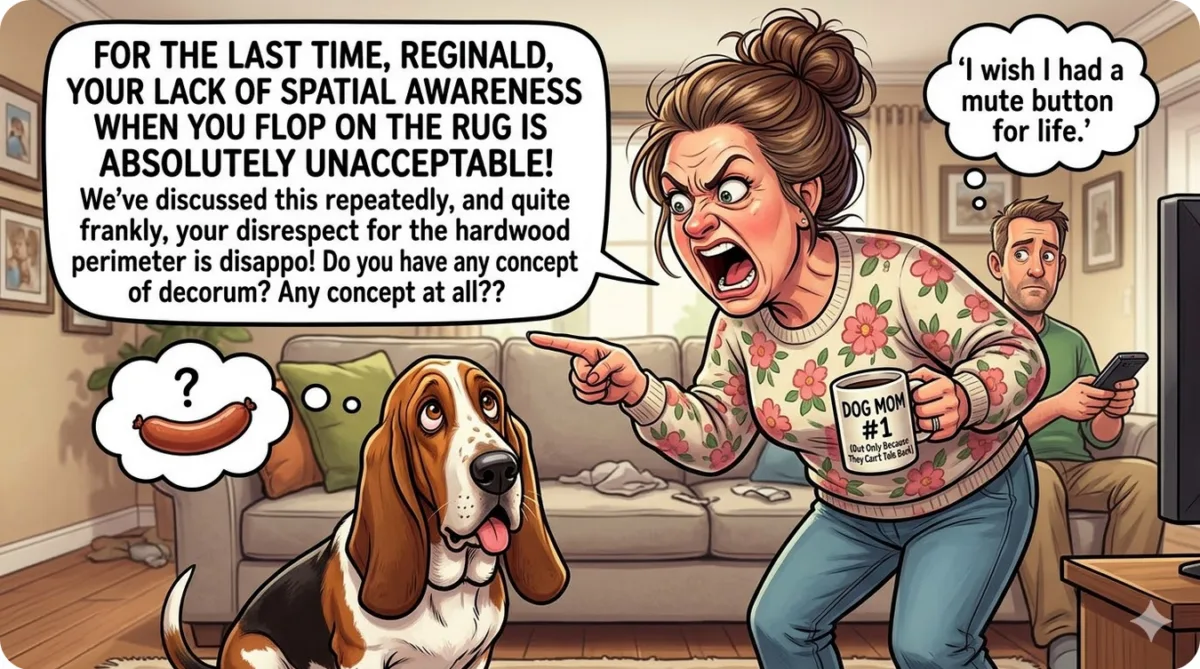
Think about the sheer audacity of it all. These individuals genuinely believe that their dogs possess the linguistic capabilities of a precocious toddler. They deliver elaborate instructions, like: “Now, Fluffy, I told you to go to your designated elimination area, not the Oriental rug! I’ve explained this repeatedly. It’s simply unacceptable!” As if Fluffy, after years of this barrage, is suddenly going to have an epiphany and respond with, “You know what, Susan? You’re absolutely right. I was being dreadfully inconsiderate. I shall henceforth respect the designated elimination area with the utmost diligence.”
It’s like they’re convinced their dogs are just playing a long game of “Pretend to Be a Dumb Animal,” waiting for the perfect moment to reveal their hidden mastery of the English language. “Oh, you thought I didn’t understand you? Joke’s on you! I’m actually working on a dissertation on the intersection of post-colonial theory and the semiotics of treats.”
The “Little Girl with Dolls” Analogy
This behavior is strikingly similar to the way little girls play with their dolls. They create elaborate scenarios, bestow upon them rich backstories, and boss them around with absolute authority. “No, Barbie, you cannot wear that dress to the ball! It’s simply not appropriate. And Ken, you need to fix the sink, immediately!”
In both cases, there’s a suspension of disbelief, a willingness to inhabit a purely imaginary world where inanimate or non-linguistic objects are suddenly endowed with human thoughts and feelings. The key difference, of course, is that with dolls, everyone knows it’s play. With the dog-yellers, they seem to genuinely believe they’re communicating on a profound level.
The “I’m in Charge!” Performance
Let’s be honest, there’s a strong element of performance involved. These individuals often seem less concerned with their dog’s comprehension and more with asserting their own dominance and importance. They want the world to know they’re in charge, that they have a firm grip on the situation, even if the “situation” is just a beagle who wants to sniff a mailbox.
It’s like they’re trying to prove they’re a strong, capable person by bossing around a creature that’s already completely dependent on them. “Look at me! I can even command a Golden Retriever to stop licking its own butt! I am a force to be reckoned with!”
The “It’s Not Working” Reality Check
The most hilarious part is that it never actually works. The dog, who has no comprehension of the words being yelled, just sees a human making loud, unpredictable noises. They might look slightly concerned, or they might just ignore it entirely and continue their pursuit of that elusive squirrel.
The yeller, meanwhile, gets increasingly frustrated, their voice rising in pitch and volume until they’re screaming like a banshee at a creature that just wants to know if there are any crumbs on the floor. It’s a masterclass in futility, a spectacle of human stubbornness in the face of absolute incomprehension.
The Final Verdict
Look, we all talk to our pets. It’s natural to feel a connection to these adorable, goofy creatures. But there’s a fine line between “Who’s a good boy?” and “If you do not cease and desist from this behavior, there will be serious consequences!”
So, next time you see someone lecturing their dog about the importance of spatial awareness or the ethical implications of chasing mail carriers, don’t judge. Just appreciate the spectacle, the glorious absurdity of human behavior. And maybe, just maybe, let out a little chuckle. After all, life is too short to take everything, including our delusional dog-whispering habits, too seriously.
The People Who Yell at Their Dogs Like They’re Employees
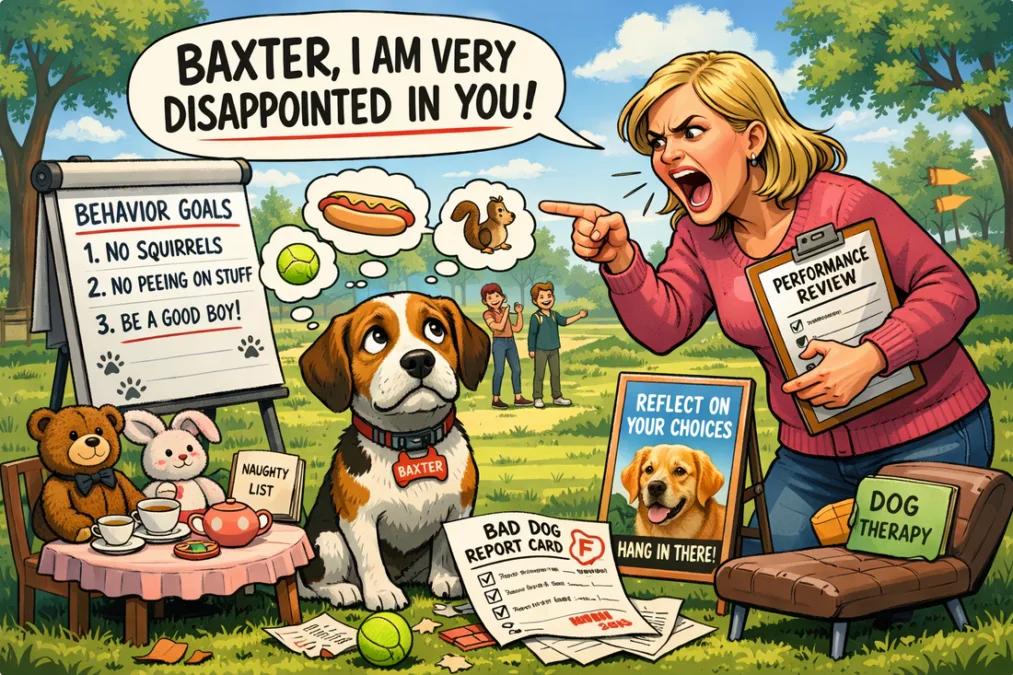
There’s a certain breed of human who believes their dog speaks fluent English, understands full sentences, and is capable of moral reflection. You see them in parks, sidewalks, and apartment complexes loudly narrating their dog’s life as if the dog is a co-worker who just botched a spreadsheet. “NO! BAXTER! I TOLD YOU WE DO NOT DO THAT!” What exactly was the dog supposed to take away from that lecture, some newfound appreciation for workplace professionalism?
The dog’s brain is basically running a four-step operating system: smell thing, eat thing, chase thing, nap. Meanwhile the owner is delivering a five-minute TED Talk about etiquette, discipline, and expectations for the rest of the quarter. Somewhere in the middle of that speech, Baxter is staring off into the distance wondering if the wind might be made of bacon.
Some people don’t just correct their dogs, they hold full performance reviews. “Baxter, I’m really disappointed in you. We talked about this. You know better.” No he doesn’t. He absolutely does not know better. Five seconds ago he tried to eat a leaf that looked vaguely like chicken. The only thing he “knows better” than is whether the squirrel he saw earlier is still in the general zip code.
You’ll also notice these people never use the one or two words a dog can actually learn. No, they deliver full paragraphs. “Baxter, we are not doing this today. You need to calm down and think about your choices.” Think about his choices? This animal tried to eat a sock ten minutes ago. His “choices” consist of deciding which leg to lick next.
This gets even better when they do it in public. Suddenly the sidewalk becomes a courtroom drama. “BAXTER! I AM VERY UPSET WITH YOU RIGHT NOW!” Everyone within fifty feet now has to listen to a one-sided domestic dispute between a grown adult and a creature whose last intellectual achievement was chasing a tennis ball into a bush. The dog looks around like, “Why is the tall food dispenser making loud noises again?”
The whole thing has the exact same energy as a six-year-old girl hosting a tea party with stuffed animals. “Mr. Bear, you cannot behave like that. Sit down and apologize to Princess Bunny.” The difference is that the little girl knows she’s playing pretend. Dog-yellers seem to genuinely believe the dog is following the conversation and possibly feeling shame about it.
Some people even escalate the situation by explaining their feelings to the dog. “Baxter, you really hurt my feelings when you jumped on that lady.” The dog’s emotional range is basically happy, hungry, extremely happy because food appeared, and suspicious of the vacuum cleaner. There is no empathy module installed. The dog did not attend therapy and has never read a self-help book. He saw movement and jumped, that’s the entire story.
You can always identify these people because they shout everything. “BAXTER, COME HERE RIGHT NOW!” Why are you yelling like you’re trying to land airplanes? The dog is six feet away and his ears are basically satellite dishes. Whisper the word “treat” from three rooms away and he’ll teleport through walls like a paranormal entity, yet somehow people think they need to shout entire novels at the poor animal.
While the owner is delivering their long speech about expectations and personal growth, the dog is running a completely different internal program. Is that a smell? Yes. That is definitely a smell. Follow smell. Excellent smell. That’s it. That’s the entire operating system.
So when someone stands in the middle of the park yelling, “BAXTER I CAN’T BELIEVE YOU WOULD DO THIS AFTER EVERYTHING WE’VE BEEN THROUGH,” the dog is not reflecting on the past. The dog is wondering if the squirrel behind you has snacks. And honestly, if anyone in that situation deserves a performance review, it might not be Baxter.
SEARCH FOR ANY ARTICLE BY KEYWORD
More results...