
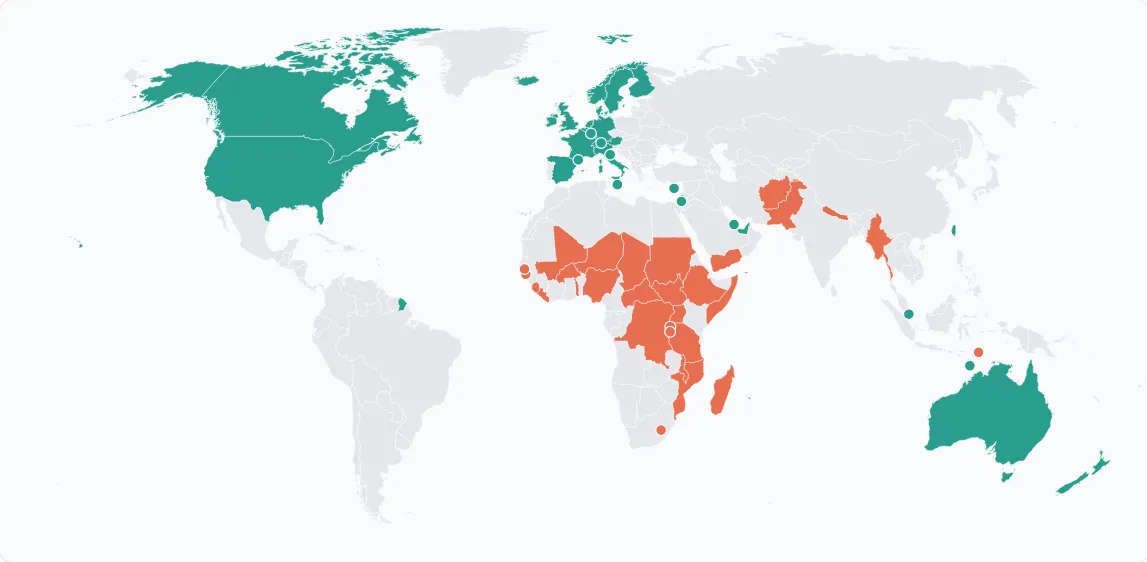
What causes the difference? Why do some countries remain poor while others grow rich?
There’s no single answer, and economists still argue about how much weight each factor deserves. But a handful of explanations come up again and again, and they tend to reinforce each other.
Institutions (probably the most influential explanation today)
Daron Acemoglu and James Robinson, who shared the 2024 Nobel in economics, argue that the key difference is whether a country’s political and economic rules are inclusive or extractive. Inclusive institutions include secure property rights, enforceable contracts, courts that aren’t for sale, and broad access to markets and education. They give ordinary people a reason to invest, save, and innovate. Extractive institutions concentrate power and wealth in a small elite, who have little interest in changes that might threaten their position. The cleanest natural experiments support this view. North and South Korea share the same culture, geography, and history up to 1945, yet they now have wildly different outcomes. Nogales, Arizona, and Nogales, Sonora, sit on either side of a fence and differ in the same way.
Colonial history
Colonialism shaped those institutions. Where Europeans settled in large numbers (the US, Canada, Australia), they built institutions for themselves. Where they came mainly to extract resources or labor (much of Africa, parts of Latin America, the Caribbean), they set up systems designed to funnel wealth out. Those systems were often inherited intact by post-independence elites. Colonial borders also lumped rival groups together, which fed later conflict. Some countries escaped colonization or had unusual colonial experiences, and they show how much this mattered.
Geography
Jeffrey Sachs and Jared Diamond emphasize physical advantages:
- Coastlines and navigable rivers make trade cheap. Landlocked countries, which include many in Africa and Central Asia, pay far more to reach world markets.
- Tropical disease burden, especially malaria, drains labor productivity and discouraged settlement historically.
- Agricultural conditions matter because poor soils or unreliable rainfall keep most people farming just to survive, which leaves little surplus labor for factories.
Critics point out that geography doesn’t explain why Singapore (tropical) is rich or why Argentina fell behind. Most economists now see geography as shaping institutions rather than determining outcomes directly.
Human capital
Rich countries invested heavily in mass literacy, schooling, and public health, often before they got rich. Healthy, educated workers are what make factories and offices productive. It’s hard to move up the value chain without them.
State capacity and stability
A government needs to actually function: collect taxes, build roads and power grids, keep order. Civil wars, coups, and chronic instability destroy capital and scare off investment for decades. Many poor countries are stuck in a “conflict trap” where poverty breeds conflict and conflict deepens poverty.
The resource curse
Counterintuitively, oil and minerals often hurt development. They let governments fund themselves without taxing or answering to citizens. They invite corruption and fights over control, and they push up the currency in ways that make manufacturing uncompetitive (sometimes called “Dutch disease”). Nigeria, Venezuela, and the DR Congo are classic examples. Norway and Botswana show the curse can be avoided with strong institutions already in place.
Development strategy and timing
The East Asian “tigers” (South Korea, Taiwan, Singapore, and later China) grew through export-oriented manufacturing. They started with cheap labor in textiles and electronics, used global markets to scale up, and invested the proceeds in education and technology. South Korea and Ghana had similar incomes around 1960; strategy is a big part of why they diverged. Many Latin American and African countries instead pursued import substitution, which protected domestic industry behind tariffs and often produced inefficient firms. Late developers also face headwinds the early industrializers didn’t. Global competition is stiffer, and automation may be closing the “cheap labor to factories” path that worked for Asia.
Why big economic cities form (or don’t)
Cities grow through agglomeration. Once firms, workers, suppliers, and ideas cluster in one place, each new arrival makes the cluster more productive, so success snowballs. That favors places that got an early head start, often ports or trade hubs. One interesting wrinkle is that many African and resource-rich countries have urbanized without industrializing. Their large cities are built around government spending or resource revenue rather than manufacturing, so they swell with informal work and slums instead of becoming productive economic engines.
Culture?
Older theories credited things like the “Protestant work ethic.” Most economists are now skeptical of culture as a primary cause, partly because “cultures” once called incompatible with growth, such as Confucian East Asia, later boomed. Trust and social norms do seem to matter at the margins, though.
The bigger picture is that these factors compound. Geography and colonial history shaped institutions. Institutions shaped whether countries invested in people and avoided conflict. Early success then attracts more capital and talent, so advantages and disadvantages tend to persist for generations.
As an aside, “third world” originally meant countries not aligned with either Cold War bloc, not poor countries. Economists today usually say “developing” or “low- and middle-income” countries.
If you want to go deeper, Why Nations Fail (Acemoglu & Robinson) and Guns, Germs, and Steel (Diamond) represent the two big competing camps. Both are very readable.
Further Reading (Amazon Links)
-
Why Nations Fail
by Daron Acemoglu & James A. Robinson
Explains how institutions shape national prosperity.
-
Guns, Germs, and Steel
by Jared Diamond
Makes the case for geography’s role in shaping societies.
List of Poorest vs. Richest Countries
GDP per capita (nominal, US$, 2026 IMF projections) alongside the year each country’s central bank or national monetary authority was founded. Hover or tap a highlighted country for details.
30 Richest Countries
30 Poorest Countries
GDP per capita: IMF World Economic Outlook (April 2026), 2026 projections. Non-sovereign territories (Hong Kong, Macao, Puerto Rico, Aruba) are excluded; Syria and Eritrea have no IMF data. Banking year = founding of the country’s central bank, national bank, or monetary authority; countries in the West and Central African monetary unions share a regional central bank (BCEAO, BEAC).
But what about Middle Eastern countries that got rich from oil?
The Gulf oil states look like a contradiction: they have very high incomes, but they don't fit the inclusive-institutions story, and they never industrialized the way Europe or East Asia did. The explanation is that they're rich in a different way, and the "resource curse" hit the region very unevenly.
Huge reserves, tiny populations
Qatar, Kuwait, and the UAE sit on enormous oil and gas reserves but have very few citizens. Qatar has only about 300,000 citizens. Split that much resource wealth among so few people and per-capita income becomes enormous, even if the rest of the economy is modest. Contrast that with Nigeria, which has big oil revenues but well over 200 million people, so the money per person is small.
The rentier state model
Gulf governments mostly don't tax their citizens. They fund the state from oil revenue and distribute wealth through public-sector jobs, free healthcare and education, subsidized housing and utilities, and sometimes direct payments. Political scientists call this a "rentier state," and it flips the usual bargain. Instead of "no taxation without representation," it's closer to no taxation, and limited representation. These are monarchies with concentrated power, which would normally predict poor outcomes. The difference is that the ruling families have, for the most part, shared enough of the wealth to keep citizens comfortable and loyal.
Imported labor
Much of the actual work is done by foreign workers from South Asia, Southeast Asia, Africa, and elsewhere. In Qatar and the UAE, they make up roughly 85–90% of the population. Citizens often hold government jobs while migrants build the cities and staff the private sector. So the skyline isn't a product of a broadly educated, industrialized native workforce in the way it was in South Korea.
Rich, but not "developed" in the classic sense
Economists point out that much of the Gulf's wealth is resource wealth rather than productivity. Economic growth over the long run comes from people getting better at producing things, and on that measure several Gulf economies have been fairly stagnant for decades. If the oil disappeared, much of the income would too. That's the vulnerability the governments themselves recognize.
Why the Gulf escaped the worst of the curse when others didn't
Compare the Gulf monarchies with Iraq, Iran, Libya, Algeria, Venezuela, and Nigeria, which have oil but much worse outcomes. A few factors seem to matter:
- Political stability. The Gulf monarchies avoided the coups, revolutions, and civil wars that destroyed wealth elsewhere. Iraq and Libya went through decades of war, dictatorship, and sanctions.
- Population size. As above, a smaller pie shared among fewer people goes further.
- Saving for the future. Several Gulf states built massive sovereign wealth funds. Norway, Kuwait, Abu Dhabi, and Saudi Arabia hold some of the largest in the world, which cushions oil price crashes.
- Security relationships. Protection from outside powers, especially the US, has helped deter invasion. Kuwait was invaded by Iraq in 1990 and restored by a US-led coalition.
Trying to diversify
The Gulf states know oil won't last forever, so most are racing to build non-oil economies. Dubai is the standout. It had relatively little oil, so it reinvented itself as a hub for trade, aviation, finance, real estate, and tourism, which is where those agglomeration effects from the earlier answer kick in. Saudi Arabia's Vision 2030, Qatar's investment in sports and media, and Abu Dhabi's bets on tech and AI are similar attempts. Whether they can build genuinely productive private sectors with largely citizen workforces is still an open question.
How this fits the bigger picture
The Gulf doesn't really contradict the institutions argument. It shows that a country can be rich without being developed if it has enough natural wealth per person and keeps things stable. The test comes when the resource runs out or demand falls, and that's exactly the transition these countries are trying to manage now.
About the data
- GDP figures come from the IMF's April 2026 projections. That edition has Liechtenstein with the highest GDP per capita and Yemen with the lowest in nominal terms.
- We used the founding year of each country's central bank or national monetary authority. It's the clearest comparable milestone, and the notes column covers the special cases.
- The median founding year for the richest 30 is around 1912; for the poorest 30, it's 1964. Most of the poorest countries got central banks only at independence from colonial rule.
Sources:
- Countries by Projected GDP per capita 2026 – StatisticsTimes (IMF WEO April 2026)
- Projected GDP per capita Ranking – StatisticsTimes (IMF WEO October 2026)
SEARCH FOR ANY ARTICLE BY KEYWORD
More results...