
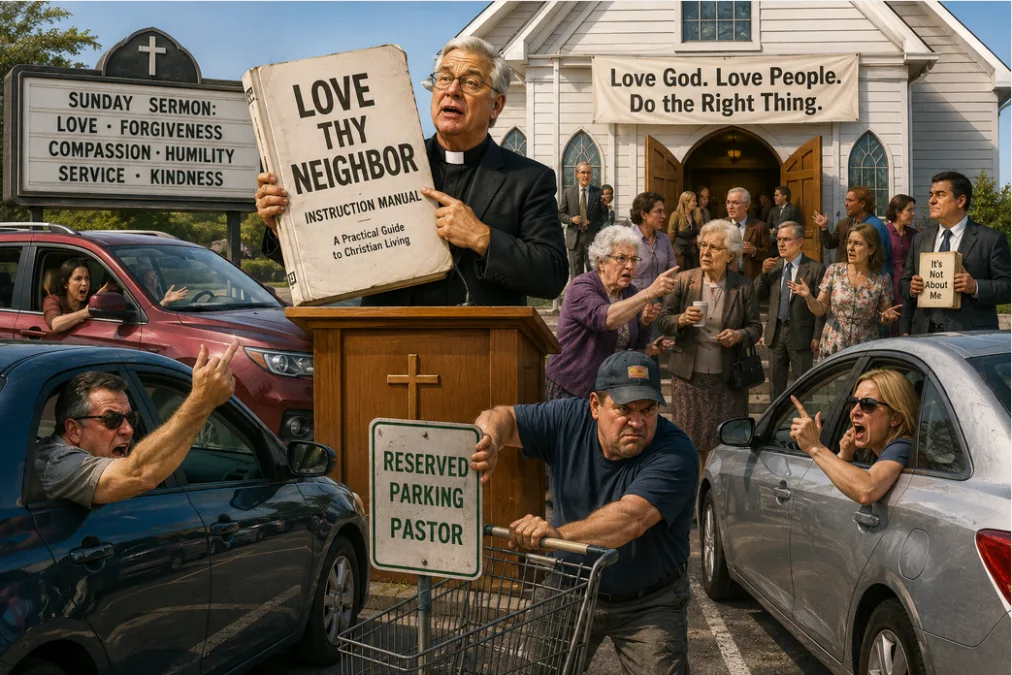
How many people put the preaching into practice?
There is an old joke that says some people go to church every Sunday for forty years and somehow manage to remain exactly the same person they were when they started. If that’s true, one has to wonder whether they attended the sermons or merely used the building as a weekly weather shelter.
Now before anyone starts clutching their pearls, let’s be clear: religion itself is not the target here. Religion can be a beautiful thing. It can provide community, meaning, tradition, comfort, and a moral framework that helps people navigate an often confusing world. Throughout history, religious traditions have inspired extraordinary acts of charity, compassion, sacrifice, and service. The funny part isn’t religion. The funny part is what sometimes happens after people spend decades being exposed to its teachings.
Most major religions, particularly Christianity, devote an enormous amount of time to discussing concepts such as love, forgiveness, humility, patience, generosity, and compassion. These aren’t exactly hidden teachings buried in some obscure appendix. They’re front-and-center themes repeated week after week, year after year. Which makes it all the more fascinating when someone spends forty years listening to lessons about kindness and emerges from the experience as a grumpy, judgmental professional critic of humanity.
At that point, it’s reasonable to ask whether there was perhaps a technical problem with the audio system.
It’s a little like taking swimming lessons for thirty years and still drowning in a kiddie pool. At some point the purpose of the lesson has to move beyond attendance and into application. Nobody becomes physically fit by purchasing exercise equipment. Nobody becomes a master chef by reading cookbooks. Nobody becomes a talented musician by hanging guitars on the wall and occasionally dusting them. In exactly the same way, listening to moral teachings does not automatically make someone moral. The teachings are the map. The journey is the walking.
Yet many people seem to collect religious knowledge the same way others collect commemorative spoons. They proudly display it. They know all the terminology. They can quote entire passages from memory and explain exactly where everyone else is falling short. Then they leave the building and immediately start cutting people off in traffic, complaining about strangers, gossiping about neighbors, and treating customer service workers like unpaid emotional punching bags. It’s almost impressive when you think about it. Imagine attending a seminar called “How To Be Nice” every week for half a century while somehow evolving into the human equivalent of a cactus.
Perhaps this is where spirituality enters the conversation.
Religion and spirituality are often presented as opposing forces, but maybe they’re more like a textbook and the homework assignment. Religion offers principles, ideals, and guidance. Spirituality is what happens when those principles actually make it into your daily behavior. Spirituality is less interested in what you claim to believe and far more interested in how you treat the cashier who’s having a rough day, the waiter who accidentally forgot your ranch dressing, the coworker who made a mistake, or the family member who disagrees with you at Thanksgiving dinner.
In other words, spirituality tends to show up when nobody is watching. It emerges during inconvenience. It reveals itself when you’re tired, frustrated, stressed, hungry, delayed, annoyed, or dealing with somebody who clearly should not have been granted access to a smartphone and an internet connection. Anyone can appear compassionate when life is easy. The real test comes when kindness becomes inconvenient.
And so, dear congregation, allow us a brief sermon.
If you’ve spent decades hearing lessons about compassion, perhaps try practicing compassion. If you’ve spent decades hearing lessons about forgiveness, maybe forgive somebody. If you’ve spent decades hearing lessons about humility, consider resisting the urge to explain why you’re the smartest person in every room. And if you’ve spent decades hearing lessons about loving your neighbor, perhaps start with the neighbors you already have instead of waiting for more lovable ones to move in next door.
Because here’s the uncomfortable truth: the world is not particularly impressed by what people say they believe. The world is impressed by what people actually do.
A person who quietly helps others, treats people fairly, keeps their word, and behaves with kindness demonstrates something meaningful regardless of what label they place on themselves. Meanwhile, someone who loudly advertises their virtue while behaving like an unpaid villain in everyone else’s story may want to revisit the source material. The irony is that most religious traditions agree on this point. Again and again they emphasize character over performance, substance over appearance, and action over declaration.
In other words, the final exam was never about memorizing the brochure. It was about becoming the kind of person the brochure was describing.
Maybe that’s the real difference between religion and spirituality. Religion can point toward the path. Spirituality is what happens when you actually walk down it. And if you’ve spent the last forty years standing at the trailhead proudly reading the map aloud to everyone who passes by, it may be time to take a few steps yourself.
Peace be with you.
And please remember to use your turn signal.
The Rulebook vs. The Vibe
To understand this holy riddle, we first have to separate the two heavyweights in the ring: Religion and Spirituality.
- Religion is the architecture. It’s the cathedral, the ancient liturgy, the potluck sign-up sheet, and the strict, multi-volume rulebook. It tells you exactly what to wear, when to stand up, when to sit down, and which hymns require harmony.
- Spirituality, on the other hand, is the electricity running through the building. It’s the internal transformation. It’s empathy, awareness, humility, and the radical, slightly inconvenient habit of seeing the divine spark in everyone—even the person who just took the last parking spot at Trader Joe’s.
Ideally, religion is supposed to be the delivery system for spirituality. The structure exists to hold the soup. But somewhere along the line, a lot of folks started worshipping the bowl and throwing the soup out the window.
A Sermon for the Pews: “Practice What You’ve Been Preached”
Now, if we were to deliver a gentle, loving sermon to our beloved, devoutly traditional brothers and sisters who might be struggling with this, it might sound a little something like this:
A Reading from the Book of Common Sense
Dearly beloved,
We gather here today to ask a simple question: What is the point?
Every Sunday, you sit in those beautifully polished wooden pews. You listen to sweeping, cinematic lessons about charity, kindness, and loving thy neighbor. You nod. You say “Amen” in all the right places. You might even shed a tear during a particularly moving rendition of Amazing Grace.
But beloved, the true test of your faith is not how well you behave in front of the altar. The true test is how you treat the teenage cashier at the grocery store when the barcode scanner breaks.
If you can quote ancient scripture verbatim, but you use those quotes as verbal throwing stars to judge the people around you, we have a plumbing issue in the pipeline of grace. If your theology is flawless but your empathy is on backorder, it’s time to audit the ledger.
You cannot absorb decades of morality lessons about “doing the right thing” and then treat daily life like an Olympic sport in finding fault. To love the abstract concept of humanity while actively disliking your actual, breathing neighbors is a fascinating cosmic magic trick. It is time, friends, to practice what you have been preached.
The Irony of the “Perfect” Portfolio
There is a distinct, dark humor in watching someone achieve absolute religious perfection on paper while completely missing the spiritual plot. It’s the spiritual equivalent of buying a top-of-the-line, $5,000 professional road bike, wearing the aerodynamic spandex, and then just sitting on it in your driveway yelling at passing cars to slow down. You’re missing the joy of the ride, my friend!
In conservative, traditional circles, it is incredibly easy to mistake compliance for goodness. If you check all the boxes—attend the services, vote the right way, memorize the code of conduct—you get to feel a comforting sense of spiritual security. You’re in the club.
But spirituality is messy. It requires actual effort. It requires looking at a world full of flawed, complicated, beautifully chaotic people and choosing love over judgment. It means realizing that the ancient texts weren’t written so you could grade everyone else’s papers; they were written to help you reform your own heart.
Bringing it Home
Look, we all fall short. Nobody expects flawless sainted behavior 24/7. But there’s a massive difference between slipping up and completely forgetting the mission statement.
The next time we find ourselves nodding along to a beautiful message of love and community, let’s make sure it doesn’t just evaporate the second we leave the sanctuary. After all, the world doesn’t need more people who are merely “religious.” It needs people who are kind.
So, go forth, do the right thing, and for heaven’s sake, smile at the barista.
Amen.
SEARCH FOR ANY ARTICLE BY KEYWORD
More results...