
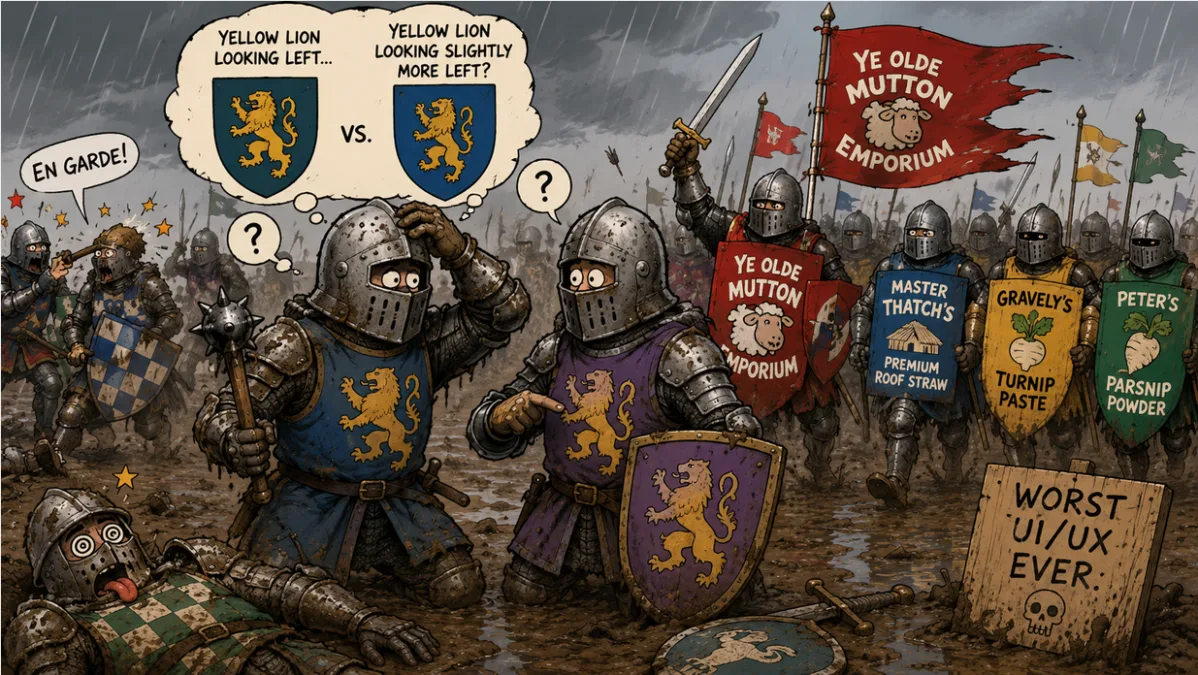
The Ultimate Medieval Design Fail: Why “Coats of Arms” Were the Worst UI/UX in Human History
According to “official” history books written by people who have clearly never tried to run in a metal trash can, the coat of arms was invented for battlefield identification.
The narrative goes like this: You are a medieval knight. You are wrapped head-to-toe in 60 pounds of cold-rolled steel. You cannot see, you cannot breathe, and you are currently being charged by a horse. But fear not! You can easily identify your friends because you have memorized a massive, hyper-specific index of pastel lions, checkered shields, and Latin phrases about honor.
Let’s face it: This is the dumbest identification system ever conceived.
1. The “Spot the Difference” Battle Royale
Imagine standing in a muddy field in the middle of a torrential downpour, waiting to be bludgeoned to death. Your life depends on instantly distinguishing your ally, Sir Bartholomew the Mildly Inconvenienced, from your bitter enemy, Lord Reginald of the Buttered Turnip.
The problem? Sir Bartholomew’s coat of arms features a yellow lion looking left on a blue background. Lord Reginald’s features a yellow lion looking slightly more to the left on a slightly darker blue background.
How many variations of “lion standing on its back legs” can one continent possibly generate before everyone just starts hitting whatever moves?
2. A Skirmish in the Mud (A Very Pythonesque Interlude)
To illustrate the sheer operational efficiency of this system, let us look at a typical Tuesday afternoon in 1342.
[Scene: A muddy field. Sword fighting noises, grunting, and wet squelching are heard. Sir Galahad the Slightly Damp bumps violently into Sir Wilfred of the Soggy Biscuit.]
Sir Galahad: (Raising a heavy mace) Yield, foul fiend!
Sir Wilfred: (Backing away, squinting through a 1-inch visor slit) Hold on! Hold on a moment, sir! Before you bash my skull in, are you a Yorkist or a Lancastrian?
Sir Galahad: I am of the House of… wait. (Looks down at his own chest) …of the House of the Golden Weasel Rampant on a Field of Mauve!
Sir Wilfred: Ah. Now, is that a Weasel or a Marten? Because my cousin, Lord Alistair of the Greasy Onion, has a Golden Marten on a Field of Violet. And we are currently in a blood feud with him, but we are allied with the Weasels.
Sir Galahad: (Adjusts his helmet, panting heavily) Let me look at your shield. Is that a checkerboard pattern of argent and azure, or is it a checkered pattern of silver and teal?
Sir Wilfred: It’s azure! Well, actually, the laundry maid washed it with the red tunics last week, so it’s more of a sad lavender.
Sir Galahad: Honestly, I can’t see a thing through this eye-slit. Tell you what, I’ll just lightly tap your shoulder. If you scream in French, I’ll know you’re an enemy.
Sir Wilfred: Fair enough. (Gets hit) En garde!
Sir Galahad: Ah, brilliant. Die, frog!
3. The Helmet Design Flaw: Just Open Your Face!
The entire reason coats of arms had to exist was because knights insisted on wearing metal buckets over their heads.
But let’s think like modern engineers for a second. Why not just use an open-face helmet?
The counter-argument is always: “But what if an arrow hits you directly in the face?!”
Come on. Have you seen medieval archery? What are the actual statistical odds of a stray arrow flying through the air, traveling 150 yards, and landing perfectly in a 3-inch gap on a moving target? The chances are astronomical! And frankly, if an archer pulls off a shot like that, they’ve earned the kill. Respect the hustle.
Even if they kept the helmets closed, why didn’t they just put a massive, giant country flag right across the chest? You know, like the giant Allied star painted on the wings of World War II airplanes. It’s simple, it’s clean, and you don’t need a bachelor’s degree in heraldry to know who to stab.
4. The NASCAR Solution
If they insisted on using individual graphics, they missed the greatest marketing opportunity of the Middle Ages: Sponsorships.
Instead of representing “The Duke of Cornwall’s Second Cousin’s Great Aunt,” shields should have looked like 200 mph stock cars.
Imagine the terror in the enemy’s eyes when they see a wall of heavily armored knights charging toward them, all sporting the logo of Ye Olde Mutton Emporium or Master Thatch’s Premium Roof Straw.
At least then, the logistics make sense. If a knight in a “Gravely’s Turnip Paste” suit of armor rides into your town, you immediately know he doesn’t belong there—because your town is strictly a “Peter’s Parsnip Powder” constituency.
The Verdict
Ultimately, coats of arms were just the medieval equivalent of NFTs. They were overly complicated, highly expensive, incredibly difficult to verify in public, and mostly used by rich guys who wanted to show off their “unique” digital assets (which were just slightly different variations of the same cartoon animal).
So, next time you see a beautiful crest of a griffin holding a spear, remember: some poor peasant knight probably died because he couldn’t tell the difference between a griffin and a very angry goose in the middle of a foggy swamp.
SEARCH FOR ANY ARTICLE BY KEYWORD
More results...