
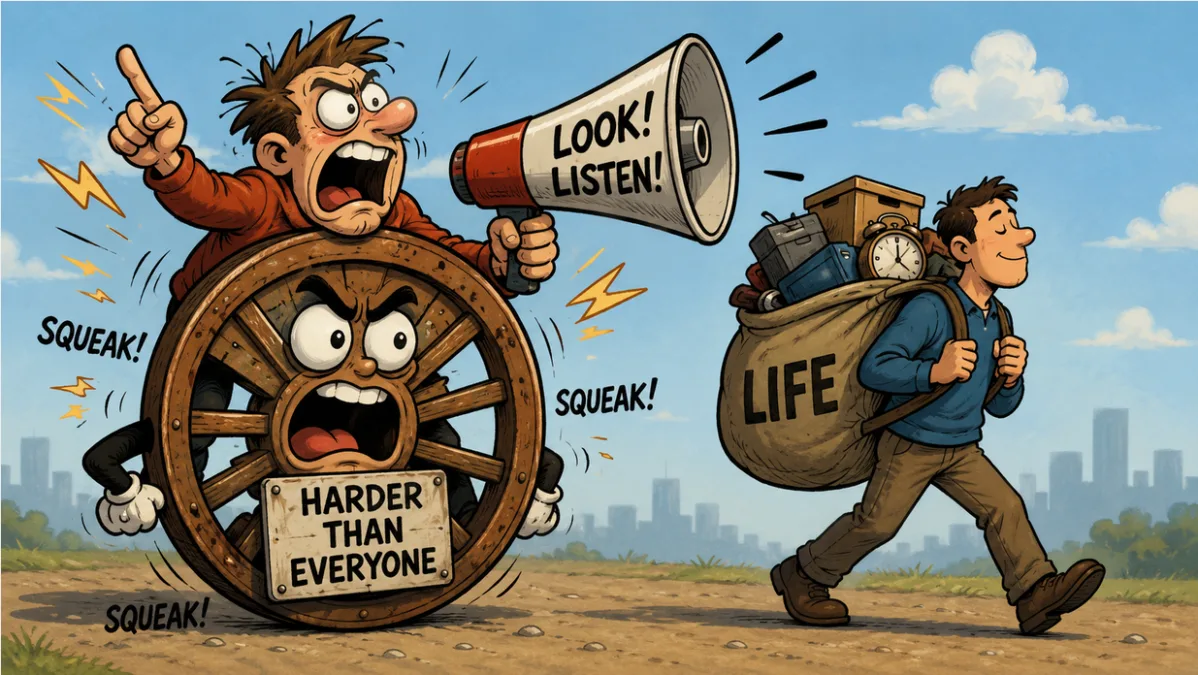
Life is hard for everyone. Squeaky Wheel Syndrome convinces people that their hardships deserve a microphone. Many people mistakenly believe Squeaky Wheel Syndrome is simply about complaining. This is only true in the earliest stages of the condition.
As the syndrome progresses, patients begin to develop a much more sophisticated strategy. Rather than merely complaining about individual inconveniences, they gradually construct an entire identity around being the person who has it harder than everyone else.
The symptoms often begin in childhood. According to the patient, parents favored siblings, teachers were unfair, coaches never gave them a chance, and other children somehow received advantages that were mysteriously unavailable to them. Every chapter of life becomes another example of how uniquely difficult their circumstances have been compared to everyone else’s.
As they move into adulthood, the cast of characters changes but the story remains remarkably consistent. Bosses fail to appreciate them. Coworkers don’t pull their weight. Customers are unreasonable. Friends don’t understand them. Family members take them for granted. The patient inevitably occupies the role of the overworked, underappreciated hero battling impossible odds while the rest of society remains blissfully unaware of their sacrifice.
Do You Have Squeaky Wheel Syndrome?
Take this extremely official medical screening to find out whether you are a calm, functioning adult or a human complaint siren who believes every inconvenience deserves a documentary series.
Checking complaint frequency…
Reviewing hardship claims…
Comparing suffering levels against national averages…
One of the most recognizable symptoms of advanced Squeaky Wheel Syndrome is the constant need to establish superiority through hardship. Ordinary conversation becomes a competition. If someone mentions being tired, the patient explains that they have barely slept in years. If someone mentions having a busy week, the patient unveils a schedule that sounds less like employment and more like a military survival exercise. If someone mentions stress, the patient immediately produces evidence that their own stress levels are operating in an entirely different league.
The goal is not communication. The goal is ranking.
Every conversation quietly becomes a contest to determine who has suffered the most, worked the hardest, slept the least, sacrificed the most, and received the least amount of appreciation for it.
Squeaky Wheel Syndrome Throughout Life
| Life Stage | Typical Person | Squeaky Wheel Syndrome Patient |
|---|---|---|
| Childhood | Experiences normal ups and downs. | Begins documenting evidence of unfair treatment. |
| School Years | Learns, socializes, and grows. | Develops detailed theories about teachers and favoritism. |
| Early Career | Learns the job. | Discovers coworkers are lazy and management is incompetent. |
| Middle Age | Handles responsibilities. | Launches ongoing campaign regarding lack of appreciation. |
| Retirement Years | Tells stories about life. | Publishes the Complete Encyclopedia of Personal Hardship. |
The truly fascinating aspect of Squeaky Wheel Syndrome is that many patients are rewarded for it. Friends accommodate them. Family members make exceptions for them. Coworkers adjust around them. Managers give them attention. Not necessarily because their burdens are greater, but because people eventually discover that providing a little grease is easier than listening to another hour-long squeaking session.
This creates a powerful feedback loop. The squeaking produces results, so the patient squeaks more. Over time, they become convinced that every inconvenience deserves an announcement, every frustration deserves an audience, and every routine responsibility deserves recognition.
Meanwhile, the genuinely easygoing people quietly go about their lives. They face setbacks, disappointments, stress, deadlines, financial problems, family issues, and countless ordinary challenges. The difference is that they don't treat every obstacle as material for a documentary series.
This leads to one of life's great ironies. The people who spend the most time talking about how tough they are often appear the least resilient. The people who rarely discuss their struggles are frequently the ones handling the biggest loads.
The easygoing person carries the burden.
The squeaky wheel carries the burden while providing live commentary, color analysis, historical context, and a three-part retrospective on previous burdens that were somehow even worse.
That is the defining characteristic of Squeaky Wheel Syndrome. It is not the presence of hardship. It is the relentless need to broadcast hardship, compare hardship, rank hardship, and remind everyone within earshot that no burden has ever been carried quite as heroically as their own.
SEARCH FOR ANY ARTICLE BY KEYWORD
More results...