
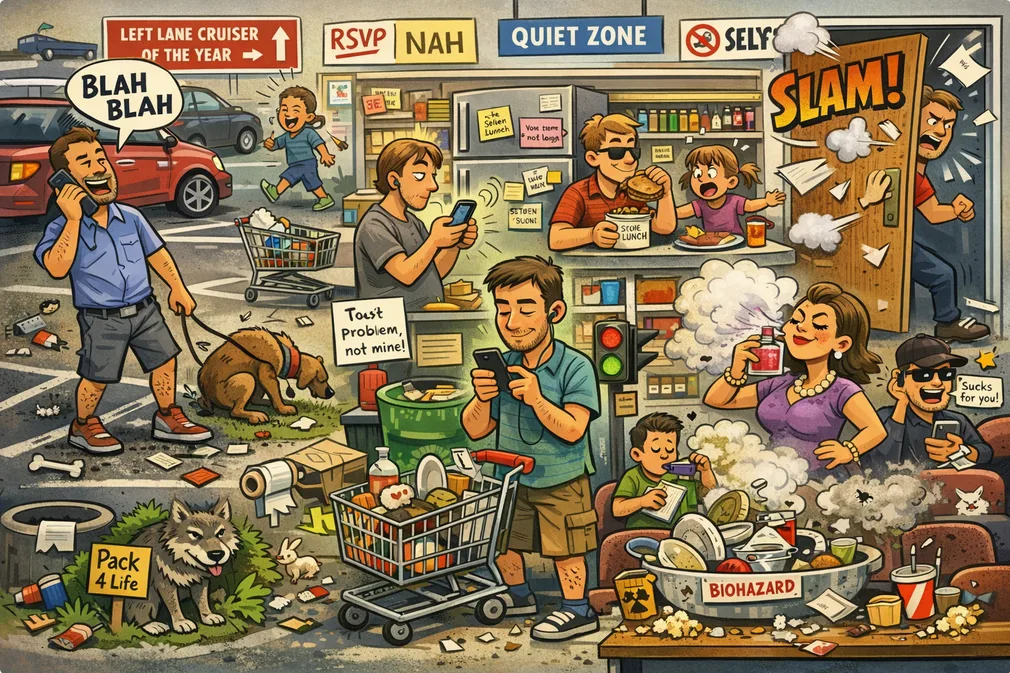
There are two kinds of people in this world: those who understand they share space with other humans… and those who move through life like they were raised by wolves and released into society with no orientation. These are the everyday behaviors that make considerate people silently lock eyes with each other in public – the shared look that says, “Are you seeing this?” None of this is complicated. No one’s asking for perfection. Just a basic awareness that you’re not the only person on the planet. If you recognize yourself in any of these, congratulations – you’re about to learn why people sigh when you leave the room.
Which kind of person are you?
People who abandon shopping carts vs. People who return them:
If you leave your cart drifting around the parking lot, you didn’t forget – you opted out. Returning a cart is the lowest bar of shared-society behavior, and somehow you tripped over it. Everyone else managed. You didn’t. That’s the whole story.
People who camp in the left lane vs. People who pass and move over:
Left-lane campers confuse “following the rules” with blocking traffic. If cars are piling up behind you, that’s not coincidence – that’s feedback. The left lane isn’t a lifestyle.
People who slam doors vs. People who close them normally:
Door slamming isn’t strength or intensity – it’s emotional punctuation. Every slam says, “I don’t regulate feelings, I outsource them to hinges.” Nobody’s impressed. Everyone’s startled.
People who leave dirty dishes vs. People who clean what they use:
Leaving dishes in the sink isn’t “later,” it’s avoidance. You’re not busy – you’re hoping someone else will deal with it because they want a usable kitchen more than you want accountability.
People who don’t clean the dryer lint filter vs. People who do:
Leaving the lint trap packed like a felt blanket isn’t forgetfulness — it’s negligence with confidence. You opened the dryer. You saw it. You closed it anyway. Lint filters exist to prevent fires, not to test fate. Cleaning it takes three seconds and zero effort, yet somehow feels optional to people who assume consequences are a group activity.
People who leave their stuff lying around vs. People who put things away:
Leaving your belongings scattered everywhere isn’t casual — it’s territorial. Shoes in walkways, bags on chairs, random junk on shared surfaces like you’re marking your zone. These people treat common areas like personal storage units and act surprised when others get annoyed. Putting your stuff away isn’t about being neat; it’s about recognizing that your mess becomes everyone else’s obstacle.
People who don’t replace empty items vs. People who do:
Empty toilet paper rolls don’t replace themselves. If you finish something and walk away, you’re announcing that inconvenience is fine – as long as it’s not yours.
People who use speakerphone in public vs. People who don’t:
Nobody signed up to hear your phone call. Not your groceries. Not your relationship. Not your medical update. Speakerphone in public is confidence without self-awareness.
People who text at green lights vs. People who pay attention:
Everyone behind you knows exactly why we’re still sitting here. The light changed. You didn’t. Driving is not a background task.
People who don’t pick up dog poop vs. People who do:
“Forgetting a bag” once happens. Forgetting every time is a personality. Dog ownership includes cleanup. Leaving it behind makes you everyone else’s problem.
People who don’t use turn signals vs. People who communicate:
Skipping your blinker doesn’t make you decisive – it makes you unpredictable. Signals exist so the rest of us don’t have to guess your next move.
People who block aisles vs. People who stay aware:
Stopping dead in the middle of an aisle like time paused is pure main-character energy. If you need to stop, step aside. This isn’t hard.
People who let kids run wild in public vs. People who parent:
Kids aren’t the issue – disengaged parents are. “They’re just kids” stops working when everyone else has to dodge them.
People who don’t mute phones vs. People who do:
Notification sounds in quiet rooms are avoidable. If your phone goes off in a movie or meeting, that wasn’t fate – that was laziness.
People who eat other people’s food vs. People who don’t:
If it’s labeled and you ate it, you knew exactly what you were doing. That’s not a misunderstanding – that’s theft with better lighting.
People who never return borrowed items vs. People who do:
Borrowing something and keeping it indefinitely isn’t forgetfulness. It’s hoping no one calls you on it.
People who crowd personal space vs. People who don’t:
Standing inches behind someone in line doesn’t speed things up. It just makes you the reason people hate lines.
People who never say thank you vs. People who acknowledge others:
If someone helps you and you say nothing, that’s not neutrality – that’s entitlement. Gratitude is basic human maintenance.
People who stop abruptly in walkways vs. People who step aside:
Doorways are not thinking zones. If you need to stop, pull over. Momentum exists behind you.
People who trash shared bathrooms vs. People who don’t:
Leaving a bathroom worse than you found it isn’t an accident. You saw it. You chose to leave it.
People who blast music in shared spaces vs. People who use headphones:
Your playlist is personal. Forcing it on everyone else is rude, not expressive.
People who ignore social cues vs. People who read the room:
If everyone’s uncomfortable and you keep going, that’s not confidence – that’s obliviousness.
People who dominate conversations vs. People who listen:
Talking nonstop isn’t being interesting. It’s preventing anyone else from participating.
People who barge into rooms vs. People who knock:
Knocking exists for a reason. Walking in unannounced isn’t casual – it’s invasive.
People who litter vs. People who don’t:
Dropping trash isn’t accidental. It’s deciding cleanup is beneath you.
People who never apologize vs. People who can admit fault:
Refusing to say “sorry” doesn’t make you right – it makes you exhausting.
People who park across multiple spaces vs. People who stay between the lines:
The lines aren’t optional. If you can’t park inside them, that’s a skill issue.
People who never RSVP vs. People who respond:
Silence isn’t mysterious. It’s inconsiderate. Hosts need answers, not vibes.
People who leave broken things unreported vs. People who speak up:
Breaking something and hoping it disappears is cowardice disguised as optimism.
People who ignore signs and rules vs. People who read them:
Rules exist because someone already tested what happens without them.
People who bring overpowering smells into shared spaces vs. People who don’t:
Shared air is still shared. Not everything needs to announce itself.
People who complain nonstop vs. People who fix things:
Complaining without action isn’t insight – it’s noise.
People who treat public spaces like private property vs. People who don’t:
Spreading out, taking over, settling in – this isn’t your living room.
People who hog shared resources vs. People who share:
If it’s communal, act like it. Grabbing everything isn’t confidence – it’s greed.
People who leave passive-aggressive notes vs. People who communicate:
Notes don’t solve problems. They just fossilize resentment.
People who overshare loudly in public vs. People who have filters:
Not every thought needs an audience. Especially strangers.
People who skip handwashing vs. People who don’t:
If you leave a bathroom without washing your hands, people noticed – even if they didn’t say anything.
People who take credit but dodge responsibility vs. People who own both:
If you want praise, you also get accountability. That’s the deal.
People who think their inconvenience matters most vs. People who live in reality:
We’re all busy. Acting like your comfort outranks everyone else’s is how inconsiderate behavior starts.
Before you forward this to someone you’re thinking about right now, pause. Go back and read it again – slowly. Because odds are, you’re not innocent. None of us are. Everyone has at least one habit on this list that made them feel slightly defensive. That’s the point. Being considerate isn’t about being flawless – it’s about noticing when your behavior affects other people and adjusting accordingly. If that idea annoys you, that’s probably your answer. Wolves don’t self-reflect. People do.
SEARCH FOR ANY ARTICLE BY KEYWORD
More results...