
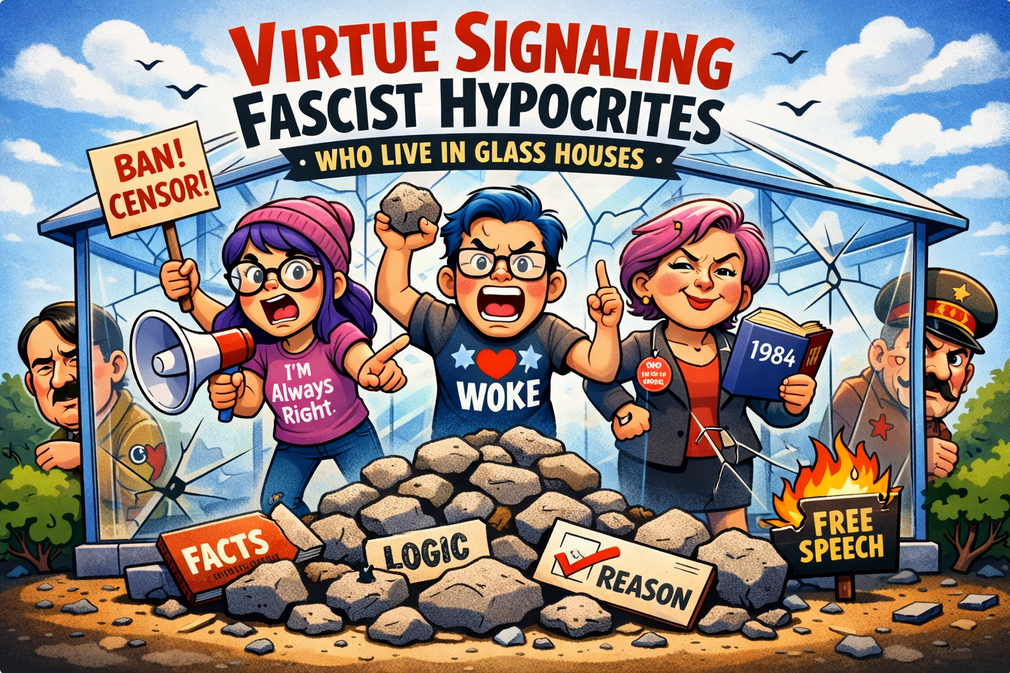
Calling everyone a fascist doesn’t make you enlightened. It makes you predictable.
Because Everyone’s a Fascist Now… and other signs you’ve lost your mind.
There was a time when calling someone a fascist meant something specific. It involved jackboots, secret police, mass censorship, authoritarian control of institutions, and a state that crushed dissent under the pretense of moral purity.
Today, it means:
“Someone enforced a rule I don’t like.”
Welcome to the modern outrage economy, where disagreement is “violence,” law enforcement is “oppression,” and context is a dangerous right-wing conspiracy.
Some people wake up every morning like kids on Christmas—except instead of presents, they’re hoping to catch someone saying the wrong thing so they can yell “RACIST! FASCIST! NAZI!” before breakfast. These labels aren’t conclusions; they’re reflexes. Pavlov rang the bell, and the dog drools accusations.
Ironically, the people most eager to label others as authoritarian are often the first to support censorship, speech suppression, and punishment for ideological noncompliance—as long as it’s their ideology doing the suppressing.
And that irony? It’s not subtle. It’s neon.
#WOKE #SJW #TWAT Poster Boy 🙉🙈🙊💩
The Fastest Way to Hitler without making an effort to connect any logical dots…
Remember the popular game from the 80’s and 90’s called “Six Degrees of Kevin Bacon” where the goal was to connect an association with anyone in the world in six steps or less to Kevin Bacon. Well this type of person has applied it to a new game they like to call, “Two Degrees of You’re a Fascist Racist Pig” where they’ll find one thing they dislike about another person and relegate them to ranks of immoral inhumane assholes all because it’s easier to do this than actually express a well thought out point of view that points out the shortcomings of behavior that they disagree with…
There’s a special mental gymnastics routine some people have perfected:
- Observe behavior they dislike
- Skip all nuance, intent, or legal context
- Draw a straight line to Hitler or Stalin
- Declare moral victory
- Block dissenting opinions
Did a politician enforce immigration law that already exists? Fascist.
Did a school enforce standards of behavior? Oppression.
Did a platform remove content—but not their content? Finally, accountability.
The logic is airtight if you never question it.
This is what happens when moral language becomes a blunt instrument instead of a precision tool. When everything is fascism, nothing is. You don’t elevate the conversation—you nuke it from orbit.
The Free Speech Paradox (Or: “Free Speech for Me, Not for Thee”)
Here’s the recurring pattern:
- “Words are violence.”
- “Speech should be regulated.”
- “Silence harmful voices.”
- “Ban this book.”
- “Deplatform that person.”
All said with the confidence of someone who believes they are immune from future consequences.
History, unfortunately, has a spoiler alert: the censorship machine always turns inward.
Every authoritarian movement starts by silencing “the bad people.” It never ends there. Eventually, the purity test tightens, the definitions expand, and yesterday’s enforcers become today’s offenders.
The mob eats its own tail. Always.
And the shocked reaction when it happens—“Wait, not me!”—is almost endearing in its naïveté.
Utopian Brains vs. Reality Software
At the core of this worldview is utopian idealism colliding head-first with reality.
Some people genuinely believe society can be perfected if only:
- Everyone thought the same way
- Bad ideas were eliminated
- Wrong people were silenced
- Rules applied selectively to “the good side”
This is not new. It’s ancient. And it has failed every single time.
Reality is messy. Humans are flawed. Tradeoffs exist. Law enforcement without compassion becomes tyranny—but compassion without law becomes chaos. Adults understand this tension. Children do not.
Which brings us to…
Childhood Psychology: Where This Stuff Brews
No, this isn’t about mocking trauma—but ignoring psychology doesn’t help either.
Patterns often include:
- Externalized blame: Bad outcomes are always someone else’s fault.
- Black-and-white thinking: You’re either pure or evil.
- Authority confusion: Rules are bad unless they enforce them.
- Moral shortcutting: Labels replace arguments.
Nature vs. nurture plays a role here. Some people are temperamentally high in emotional sensitivity and low in ambiguity tolerance. Combine that with an upbringing where disagreement was framed as hostility, and you get adults who interpret friction as fascism.
Not malicious. Just underdeveloped in critical reasoning.
Echo Chambers: The Greenhouse Effect for Bad Ideas
Ideas, like plants, need exposure to the elements to grow strong. Shield them from wind, and they collapse the first time reality sneezes.
Echo chambers are intellectual greenhouses:
- Dissent is removed
- Reinforcement is constant
- Language becomes ritualized
- Outrage becomes currency
Cherry-picking facts isn’t accidental—it’s structural. When everyone around you agrees, disagreement feels unnatural, even threatening. So when reality intrudes, it must be labeled as evil rather than examined.
Critical thinking requires friction. Echo chambers require none.
Simple Analogies (For When Theory Doesn’t Land)
The Glass House Rule
If you support silencing others, don’t be surprised when your own voice is eventually muted. Throwing rocks from a glass house isn’t brave—it’s short-sighted.
The Fire Alarm Fallacy
If everything is a fire, no one responds when the building is actually burning. Calling everything fascism guarantees real fascism won’t be taken seriously.
The Referee Analogy
A referee enforcing rules isn’t “biased” because your team got penalized. It means rules exist. Screaming “tyranny” every time you lose credibility just tells everyone you can’t handle boundaries.
Why This Feels So Good (And Why It’s Dangerous)
Virtue signaling is addictive because it:
- Grants instant moral superiority
- Requires no self-reflection
- Earns social approval
- Avoids accountability
It’s easier to accuse than to analyze. Easier to shame than to reason. Easier to label than to listen.
But societies built on accusation don’t become just—they become paranoid.
A Gentle Reality Check (Disguised as Brutal Honesty)
If your worldview requires:
- Silencing opposition
- Treating disagreement as evil
- Redefining words to win arguments
- Assuming moral infallibility
You’re not fighting authoritarianism.
You’re rehearsing it.
And history is littered with movements that were certain they were the good guys right up until they weren’t.
Books, Movies & Resources for Escaping the Loop
If any of this stings, good. That’s growth knocking.
Books
- The Righteous Mind – Jonathan Haidt
- 1984 – George Orwell
- The Coddling of the American Mind – Haidt & Lukianoff
- Animal Farm – George Orwell
Movies / Documentaries
- The Lives of Others
- Good Night, and Good Luck
- The Social Dilemma
Mental Habits Worth Practicing
- Steel-man arguments you disagree with
- Seek out dissent intentionally
- Ask “What would falsify my belief?”
- Separate intent from outcome
Final Thought
Calling everyone a fascist doesn’t make you enlightened. It makes you predictable.
Real courage isn’t moral shouting—it’s intellectual humility. It’s the ability to hold two competing ideas in your head without screaming. It’s recognizing that if you demand the power to silence others, you’re building the cage you’ll eventually sit in.
And when that day comes, yelling “I didn’t mean me!” has never worked—historically speaking.