
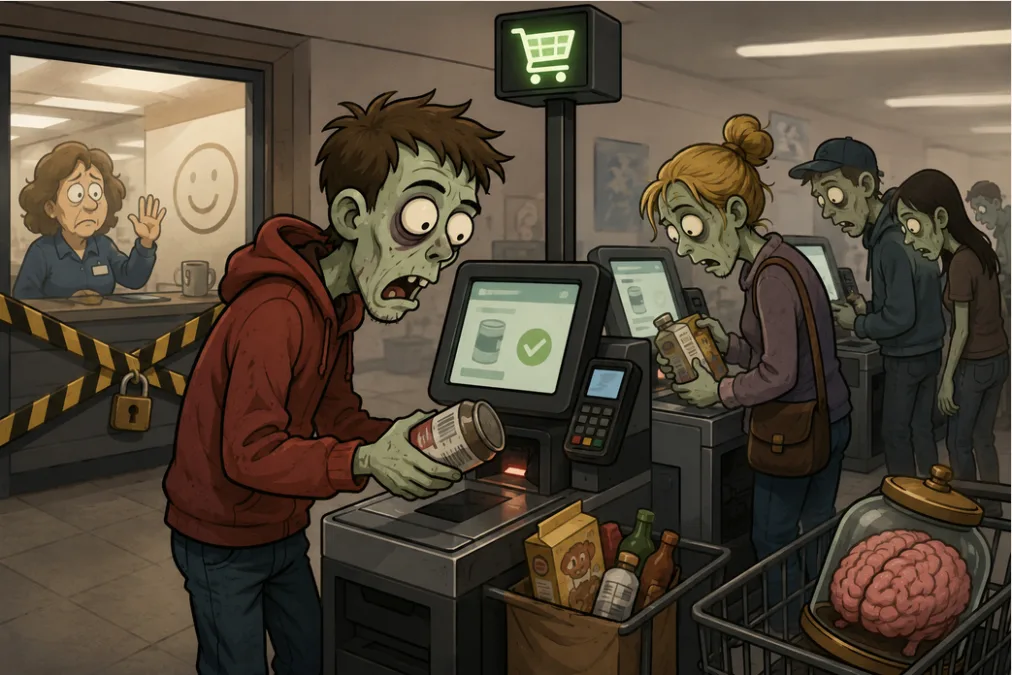
Welcome to the Idiocracy: How Self-Checkout is Turning Us Into Screen-Staring Zombies
We need to talk. Or rather, I need to type words at you while you stare at a glowing rectangle, which is ironically the exact problem we’re here to discuss.
Have you noticed that society is slowly but surely fulfilling the entire premise of the movie Idiocracy? We are systematically stripping away every single ounce of required human effort, common sense, and actual communication. We’re flattening our rich, complex language into a series of pixelated yellow smiley faces, and if we keep going down this path, we are all going to end up as literal brains in jars, virtually high-fiving each other in a digital void.
The absolute pinnacle of this modern tragedy? The Self-Checkout Lane.
The Death of the “Coffee Chat”
Think about it. It used to be that when you went to get your morning coffee or grabbed a few groceries, you had to interact. You’d see a regular face—let’s call her Sue or Bob. You’d say, “Hey Sue, how about this weather?” It wasn’t a deep, philosophical debate, but it was human. It was a pleasant, sociable micro-interaction that anchored you to the real world. You might even nod at the other regulars. You were part of a community.
Now? You walk into the store with your chin glued to your chest. You weave through the aisles like a stealth bomber, load your stuff, and head straight for the self-checkout terminal.
You stand there in a silent, dystopian queue, completely isolating yourself. You scan your own items, argue with a robotic voice about an “unexpected item in the bagging area,” slap your card against the reader, and walk out. Zero interactions. You didn’t look anyone in the eye. If this keeps up, the odds of running into someone you actually know will drop to zero, because nobody will be looking up long enough to recognize a face anyway.
The Slippery Slope of Lazy Communication
How did we get here? It didn’t happen overnight. It was a slow, lazy descent into the communication abyss:
- The Golden Age (Letters): People used to dip quills in ink and write long-form, beautiful letters. They expressed deep thoughts, utilized proper grammar, and actually gave a damn about sentence structure.
- The Compromise (Email): Along came email. Okay, fine, we lost the calligraphy, but people were still writing paragraphs. There was still a beginning, a middle, and an end to a thought.
- The Downward Slide (Texting): Then came the text message. Initially, we tried. But soon, texting replaced actually calling people. Why hear a friend’s voice when you can send a disjointed fragment of a sentence?
- The Modern Pit (Apps & Emoticons): Now, we live on apps that compartmentalize our relationships into 10-second bursts. We think we’re “staying in touch” with 50 people, but we’re actually having vastly inferior, superficial interactions. We’ve devolved so far that we’re on the verge of abandoning words entirely. We’re just throwing emoticons at each other like cavemen throwing rocks. 🦖🔥 Ghost emoji, skull emoji, thumbs up. Look, Mom, I’m communicating!
9 Other Ways Society is Deteriorating Into a Screen-Sucking Dystopia
Self-checkout is just the gateway drug. Here are nine other ways we are actively destroying the quality of human relationships and common sense:
1. QR Code Menus at Restaurants
Nothing says “romance” or “family bonding” like sitting down at a nice restaurant, pulling out your phone, and staring at a digital PDF. You don’t get to ask a waiter for recommendations; you just stare at your screen, tap a button, and wait for a silent runner to drop off your food. We’ve managed to turn dining out into an online shopping experience.
2. The “Automated Customer Service” Loop of Despair
Try calling a company today. Just try. You are met by an AI voice that absolutely refuses to let you speak to a human. “In a few words, tell me what you’re looking for.”
“A human.”
“I’m sorry, I didn’t get that. Did you say ‘Pay my bill’?”
By the time you get to a real person, you’ve lost all will to live.
3. Ghosting as a Standard Exit Strategy
Because we view people through screens, we’ve forgotten they have feelings. Instead of having a mildly uncomfortable, 2-minute conversation to say, “Hey, I don’t think this is working out,” we just… evaporate. We turn into digital ghosts because sending a text explaining a boundary requires too much human effort.
4. Group Hangouts Where Everyone is on Their Phone
Have you looked at a table of teenagers—or worse, adults—at a cafe lately? They are physically together, but mentally lightyears apart. They are texting people who aren’t there, scrolling through videos of people they don’t know, completely ignoring the living, breathing human sitting right across from them.
5. Algorithmic “Friendships”
We don’t check in on friends anymore; we just look at their stories. “Oh, I saw on Instagram that Sarah went to Cabo, so I know what’s happening in her life.” No, you don’t. You saw a curated, 3-second highlight reel. But because you tapped a little heart icon, you feel like you checked the “friendship maintenance” box for the month.
6. Curbside Pickup and Grocery Delivery
We don’t even have to risk running into our neighbors at the supermarket anymore. We just tap an app, drive up, pop the trunk, and a mute stranger loads our trunk while we stare at our dashboard. We are actively paying extra money to ensure we never have to make eye contact with the public.
7. Wireless Headphones as a Permanent Forcefield
Walking down the street used to involve ambient noise and occasional small talk. Now, everyone wears noise-canceling earbuds. It is the universal sign for: “Do not look at me, do not speak to me, I am currently locked in my own private audio capsule.” We’ve created a psychological forcefield against the rest of humanity.
8. GPS Destroying Our internal Compass and Social Interaction
Remember when you’d get lost and have to pull over at a gas station to ask a local for directions? It was a little adventure. Now, if Google Maps stops working for three seconds, we panic, pull over, and weep. We have entirely outsourced our spatial awareness and common sense to a satellite.
9. Dating Apps (The Ultimate Human Meat Market)
We’ve turned finding love into a game of Tinder-Tetris. Swipe left, swipe right, judging a human soul based on a three-word bio and a heavily filtered photo. It has completely stripped the magic, the awkwardness, and the humanity out of meeting someone organically at a bookstore or through a mutual friend.
The Bottom Line: If we don’t start putting down the phones, looking up, and embracing the minor inconveniences of talking to real people, we are going to wake up in 50 years as floating brains in jars, communicating entirely in animated poop emojis.
Next time you’re at the store, bypass the self-checkout machine. Go find Sue. Ask her how her day is. It might feel weird at first, but hey—it’s a start.