
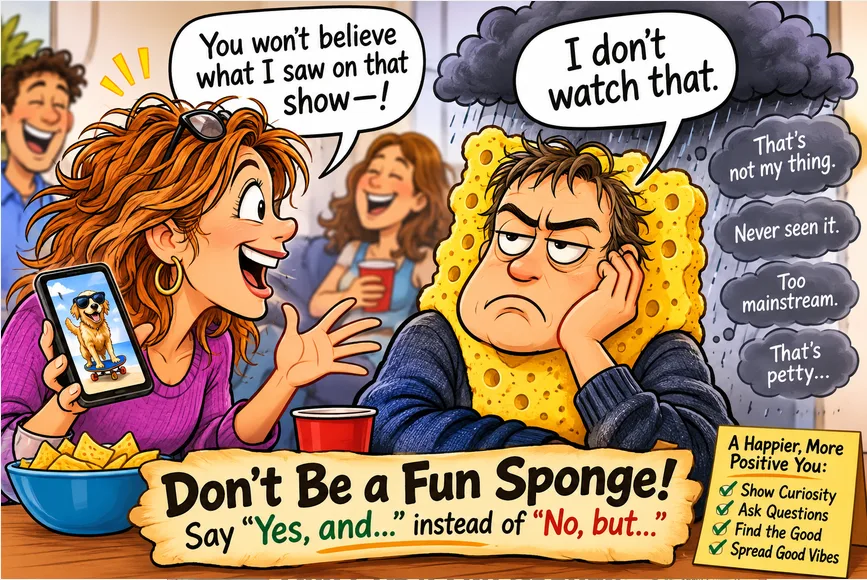
How to recognize people who suck the joy out of every conversation, why they do it, and how to stop being one.
Have you ever been talking to someone, sharing something genuinely funny, interesting, or exciting, only to have them shut it down faster than a toddler can drop an ice cream cone? You know the type. You mention that you saw the funniest thing on television last night, and their immediate response is, “I don’t watch that.” You bring up an interesting radio interview, and they announce that they never listen to that station. You start telling them about a movie you enjoyed, only to hear that they’ve never seen it and aren’t particularly interested. Well, that’s wonderful, but you weren’t conducting a survey of their entertainment preferences. You were trying to have a conversation!
🧽 Are You a Human Fun Sponge?
Do you accidentally suck the joy out of every conversation? Are you a professional “Yeah, but…” person? Or are you a delightful ray of conversational sunshine? Take this 10-question quiz and find out!
Just for fun! This quiz is not a psychological assessment.
It's almost as if some people have a built-in conversational kill switch. They don't seem particularly interested in what you're saying, what made you laugh, or why you found something fascinating. Instead, they appear to be waiting for an opportunity to explain why whatever you're talking about doesn't appeal to them. And if they aren't dismissing your subject, they're usually finding something else to criticize or complain about. Welcome to the world of the Human Fun Sponge, a person who seems to possess an extraordinary talent for absorbing every ounce of enthusiasm in a room and replacing it with negativity.
What Exactly Is a Human Fun Sponge?
We're not talking about people who simply have different tastes, opinions, or interests. That's perfectly normal. Nobody expects everyone to enjoy the same television shows, movies, music, hobbies, restaurants, or recreational activities. The problem is something entirely different. It's the habitual tendency to respond to almost everything another person shares with some variation of "No," "But," "I don't," "I wouldn't," or "That's not my thing."
Imagine telling someone about a hilarious scene from a television show. Rather than asking what happened or why you found it funny, they immediately announce that they don't watch that particular program. You mention a fascinating interview you heard on the radio, and they tell you they never listen to that station. You recommend a restaurant, and before you've even had a chance to explain why you enjoyed it, they've already told you why they wouldn't eat there. It's almost impressive how efficiently they can eliminate perfectly good conversation topics without actually having a conversation.
The truly frustrating part is that the conversation was never necessarily about the television show, radio station, restaurant, or movie. You were simply sharing something from your day that you thought might be interesting or entertaining. You were making a small attempt to connect with another person. A little curiosity would have gone a long way. Instead, you get the conversational equivalent of a slammed door.
It's Not About Liking the Same Things. It's About Showing Some Interest!
Here's something worth understanding: you don't have to like everything someone else likes. You don't have to watch their favorite television shows, listen to their music, enjoy their hobbies, or agree with their opinions. But you can show a little interest in the person who's sharing something with you.
Consider the difference in these exchanges:
- You: "I saw the funniest thing on TV last night!"
Them: "I don't watch that." - You: "I heard a really interesting interview on the radio yesterday."
Them: "I never listen to that station." - You: "Have you seen that new movie? It was hilarious!"
Them: "No, I don't watch those kinds of movies." - You: "We tried this great new restaurant over the weekend."
Them: "I don't eat there."
Now compare those responses with someone who actually knows how to carry on a conversation:
- You: "I saw the funniest thing on TV last night!"
Them: "Really? What happened?" - You: "I heard a really interesting interview on the radio yesterday."
Them: "Oh yeah? Who were they interviewing?" - You: "Have you seen that new movie? It was hilarious!"
Them: "I haven't seen it. What's it about?" - You: "We tried this great new restaurant over the weekend."
Them: "Nice! What did you think of the food?"
See the difference? Nobody is asking anyone to pretend to be fascinated by something they don't enjoy. The difference is that one person is shutting down the conversation while the other is showing an interest in the person sharing the experience. You might even discover something you hadn't considered watching, listening to, or trying before. What a revolutionary concept!
The point isn't that everyone needs to pretend to be fascinated by everything. Nobody wants to spend an entire evening listening to someone explain the finer points of competitive lawn mower racing if they genuinely have no interest in the subject. However, there's a difference between not sharing someone's enthusiasm and making them feel foolish for having it. Good conversation involves a little give and take, and sometimes the nicest thing you can do is simply allow someone to enjoy telling you about something they enjoyed.
The Five Common Types of Human Fun Sponges
Human Fun Sponges come in several varieties, although some individuals have managed to incorporate all five personalities into one impressive package.
1. The Instant Dismissal Artist. This person has already decided they're not interested before you've finished your first sentence. Their favorite expression is "That's not my thing." They have no intention of finding out whether it might become their thing, and the investigation has been canceled before it even begins. They're perfectly happy to tell you what they don't like, but don't expect them to ask what you found interesting.
2. The Perpetual Complainer. This person can find something wrong with absolutely anything. Beautiful weather? Too hot. Rain? Too wet. A delicious dinner? Too expensive. A free gift? Not the right color. They don't just see the glass as half empty. They complain that the glass is poorly designed. You could arrange the perfect vacation, and they'd probably find something wrong with the hotel pillows, the flight schedule, or the fact that the ocean is salty.
3. The Conversation Hijacker. You start telling a story, and within seconds they've redirected the conversation to something that happened to them. You might say, "I had the funniest thing happen yesterday," only to hear, "That reminds me of something that happened to me 20 years ago." Before you know it, you're listening to a 15-minute story about their former neighbor's cousin, and your original story has disappeared into the conversational Bermuda Triangle.
4. The Unsolicited Critic. This person seems to have an opinion about absolutely everything, particularly things they know very little about. They're always ready to explain why your new car was the wrong choice, why your vacation destination isn't worth visiting, or why the restaurant you enjoyed isn't nearly as good as the one they prefer. They don't necessarily offer constructive advice. They just seem to enjoy finding something wrong with whatever someone else happens to be enjoying.
5. The Yeah-But Specialist. This is perhaps the most advanced model of all. You say you had a great weekend, and they respond, "Yeah, but Monday's coming." You mention how beautiful the weather is, and they remind you that winter is right around the corner. You tell them you finally got some much-needed rain, and they complain that now everything is muddy. You could announce that you've won the lottery, and they'd probably remind you about taxes. At some point, you begin to wonder whether these people actually enjoy anything.
Why Do Some People Act This Way?
There isn't one universal explanation, and we shouldn't automatically assume that someone who responds negatively is intentionally trying to ruin your day. Sometimes it's simply a learned communication habit. People can become so accustomed to expressing their preferences, pointing out problems, and offering unsolicited criticism that they no longer recognize how their responses affect those around them.
Other factors may contribute. Some people naturally focus more on potential problems than positive possibilities. Others are so wrapped up in their own experiences and preferences that they forget conversations are supposed to be a two-way street. Some may have difficulty showing curiosity about subjects outside their familiar interests, while others seem to regard every conversation as an opportunity to express an opinion or demonstrate that they know something you don't.
Habitual negativity can also become a self-reinforcing cycle. When someone constantly focuses on what's wrong, they begin to notice more things to complain about. Eventually, criticism becomes their default response, even when there's absolutely nothing useful to criticize. The unfortunate result is that people around them may gradually stop sharing things. They learn that telling this person about something exciting or interesting is likely to produce another dismissive response, so why bother?
And that's a shame. Some of the funniest and most interesting conversations happen when someone introduces us to something we would never have discovered on our own. A little curiosity can open the door to new experiences, new interests, and sometimes even unexpected friendships.
When the Human Fun Sponge Is a Family Member
This is where things get especially challenging. You can limit your time with a negative acquaintance, and you can keep a difficult coworker at a professional distance. But what happens when the person is your spouse, parent, sibling, adult child, or another close family member? You can't exactly put them on Craigslist under "Slightly Used, Conversationally Challenged."
You may genuinely love these people, enjoy spending time with them, and recognize plenty of wonderful qualities in them. But their constant negativity can make even the simplest interactions exhausting. You might find yourself thinking twice before sharing something funny, mentioning a new interest, or talking about an experience you enjoyed because you already know what kind of response is coming. Eventually, you begin to edit yourself just to avoid the predictable criticism or dismissal.
The answer isn't necessarily to avoid these people or start an argument every time they make a negative comment. Sometimes it's worth explaining how their responses affect you. Something as simple as, "I know that particular show isn't your thing, and that's perfectly fine. But sometimes I'm just trying to share something funny or interesting with you. You don't have to like it to enjoy hearing about it," can help communicate the difference between sharing interests and demanding agreement.
It's also perfectly reasonable to recognize that not everyone will be your ideal conversation partner. Find other people who share your enthusiasm for particular interests, and don't feel obligated to turn every casual interaction into an exercise in trying to generate enthusiasm from someone who isn't interested. You can love someone without enjoying every conversation you have with them.
How to Stop Being a Human Fun Sponge
Now comes the uncomfortable part. What if you're the Fun Sponge? What if you've become so accustomed to saying "I don't like that," "I've never seen it," or "That's not my thing" that you don't even realize you're shutting people down? Perhaps you've developed a habit of criticizing things before giving them a chance, or you find yourself automatically pointing out the downside whenever someone shares something positive.
Don't worry. You don't need a personality transplant. You might simply need to become a little more aware of how you communicate with other people. Here are some practical ways to start changing those habits.
1. Ask a question before expressing an opinion. Instead of immediately announcing that you don't watch a particular show, try asking what the other person found interesting about it. Instead of dismissing a hobby, ask what they enjoy about it. You don't have to become an expert in someone else's interests. You just have to show that you're willing to listen.
2. Replace automatic negativity with curiosity. Try phrases such as "I've never tried that. What's it like?" or "I haven't heard of that before. Tell me more." These small changes can make a surprising difference in how people experience conversations with you.
3. Stop treating every conversation like a debate. Not everything requires a counterargument, correction, or criticism. Sometimes people aren't looking for advice or an evaluation of their choices. They're simply sharing an experience. If someone tells you they had a wonderful weekend, you don't need to remind them that Monday is coming. If someone is excited about a new purchase, you don't need to explain why you would have bought something different. Let people enjoy things without feeling compelled to point out every possible downside.
4. Become a better listener. Give people time to finish their stories, ask follow-up questions, and resist the temptation to immediately redirect the conversation toward yourself. You might be surprised by how much more enjoyable conversations become when you aren't constantly thinking about what you're going to say next.
5. Practice gratitude. Make an effort to notice the good things happening around you. Developing a gratitude habit can help shift your attention away from the endless parade of things that aren't quite right. You don't need to pretend life is perfect or ignore legitimate problems. It's simply a matter of making room for positive experiences rather than allowing complaints to dominate every interaction.
6. Learn to celebrate other people's enthusiasm. You don't have to share someone's excitement to appreciate it. Sometimes a simple "I'm glad you enjoyed it!" or "That sounds like fun!" is all that's needed. Being happy for someone else's enjoyment is a wonderful social skill, and it costs absolutely nothing.
7. Think before you complain. Before pointing out something negative, ask yourself whether your comment is helpful, necessary, or simply a reflex. Not every minor inconvenience deserves a full discussion, and not every observation needs to be shared. Sometimes the best contribution you can make to a conversation is deciding not to complain.
Take the Human Fun Sponge Quiz!
Are you a Conversation Sunshine, an Occasional Fun Sponge, or the Supreme Commander of the Department of No? Perhaps you're convinced that you're perfectly pleasant company, but your family and friends might have a slightly different opinion. It's time to find out!
Take our completely unofficial, scientifically unscientific personality quiz and discover whether you have a tendency to shut down conversations, criticize harmless things, or drain the enthusiasm out of perfectly nice people. Be honest with your answers. Nobody's watching, although there may be a few people in your life who would love to see your results.
[INSERT INTERACTIVE 10-QUESTION QUIZ HERE]
Whatever your score, remember that the purpose isn't to label yourself or anyone else permanently. It's to recognize habits that might be making everyday interactions less enjoyable than they need to be. A little self-awareness can go a long way, particularly when it comes with a willingness to make a few changes. And if your score suggests that you're a card-carrying member of the Department of No, don't despair. Recognizing the problem is a pretty good place to start.
A Few Resources for Becoming a More Positive Person
If you'd like to develop better conversational habits and cultivate a more positive outlook, there are some worthwhile resources that can help. The University of California, Berkeley's Greater Good in Action website offers practical, research-informed exercises designed to encourage gratitude and well-being. Its Three Good Things exercise is particularly simple: take a few minutes each day to write down three things that went well and consider why they happened. They don't have to be extraordinary experiences. A good cup of coffee, an enjoyable conversation, a beautiful afternoon, or someone doing something unexpectedly thoughtful can all count. You can explore these exercises at Greater Good in Action.
There are also several books worth considering. Dale Carnegie's How to Win Friends and Influence People remains a classic for anyone interested in developing better relationships and learning how to show genuine interest in others. Debra Fine's The Fine Art of Small Talk offers practical advice for becoming a more engaging conversationalist, while Sonja Lyubomirsky's The How of Happiness explores research-informed ways to cultivate a happier outlook. Sometimes a little reading and a willingness to practice new habits can make a surprisingly big difference.
And if you prefer a little entertainment with your personal development, consider watching Paddington 2, a delightful reminder of the power of kindness; The Princess Bride, which proves that life doesn't always need to be taken so seriously; or Groundhog Day, a hilarious story about a cynical man who gradually learns to become a better person. All three offer a little perspective on how much more enjoyable life can be when we make an effort to appreciate the people and experiences around us.
Recommended books and movies:
- How to Win Friends and Influence People by Dale Carnegie
- The Fine Art of Small Talk by Debra Fine
- The How of Happiness by Sonja Lyubomirsky
- Paddington 2
- The Princess Bride
- Groundhog Day
Affiliate disclosure: Some links in this article are Amazon affiliate links using the tracking ID wtfxyz-20. If you make a qualifying purchase through these links, the publisher may earn a commission at no additional cost to you. Product availability and formats may vary.
The Bottom Line: Don't Be the Person Who Makes Everyone Regret Starting a Conversation
Life is too short to spend every conversation pointing out what's wrong with everything. We don't have to agree on everything, share the same interests, enjoy the same hobbies, or have identical opinions. In fact, conversations would be pretty boring if we did. But we should be able to enjoy hearing about something that makes another person happy, even when it isn't something that particularly interests us.
The next time someone tells you about a funny movie, an interesting radio program, a new restaurant, or something unusual they experienced, resist the temptation to immediately announce why you don't like it. Ask a question. Show a little interest. Maybe even laugh. You might discover something new, learn something interesting, or simply make another person feel good about sharing a small part of their world with you.
Remember, you don't have to like everything someone else likes. You just have to avoid making them feel bad for liking it. The world has enough problems without turning every casual conversation into a complaint session. So put down the negativity megaphone, step away from the Department of No, and try spreading a little enthusiasm instead.
Life is too short to be a Human Fun Sponge.
Disclaimer: This article is intended for humor and personal reflection. The descriptions are not psychological diagnoses, and occasional disagreement, criticism, or lack of shared interests does not make someone a negative person.
Add the missing ten-question quizTrim repeated negativity examples
SEARCH FOR ANY ARTICLE BY KEYWORD
More results...