
Question:
What are the two types of people—you have some people that ask “how was your day,” and other people that say “what kind of stuff did you do today”? What’s the difference, and what type of conversation are these different people trying to have?
Answer:
That’s a sharp observation—those two questions sound similar, but they’re actually aiming at different layers of conversation.
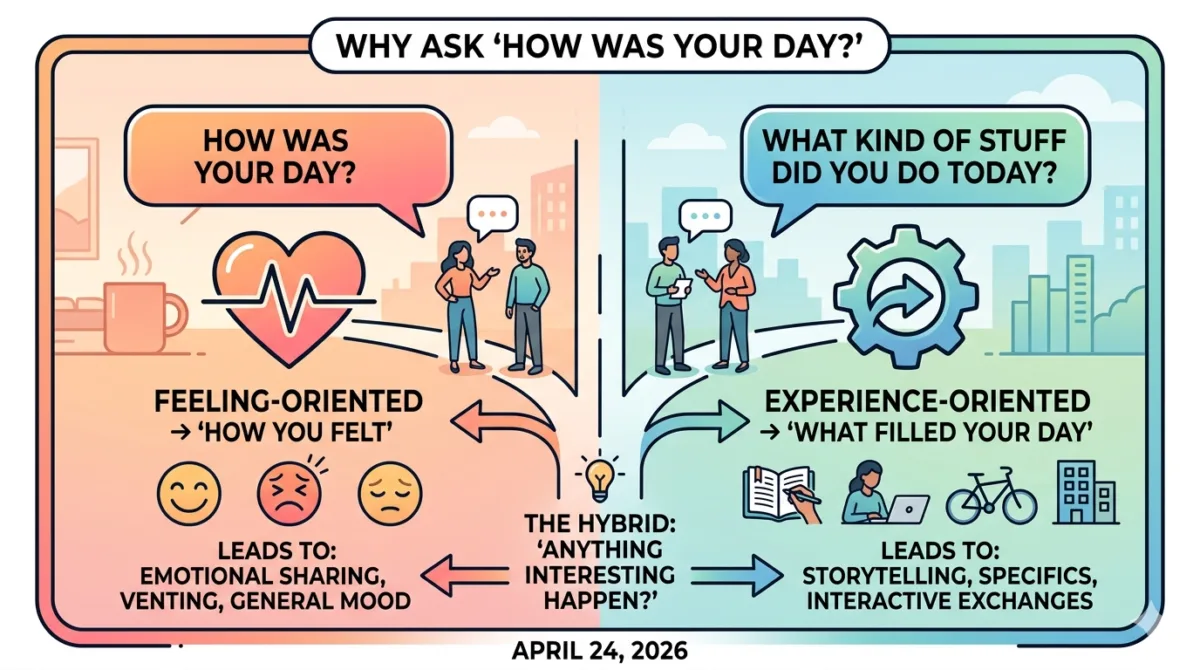
“How was your day?”
This is about emotional tone. The person is checking in on how you felt about your day overall—good, stressful, boring, exciting. It invites a summary like “pretty rough” or “really nice, actually.”
People who ask this are usually:
- Looking for a quick emotional read
- Opening the door for you to share feelings if you want
- Keeping things socially smooth and polite
“What kind of stuff did you do today?”
This is about content and specifics. They’re asking for the events—what happened, what you worked on, what you experienced.
People who ask this are usually:
- Interested in the details of your life
- Trying to build a more concrete picture of your day
- Often more curious or conversationally engaged in a practical way
The deeper difference:
- One is feeling-oriented → “What was your day like emotionally?”
- The other is experience-oriented → “What filled your day?”
What kind of conversation each leads to:
- “How was your day?” → tends to lead into emotional sharing, venting, or general mood talk
- “What did you do today?” → tends to lead into storytelling, specifics, and back-and-forth about activities
Interesting twist:
People also use these differently depending on comfort level. Someone might ask “how was your day?” because it’s safer and less intrusive, while “what did you do?” can feel a bit more personal or invested.
If you want to steer a conversation:
- Answering with feelings keeps it light or emotional
- Answering with details invites a deeper, more engaging exchange
If you’ve noticed patterns in who asks which, there’s usually something behind it—different personalities, levels of interest, or communication styles.
Question:
What are the types of people who really can’t stand being asked how they are or how their day was, and would rather just get right into some sort of interesting conversation topic?
Answer:
There are people who react that way—but it’s less about a fixed “type” and more about a mix of personality, habits, and what they value in conversation.
A few common patterns behind that reaction:
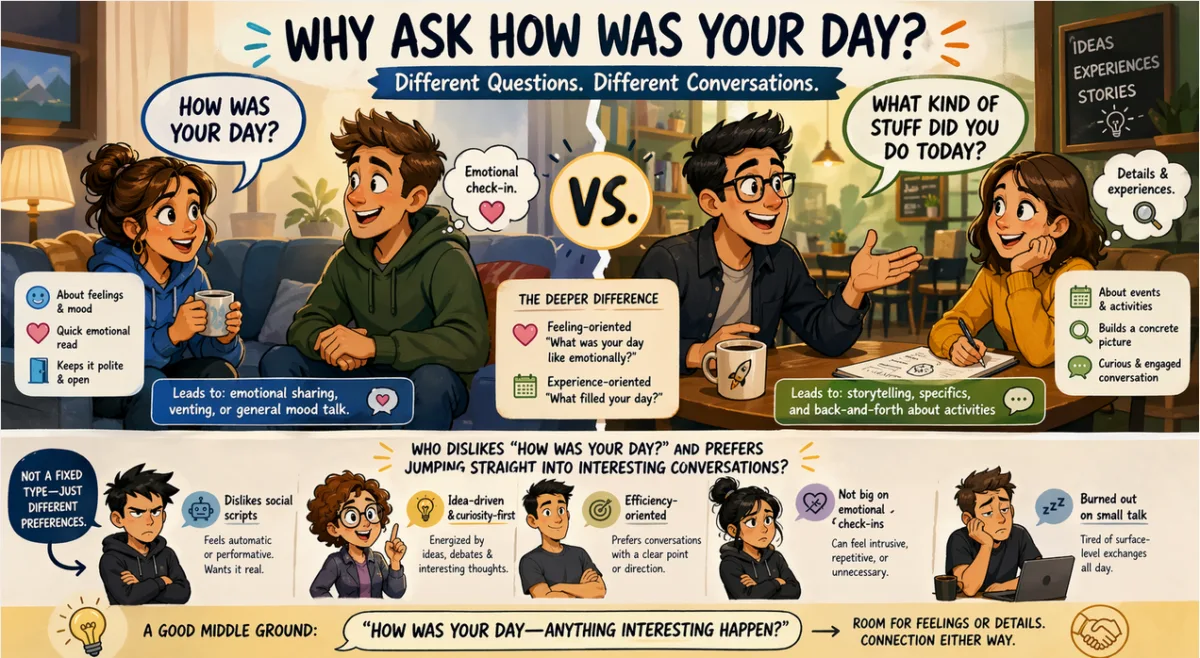
People who dislike “social scripts”
They see questions like “How was your day?” as automatic or performative. To them it can feel like you’re going through the motions rather than actually engaging. They’d rather skip straight to something that feels original or meaningful.
Idea-driven or curiosity-first conversationalists
Some people get energy from exchanging thoughts—opinions, ideas, debates, interesting observations. Talking about the mechanics of a day can feel dull compared to jumping into something more stimulating.
Efficiency-oriented communicators
They prefer conversations that have a clear point or direction. A broad question like “How are you?” can feel vague or meandering, so they’d rather jump into something specific.
People who don’t enjoy emotional check-ins
Not everyone likes being asked about their feelings or mood, especially in casual settings. It can feel intrusive, repetitive, or just not how they process their day.
People burned out on small talk
If someone has a job or lifestyle where they repeat the same surface-level exchanges all day, they might have very little patience for it outside that context.
Important nuance:
Disliking that question doesn’t necessarily mean they’re deeper, more interesting, or more honest—it just means they have a different entry point into conversation.
And it can cut both ways:
- Jumping straight into “interesting topics” can feel refreshing to some people
- But to others, skipping the basic check-in can feel abrupt or even a bit impersonal
So what you’re really seeing is a difference in how people warm up socially:
- Some start with connection → then depth
- Others prefer depth → and connection follows
If you want to meet both styles in the middle, a good hybrid is something like:
“How was your day—anything interesting happen?”
That gives room for either emotional or engaging answers without locking the conversation into one track.
SEARCH FOR ANY ARTICLE BY KEYWORD
More results...