
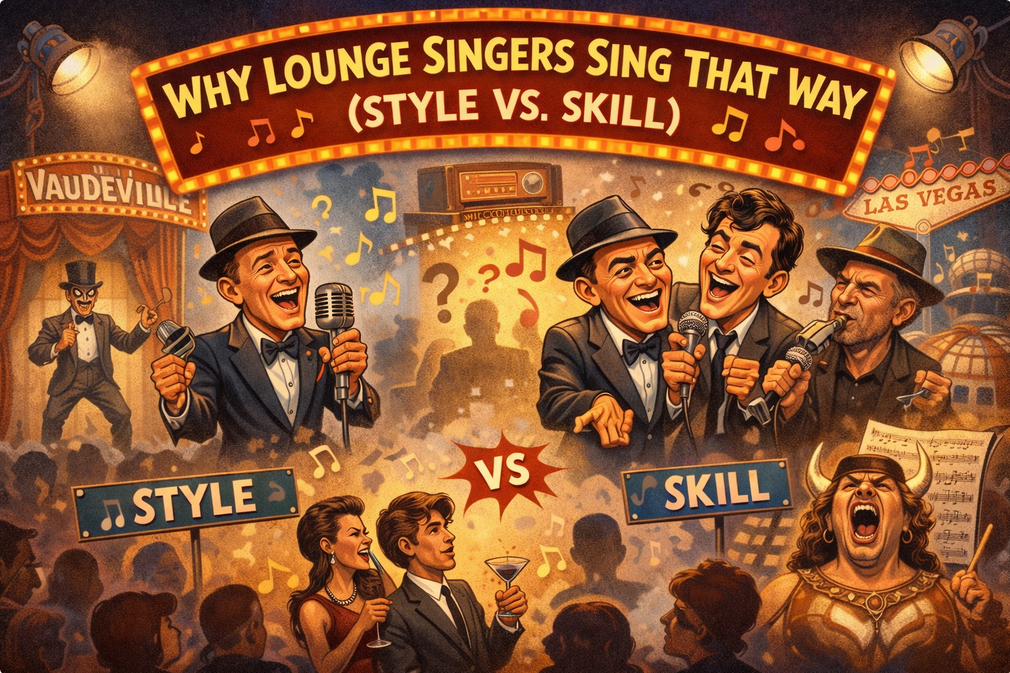
🕶️ Where Did “Lounge Lizard Singing” Come From, Anyway?
Before the cigarette smoke, martinis, Vegas carpets, and pitch-optional crooning, this style actually came from somewhere very specific — and no, it did not start as a joke.
It started as a practical workaround, then evolved into a persona, and finally calcified into a parody of itself.
Let’s break it down.
🎩 The Real Origins: Pre-Microphone Survival Mode
In the early 1900s, singers had a very real problem:
👉 No amplification.
Vaudeville theaters, cabarets, and supper clubs were loud, chaotic environments. Singers had to:
- Project without microphones
- Be heard over talking, clinking glasses, and live bands
- Prioritize rhythm and diction over perfect pitch
This gave rise to speech-like singing — halfway between talking and melody.
Early influences included:
- Al Jolson – bombastic, theatrical, rhythm-first
- Eddie Cantor – comedic timing over musical precision
At this stage, the style was functional, not lazy.
🎙️ The Microphone Changes Everything (And Ruins Everything)
The single most important turning point:
The invention of the microphone (1920s–1930s)
Once singers no longer had to project, they could:
- Whisper
- Slide
- Stretch phrasing
- Ignore classical technique
Enter the crooner.
The poster child of this transition:
- Bing Crosby
Crosby didn’t belt — he leaned into the mic.
This intimacy felt revolutionary and modern.
But it also introduced:
- Softer delivery
- Less breath support
- Pitch that could now drift unnoticed
This is where note hunting quietly enters the room.
🍸 Nightclubs, Not Concert Halls
By the 1940s–1950s, entertainment had shifted:
- From formal theaters → nightclubs & lounges
- From attentive audiences → half-drunk patrons
This environment rewarded:
- Charm over clarity
- Personality over precision
- Phrasing over pitch
If you could:
- Tell a joke
- Flirt with the crowd
- Look cool holding a mic
You didn’t need to sing particularly well.
This is the ecosystem that created the Lounge Lizard.
🐍 The Term “Lounge Lizard” (Yes, It’s a Diss)
The phrase “lounge lizard” dates back to the early 20th century and originally meant:
A smooth-talking man who hangs around bars and clubs to impress women and soak up attention.
By the mid-century, it became shorthand for:
- Overconfident performers
- Slick but shallow entertainers
- Style-first, substance-second personalities
When applied to singers, it meant:
“This guy is selling vibes, not vocals.”
🎩 Sinatra Didn’t Invent It — He Perfected the Persona
Here’s the key historical correction:
Frank Sinatra did NOT invent lounge singing.
He industrialized it.
Sinatra combined:
- Crosby’s mic intimacy
- Nightclub swagger
- Hollywood myth-making
- Mob-adjacent mystique
And turned the lounge singer into:
- A cultural icon
- A masculine archetype
- A lifestyle brand
By this point, technical singing was no longer the goal.
The goal was:
Sound cool. Look unbothered. Never let the audience hear effort.
🎭 From Style to Self-Parody
Once the formula was established, imitators flooded in:
- Vegas acts
- Cruise ship singers
- Casino lounges
- Corporate events
The style slowly mutated into:
- Excessive phrasing
- Overdone vibrato
- Deliberate pitch ambiguity
By the 1970s, it was ripe for ridicule.
Which is why comedy stepped in.
🎬 Comedy Didn’t Kill Lounge Singing — It Exposed It
The reason lounge singer parody works so well is simple: The style was already absurd. Shows like Saturday Night Live didn’t invent the joke — they just removed the tuxedo and spotlight. Performers like Bill Murray exaggerated:
- Wandering pitch
- Overconfidence
- Meaningless phrasing
Because that’s what was already happening — just without the laugh track.
🧠 The Big Takeaway
Lounge lizard singing became popular because it was:
- Born from technological change (microphones)
- Rewarded by social environments (nightclubs, not concert halls)
- Protected by charisma and status
- Reinforced by nostalgia
- Excused by audiences who confused confidence with competence
It wasn’t designed to be technically correct. It was designed to be socially effective.
Lounge lizard singing didn’t start as fraud — It started as adaptation. But somewhere between the mic stand and the martini glass, the notes got lost, and nobody important cared enough to go looking for them. Except comedians. 🍸😈