
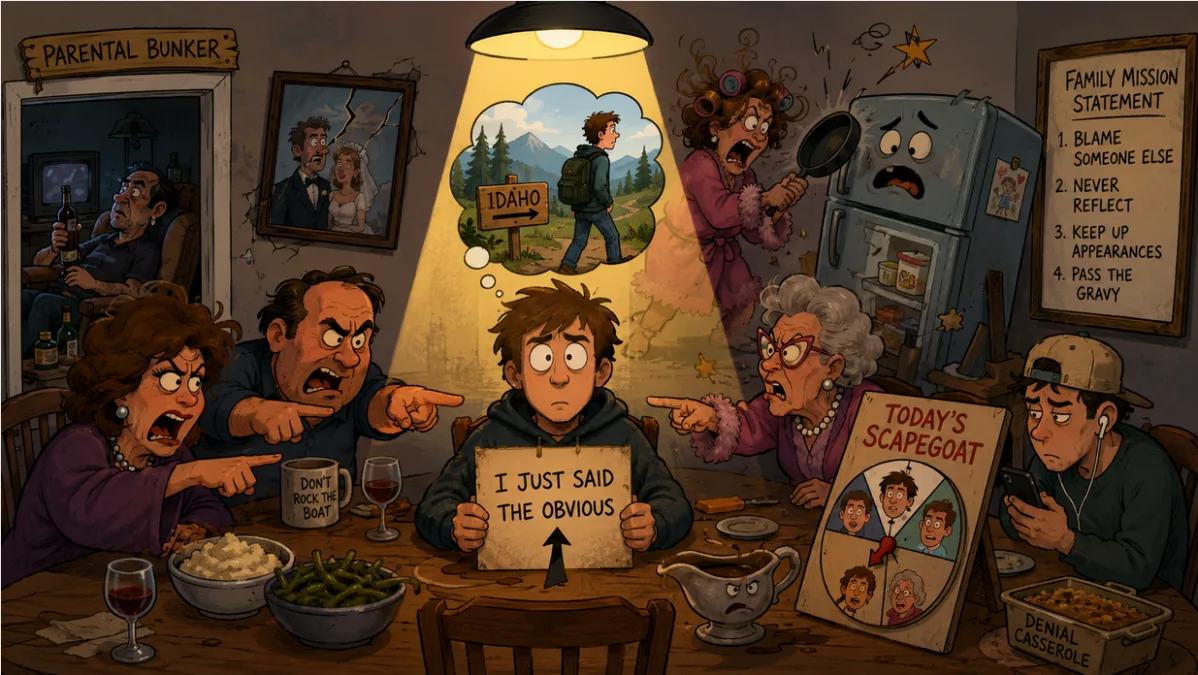
Welcome to The System: Why Every Broken Family Needs a Designated Villain
Every corporate entity needs a product, and every functional team needs a goal. But a highly dysfunctional family system? They only need one thing to survive: A Distraction.
If you have a parental unit with a marriage so rocky it looks like a geological formation, or a couple of core members who are completely out of whack, the family faces a grim choice. They can either look inward, unpack their baggage, and do the hard work of self-reflection… or they can find a scapegoat.
Spoiler alert: They always choose the scapegoat. It’s cheaper, faster, and you don’t have to learn how to apologize.
1. The Core Objective: “Protect the Status Quo at All Costs”
In a classic dysfunctional setup, the family functions like a Jenga tower held together by dried spit and denial. Two people at the top are clearly unstable or profoundly mismatched, but acknowledging that would mean the whole tower collapses.
To keep the peace, the rest of the family adopts a strategy known as “Don’t Rock the Boat.” If Mom is prone to nuclear meltdowns because someone used the wrong tone of voice, or Dad is permanently checked out in an alcoholic or emotional bunker, the family doesn’t try to fix them. Instead, they become Olympic-level boat-stabilizers. They learn to walk on eggshells so quietly they could pass for ninjas.
2. Enter the Scapegoat (The Only Person with a Working GPS)
Eventually, someone in the family grows a backbone or simply runs out of patience. They look around the dinner table and say something radical, like: “Hey, is anyone else noticing that Uncle Greg is currently trying to fight the refrigerator, or are we just going to keep passing the gravy?”
In psychology, this person is stepping out of the script. But in the family narrative? They have just committed high treason.
By setting a boundary or pointing out the obvious, they aren’t viewed as the healthy one—they are branded as the Instigator. The family immediately unites against them because the scapegoat is threatening the one thing keeping the family together: their collective delusion.
The Scapegoat Rule: If you point out the fire, you will be blamed for arson.
3. The Rotating Cast of “The Problem Child”
One of the most fascinating (and dark) aspects of this dynamic is how people phase in and out of favor. It’s like a reality TV show where the producers constantly need to edit someone to look like the bad guy to keep ratings up.
If the primary scapegoat goes “No Contact” or moves to Idaho to escape the madness, a sudden vacuum opens up. The unhappy parental unit can’t possibly look at each other—that would cause an existential crisis. So, the spotlight shifts.
- Phase A: Timmy didn’t get a promotion? “Timmy has always lacked drive. He’s the real stressor in this house.”
- Phase B: Timmy gets his act together? “Have you noticed how Sarah looks at us? She’s so judgmental. Her energy is ruining Sunday dinner.”
The family system requires a Central Casualty. It needs someone to be “the one having problems” or “the one causing problems” because as long as everyone is focused on fixing, lecturing, or gossiping about that person, nobody has to ask why the parents haven’t spoken a kind word to each other since 2011.
4. The Horror of Self-Reflection
God forbid anyone should look within. In these systems, self-reflection is treated like a deadly allergen. If a dysfunctional parent were to genuinely ask, “How does my behavior affect others?” the universe might actually fold in on itself.
Instead, they rely on a beautiful piece of psychological machinery called Projection.
- Are they miserable? No, you’re just making them miserable.
- Are they chaotic? No, you’re just too sensitive.
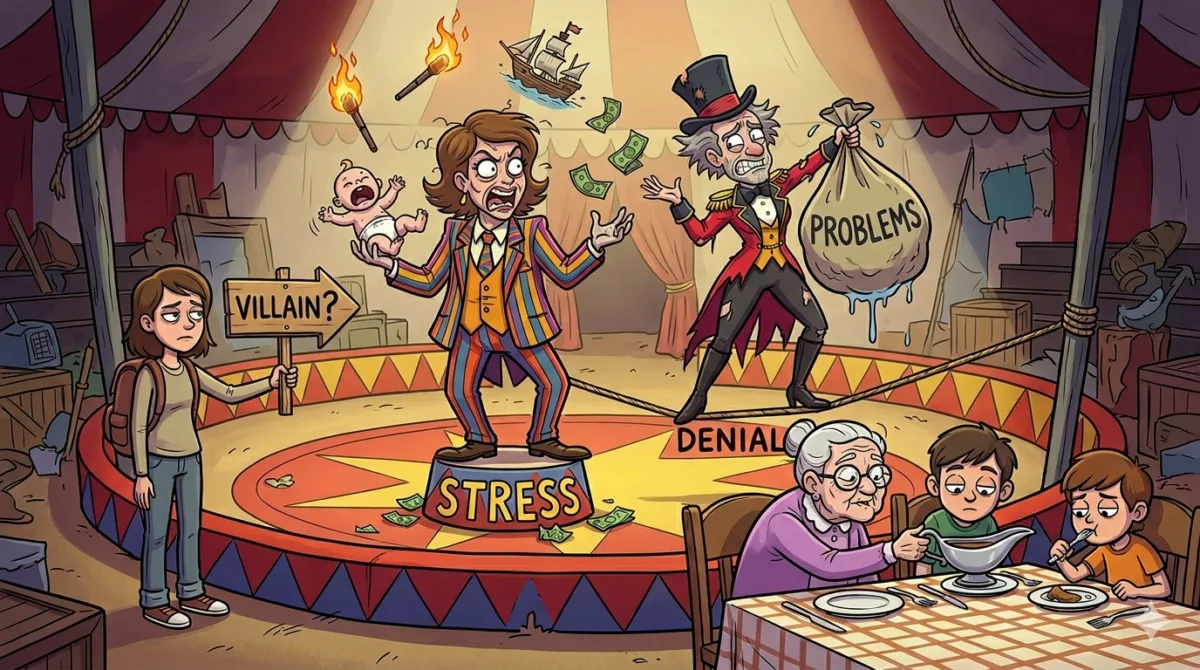
The Takeaway
If you’re the one who has been relegated to the scapegoat narrative, congratulations: it means your reality meter is still functioning perfectly. You aren’t the glitch in the system; you’re just the only one refusing to pretend the haunted house is a luxury condo.
Next time the family spotlight swings your way to cast you as the villain of the week, just remember: you’re not crazy, you’re just the mandatory distraction keeping a historic marital disaster from having to talk to each other. Take a bow, and pass the gravy.
SEARCH FOR ANY ARTICLE BY KEYWORD
More results...