
How to “sound smarter” while saying NOTHING 💩
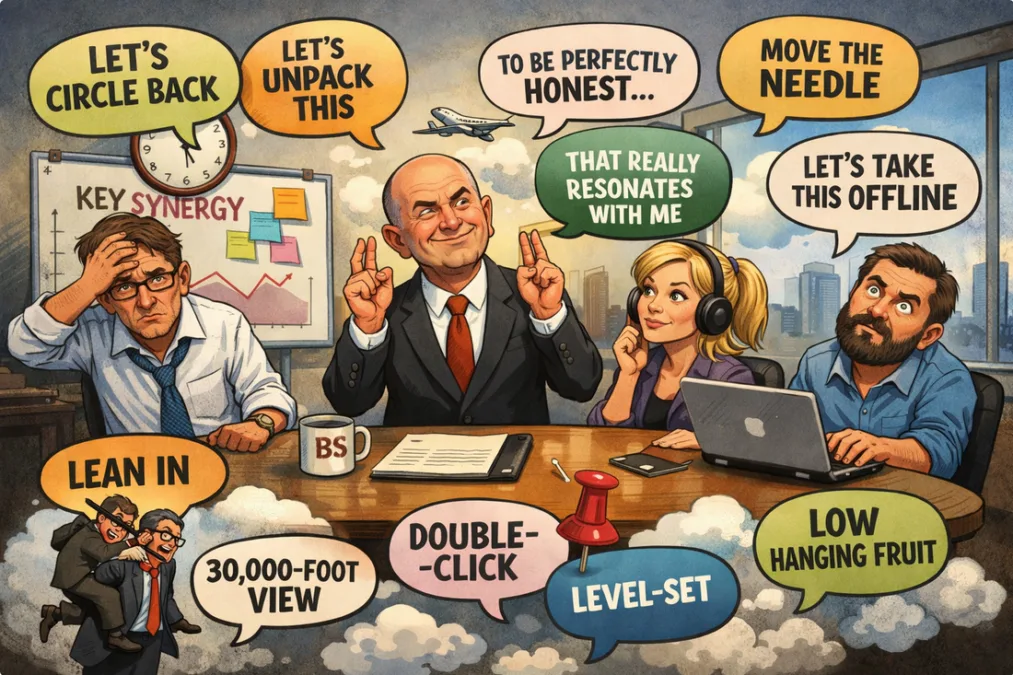
Somewhere along the way, the English language got hijacked. A perfectly good, efficient tool for communicating thoughts between humans got turned into a fog machine — a device for filling rooms with warm, confident-smelling air that contains zero nutritional value.
And the worst part? The people doing it aren’t dumb. They’re smart people. Educated people. People with LinkedIn profiles that use the word “visionary.” They’ve just discovered that if you say nothing in a sufficiently impressive way, many people will nod along rather than admit they have no idea what just happened.
This is a roast. Consider it an intervention. Below are 20 of the most offensively empty phrases that have wormed their way into our offices, podcasts, therapy sessions, and dinner parties. We are naming them. We are shaming them. And we are asking them — politely but firmly — to get out.
1. “At the end of the day…”
At the end of the day, the sun goes down. That’s about the only reliable thing that happens at the end of the day. This phrase has become the verbal equivalent of clearing your throat — a stall tactic disguised as profundity. “At the end of the day, what really matters is results.” Cool. What about at the beginning of the day? The middle? Does truth take a lunch break? No one knows. No one asks.
2. “Let’s unpack this.”
Oh, are we going somewhere? Did someone pack something? “Unpack” was a perfectly innocent word that meant removing clothes from a suitcase. Now it means “let me talk about this for 45 minutes while you slowly lose the will to live.” The idea is that whatever topic is being discussed is so dense, so rich with layers, that it must be unpacked like a steamer trunk full of feelings. It rarely is. Usually it’s just a medium-length opinion about a podcast episode.
3. “Can you speak to that?”
No. Because speaking to something means talking at an inanimate concept, which is what motivational speakers do to the word “success.” You mean “speak about that.” “About.” One syllable. Completely free. “Speak to” entered corporate English sometime in the early 2000s and refuses to leave, like that one consultant who billed 300 hours and fixed absolutely nothing.
4. “Circle back”
“Let’s circle back on that.” Translation: I have no answer, no plan, and mild interest in ever discussing this again. “Circling back” implies motion, progress, the satisfying arc of a boomerang returning. In reality, “circling back” is where ideas go to quietly die. You schedule the follow-up. The follow-up gets rescheduled. Eventually everyone pretends the original conversation never happened. The circle is complete. Nothing was accomplished.
5. “Move the needle”
On what needle? A compass? A record player? A sewing machine? This phrase is supposed to mean “make meaningful progress,” and yet it conjures the image of a group of executives hunched over a single antique gauge, breathlessly watching for the slightest tremor. “We really need to move the needle this quarter.” Do you? Do you need to move the needle, or do you need to do something useful? Pick one.
6. “It is what it is.”
Congratulations. You have just discovered tautology. A thing is identical to itself. Groundbreaking. This phrase is deployed when someone wants to sound philosophical while actually communicating total surrender. It’s the white flag of the articulate. “How’s the project going?” “It is what it is.” So: bad. It’s bad. Just say bad. It’s four letters. It’s efficient. It does not pretend to contain hidden wisdom.
7. “I’m not going to lie…”
Implying that lying was previously on the table. Were you lying before? Are you normally lying? If you have to announce that you’re telling the truth, that’s less a sign of honesty and more a sign that your credibility has some infrastructure issues. Also: you are almost always about to say something completely banal. “I’m not going to lie, that sandwich was incredible.” Why would anyone lie about that? Who are you protecting?
8. “Let’s take this offline.”
Technically, this made sense when meetings were sometimes virtual and “online.” Now people say it during in-person conversations, which means they want to take an already offline conversation… more offline? Into a parking garage? A sensory deprivation tank? What it really means is “this is awkward and I want everyone else to stop hearing it.” Just say that. “This is awkward.” We can handle it.
9. “Synergy”
Synergy is what happens when companies merge and need a word that sounds like the merger was a great idea instead of a spreadsheet-driven act of desperation. “The synergy between our teams is incredible.” The synergy. The magical force that emerges when two groups of humans are now forced to use the same Slack workspace. Synergy has never been observed in the wild. It exists only in PowerPoint slides and the dreams of consultants.
10. “Learnings”
“What were your learnings from this project?” Learnings. The word “lessons” was right there. It was free. It was waiting. It has been working reliably since the 14th century. But no — we needed “learnings,” a word that sounds like something a kindergartener says while their parents smile and take a video. “Learnings” is what you get when someone decides “lessons” sounds too much like they went to school instead of a leadership retreat in Sedona.
11. “Pivot”
Originally a basketball term. Then a startup term. Now an everything term. Lost your job? You’re pivoting. Got dumped? You’re pivoting. Set your kitchen on fire? Pivoting to takeout. “Pivot” allows anyone to reframe spectacular failure as an agile strategic maneuver. The only honest use of “pivot” is in basketball, where it describes a specific legal footwork move. Everywhere else, it means “plan A exploded and we’re hoping no one noticed.”
12. “At this point in time”
This is just “now” wearing a trench coat and fake mustache. “At this point in time, we’re unable to confirm.” You mean currently. Or now. Or just… nothing, because you could often delete this phrase entirely and the sentence would mean the same thing and be 80% shorter. “At this point in time” is what you say when you want to sound like you’re testifying before Congress, even though you’re just answering an email.
13. “I just want to be transparent…”
What follows is never, ever fully transparent. Full transparency would be wild. Full transparency would be “I want to be transparent: I disagreed with this decision but lacked the political capital to stop it and am now choosing my words carefully so that no one is angry at me personally.” That would be transparent. “I just want to be transparent” is what people say right before they tell you something carefully pre-approved by Legal.
14. “That really resonates with me.”
Does it? Did it vibrate you? Did you hum at the same frequency as the idea? “Resonates” comes from physics — it’s what happens when sound waves align. Now it means “I agree, but I want you to feel like agreeing with you is a spiritual experience for me personally.” You could say “That makes sense” or “I agree” or “Yes.” But those don’t make the speaker sound like they were moved.
15. “Going forward”
“Going forward, let’s make sure this doesn’t happen again.” As opposed to going backward? Into the past? To prevent the thing from happening? Unless you have a time machine, all plans are going forward. This phrase exists purely to make the word “from now on” feel more corporate. It has exactly zero additional meaning. It is linguistic filler masquerading as direction. Going forward, let’s retire it.
16. “Thought leader”
A thought leader is a person who has thoughts and has successfully convinced a large number of people that their thoughts are worth following — usually through a combination of a TED Talk, a book with an airport-friendly title, and a lot of LinkedIn activity. Here is the secret: everyone has thoughts. The question is whether the thoughts are any good. “Thought leader” does not answer this question. It is a title you give yourself on the internet and hope no one checks.
17. “Lean in”
Sheryl Sandberg wrote a book called Lean In in 2013, and now people “lean in” to everything. Challenges, opportunities, feedback, discomfort, the weekend. “I’m really trying to lean into my anxiety.” Are you? Are you reclining toward your anxiety at a slight angle? This phrase used to mean something specific about workplace ambition. Now it means “I am going to do the thing” but with more commitment, and slightly better posture.
18. “Let’s put a pin in it.”
A pin in what, exactly? The idea? Are we treating ideas like maps now, like we’re pinning locations of interesting thoughts we intend to revisit during a later expedition? “Putting a pin in it” sounds so much more organized than “ignoring this entirely,” which is what actually happens. Nobody goes back for the pin. The pin is alone. The pin is forgotten. The pin is a metaphor for every good idea that died in a conference room.
19. “Double-click on that”
We’ve moved from geography (“let’s circle back,” “let’s take this offline”) to computer interfaces. “Can we double-click on that point?” This means “can we look more closely at that,” which could also be expressed as “can we look more closely at that.” The computer metaphor adds nothing except the impression that the speaker once read an article about technology. A single click opens something. A double click opens it faster. We get it. Please stop.
20. “At the end of the day, we need to move the needle by leaning in, circling back after we unpack the synergy, and going forward with our learnings.”
This is not a real sentence. And yet, somewhere right now, in a conference room with too many chairs and not enough windows, someone is saying it. And everyone is nodding. And nothing is being decided. And the day is ending, as it always does, whether the needle moves or not.
In Conclusion
Language is a gift. It is, arguably, the thing that makes us human — the ability to take a thought that exists only in our skulls and transmit it with precision into someone else’s skull. It’s incredible when you think about it.
So maybe, going forward, at the end of the day, when we really unpack the learnings of this moment and speak to the synergy of what resonates — let’s just say what we mean.
Or don’t. Honestly? It is what it is.
If this resonated with you, feel free to share it. If it didn’t, let’s circle back.
SEARCH FOR ANY ARTICLE BY KEYWORD
More results...