
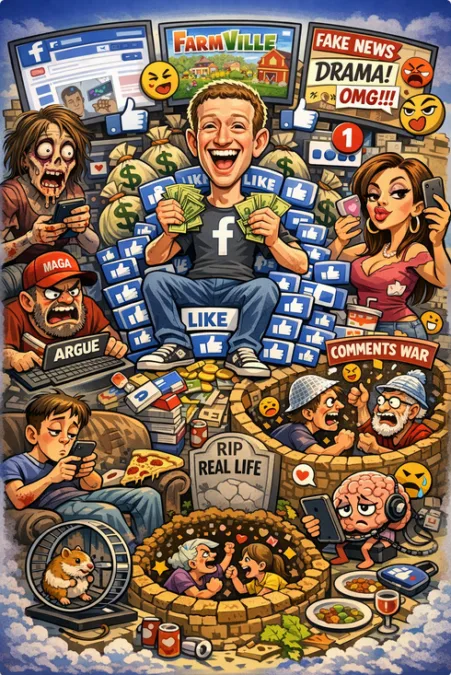
There’s something almost poetic about a guy who started by ranking people’s attractiveness ending up building a machine that makes millions of people feel unattractive every single day. That’s not a pivot; that’s brand consistency. Mark didn’t evolve the idea; he just scaled it until it became a global emotional support casino where everyone’s losing but nobody leaves.
The origin story alone sounds like a rejected subplot from a bad college comedy. A socially awkward coder builds a creepy “who’s hot” site, gets called out, then somehow stumbles into meeting the exact type of people who would never invite him to a party, then repackages their idea into a platform that eventually convinces the entire world to attend a digital version of that same party… except now everyone’s pretending they’re having a better time than they actually are.
And what did we get out of it? A bloated, glitchy, labyrinth of a website that somehow got worse the more money was poured into it. It’s like they kept adding rooms onto a house without ever fixing the foundation. You click one thing and suddenly you’re in Marketplace looking at a half-broken lawnmower posted by a guy named Randy who types like he’s in a hostage situation.
The “Like” button was the gateway drug. Simple. Harmless. A little dopamine tap. But that wasn’t enough. Oh no. They needed engagement. They needed conflict. They needed people arguing about potato salad recipes like it’s a Supreme Court case. So they added comments. On everything. Now every post is a potential cage match between your aunt, a guy with a truck profile picture, and someone who thinks punctuation is a government conspiracy.
And the users? Let’s talk about the users.
These are people who will say, with a straight face, “Yeah social media is toxic,” right before spending four straight hours scrolling through people they don’t even like. They’ll watch a video, get mad, read the comments, get more mad, reply to a stranger, then check back every five minutes like they’re waiting on lab results. Congratulations—you’ve turned your brain into a customer support ticket system for nonsense.
The same people who claim they “don’t have time” to work out, read, learn a skill, or start a side hustle somehow have unlimited time to watch a stranger review a blender, argue about politics with someone named “PatriotWolf1776,” and then deep-dive into a high school acquaintance’s vacation photos like it’s investigative journalism.
And the phone at the table? That’s the crown jewel of modern absurdity.
You’re sitting with actual humans. Real conversation. Real laughter. And someone just casually pulls out their phone and starts scrolling mid-sentence like you just turned into background noise. Imagine doing that with a book. Someone’s talking to you and you just open a novel and start reading. You’d get punched in the face. But with a phone? Totally normal. “Sorry bro, just checking something.” Yeah, checking out of reality.
What’s even better is when everyone at the table is doing it. A group of people sitting together… alone. Silent. Occasionally looking up just long enough to say, “That’s crazy,” before diving back into the glowing rectangle of curated nonsense.
And let’s not pretend this is accidental.
The entire system is engineered to keep you hooked. Notifications, infinite scroll, algorithmic feeds designed to show you just enough outrage, just enough validation, just enough curiosity to keep your thumb moving. It’s not a social network; it’s a behavioral experiment with ad revenue.
But here’s the part nobody wants to admit: it only works because people let it.
Everyone talks about how bad it is. The mental health issues. The addiction. The comparison. The anxiety. The absolute brain rot of it all. And yet… nobody logs off. Nobody sets limits. Nobody says, “You know what, maybe I don’t need to check what my third cousin’s neighbor had for lunch.”
Because that would require discipline. And discipline doesn’t come with a notification badge.
So here we are. A world where the most powerful communication tool ever created is mostly used to argue, flex, complain, and avoid eye contact in real life. Built by a guy who started out ranking people he couldn’t talk to… and perfected into a system where millions of people now avoid talking to each other altogether.
Honestly, you’ve got to respect the efficiency.
SEARCH FOR ANY ARTICLE BY KEYWORD
More results...