
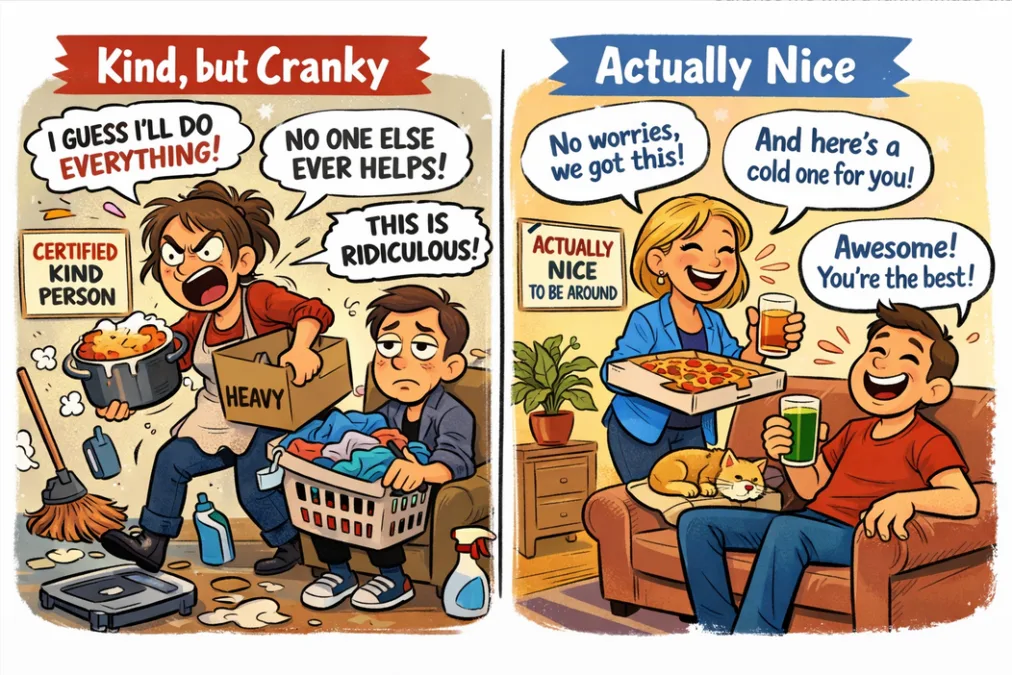
Here’s the Difference
There’s a certain type of person walking around these days who has fully branded themselves as “a kind person.” It’s practically their personality. If they had a LinkedIn headline it would read: Kind Human. Empath. Occasional Soup Deliverer.
And to be fair, they do kind things. They’ll cook you a meal if you’re sick. They’ll help you move. They’ll pick up your kid from school when you’re stuck in traffic. On paper, this person looks like a walking, talking Hallmark commercial.
But then… you spend an hour with them.
And suddenly you’re wondering how someone who just made you lasagna can also make you feel like you need a nap and a therapy session.
Because while they are kind… they are absolutely not nice to be around.
Let’s break this down.
Being kind is about actions. It’s what you do. It’s helping, supporting, giving, showing up when it counts. Kindness is often intentional and sometimes even difficult. It can involve sacrifice, discipline, or doing something uncomfortable for someone else’s benefit.
Being nice, on the other hand, is about energy. It’s what it feels like to be around you. Nice people are pleasant. They’re easy to talk to. They don’t suck the oxygen out of the room with a running commentary of complaints, criticisms, and low-grade negativity.
And here’s where things get interesting.
You can absolutely be kind without being nice.
Picture a coach who pushes a kid hard. They’re strict. They correct mistakes. They don’t sugarcoat anything. That coach might not feel “nice” in the moment, but they’re being kind in the long run because they’re helping that kid grow, improve, and build discipline.
That’s tough love. That’s kindness with a little edge on it.
But the reverse is also true.
You can be “kind” in your actions while being an absolute drain in your presence.
You know the type. They’ll help you clean your house… while complaining the entire time about how messy everything is, how nobody else helps, how society is collapsing, how their back hurts, how the grocery store was out of their favorite brand of hummus, and somehow—by the end of it—you feel like you owe them an apology for existing.
They did a kind thing.
But the experience of being around them was… not nice.
At all.
It’s like getting a free car wash where the guy insults your car the entire time. “Wow, this thing is filthy. What do you do, drive through a swamp every day?” Thanks for the service, but now I feel personally attacked by a sponge.
And this is where the hypocrisy starts to creep in.
Some of the loudest “Be Kind!” advocates are operating under the assumption that kindness in action automatically excuses unpleasantness in attitude. Like as long as they’re checking the “good deeds” box, they get a free pass to be negative, critical, or exhausting in every conversation.
Spoiler alert. It doesn’t work like that.
Because human relationships are not built on a checklist of favors. They’re built on how people feel when they’re around you.
If every interaction feels like a slow drip of complaints, sarcasm, or subtle judgment, people will start to avoid you. Not because you’re not kind, but because you’re not enjoyable to be around.
And people don’t say this out loud. They don’t pull you aside and go, “Hey, just so you know, you’re incredibly helpful but emotionally exhausting.” They just slowly stop calling.
Now let’s be clear. This is not about being fake, bubbly, or walking around like a motivational poster. Nobody wants to hang out with a human screensaver either.
Being nice doesn’t mean suppressing every negative thought. It means having some awareness of how often you’re bringing those thoughts into every interaction like a rain cloud that refuses to move on.
It means mixing in some humor. Some curiosity. Some lightness. Maybe even letting a conversation exist without turning it into a breakdown of everything that’s wrong with the world.
Here’s a simple gut check.
After people spend time with you, do they feel better, worse, or neutral?
Kindness might get you invited.
Niceness is what gets you invited back.
And the real sweet spot. The gold standard. The rare unicorn of human behavior.
Is being both.
Doing thoughtful, supportive things for people and being someone who is genuinely pleasant, engaging, and easy to be around. Someone who can help you move a couch without also moving your mood into a ditch.
So yes, be kind. Absolutely.
But maybe also ask yourself…
Are you nice to be around?
Because if the answer is “Well, I made them soup,” but they still need a break from you afterward…
We might have some room for improvement.
SEARCH FOR ANY ARTICLE BY KEYWORD
More results...