
People Who Have Completely Lost the Plot About Food
Somewhere between Julia Child cheerfully dropping a potato on the floor and brushing it off with a laugh, and the current generation of home cooks who won’t commit to a side dish without first consulting three cookbooks and a mood board — something went catastrophically, hilariously wrong.
We’re not here to kinkshame anyone’s sourdough starter (well, maybe a little). We’re here because people are genuinely ruining dinner for themselves. Not because the food is bad. Because they can’t stop judging it — and because they cannot, under any circumstances, let a vegetable just be a vegetable.
Julia Child made beef bourguignon on a 13-inch black-and-white TV with a dull knife and the energy of someone who was having the actual time of her life. She didn’t have a “flavor journey.” She had dinner. And it was fantastic. Meanwhile, your friend Dave just spent 45 minutes deciding whether to “respect the beet” or “challenge it.” Dave, the beet does not know you exist. Roast it and move on.
“Julia Child made beef bourguignon on a 13-inch black-and-white TV with a dull knife and the energy of someone having the actual time of her life.”
The Ingredient Coward: A Portrait
Let’s talk about the real villain here. Not the food snob who uses too many fancy words. The deeper, more insidious creature: the person who is fundamentally, secretly, completely terrified of tasting actual food.
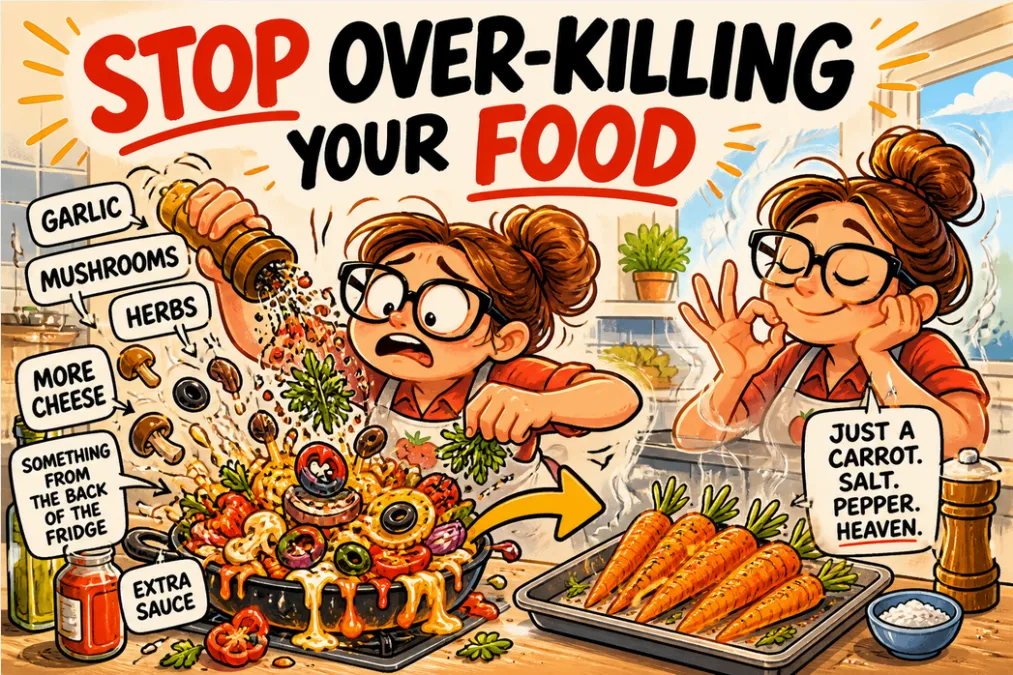
You can identify them immediately. Hand them a beautiful carrot — fresh, sweet, peak of the season — and watch the panic set in. Within 90 seconds they are reaching for garlic. Then mushrooms. Then half an onion. Then “a little” olive oil that turns into a quarter cup. Then some herbs because why not. Then another vegetable because the pan “looked empty.” Then a splash of something from a bottle. The carrot is now in witness protection. It has a new identity. It is gone.
And here’s the thing — the carrot was fine. The carrot was more than fine. A fresh carrot roasted with a little butter, a pinch of salt, maybe a crack of pepper, and some actual time in a hot oven is one of the most genuinely pleasurable things you can put in your mouth. It’s sweet. It’s slightly caramelized. It tastes like a carrot, which is — and this is the part these people cannot grasp — the entire point.
But they can’t stand it. They cannot sit with the taste of a single honest ingredient. The silence of a plain roasted carrot is deafening to them. They need noise. They need chaos. They need seventeen things happening at once so that nothing has to be accountable for tasting like itself.
The Pizza and Sub Problem: When “More” Becomes a Medical Condition
This pathology doesn’t stop at the roasting pan. Oh no. It follows these people to the pizza place. To the sandwich counter. To any situation where a reasonable human being would exercise basic restraint and instead they absolutely will not.
Here is a scientific fact that these people refuse to accept: after about three toppings, you cannot taste any of them individually anymore. It’s over. You’ve crossed the threshold. What you now have is not a pizza with pepperoni, mushrooms, olives, jalapeños, artichoke hearts, roasted red peppers, and “a little” extra cheese — what you have is a hot flatbread delivery system for undifferentiated savory matter.
Every topping is fighting every other topping. The jalapeño is screaming over the artichoke. The extra cheese has smothered the mushrooms into submission. The olives gave up about four toppings ago. Nobody wins. The pizza, which could have been a magnificent margherita that tasted like tomato and fresh mozzarella and basil and joy, is now a $24 argument you’re eating alone over a paper plate.
Same goes for the sub. You know who you are. You walked up to that counter and you said yes to every single thing. The works. Lettuce, tomato, onion, peppers, olives, pickles, banana peppers, three sauces, extra mayo. What are you tasting? Nothing. Everything. The same thing. A wet, structurally compromised torpedo of flavors that have cancelled each other out into beige oblivion.
The jalapeño is screaming over the artichoke. The extra cheese has smothered the mushrooms into submission. The olives gave up about four toppings ago. Nobody wins.
A great sub is meat, bread, maybe one or two things that complement it, and a little acid to cut through. That’s it. That’s the whole game. The bread should taste like bread. The meat should taste like meat. You should be able to identify what you’re eating with your eyes closed. If you can’t — if it all just tastes like “sub” — you have failed the sub.
Why This Is Actually Happening
Here’s the uncomfortable truth underneath all of this: people who bury their food in ingredients don’t trust their own cooking. They don’t believe that a carrot roasted simply will be good enough, so they hedge. They add. They compensate. They mistake complexity for quality and quantity for skill.
It’s the culinary equivalent of someone who talks too much because they’re nervous. The silence of a simple dish feels like failure to them, so they fill it with stuff. More stuff. All the stuff. Until the dish is so busy that nobody — including the cook — can tell if it’s actually good or not, which is, when you think about it, entirely the point. You can’t be judged for a bad carrot if nobody can find the carrot.
Great cooking is not about how many things you can fit in a pan. It’s about confidence. It’s about tasting a fresh ingredient, understanding what it already is, and then doing the minimum necessary to help it become more fully itself. Salt draws out flavor. Heat creates sweetness. Butter adds richness. Done. Go sit down. Let the carrot do its job.
Julia Child understood this in her bones. When something was good, she left it alone. When something needed help, she gave it exactly what it needed and stopped. She wasn’t afraid of the food. She trusted it.
These people are afraid of the food. And until they make peace with that, no carrot is safe.
Normal Person vs. Ingredient Coward: A Field Guide
Roasting carrots Normal person: Butter, salt, pepper, hot oven, done. Tastes like the best carrot of your life. Ingredient coward: Garlic, mushrooms, onion, two other vegetables, olive oil, fresh herbs, a “light” balsamic drizzle. Tastes like a pan of warm things. The carrot has fled.
Making a pizza Normal person: Good sauce, mozzarella, maybe one or two toppings. Every bite is distinct and delicious. Ingredient coward: Nine toppings. “I just like variety.” You cannot taste a single one of them. You are eating beige.
Building a sub Normal person: Good meat, good bread, one or two things that belong there. Perfection. Ingredient coward: Yes to everything. Every sauce. Every vegetable. The sandwich weighs more than a small child and tastes like nothing specific.
Cooking any vegetable at all Normal person: Respects the vegetable. Seasons it. Steps back. Ingredient coward: Cannot be alone with the vegetable. Must immediately invite eleven other ingredients to the pan. The vegetable’s original identity is never spoken of again.
Ordering at a restaurant Normal person: Picks something that sounds good. Eats it. Has a nice time. Ingredient coward: Asks for substitutions, additions, and modifications until the dish shares only its name with what the chef intended. Complains it doesn’t taste like what they ordered.
The Final Verdict
Good cooking is not about how much you can pile on. It’s about how much you can leave off.
A carrot is not a blank canvas waiting for your self-expression. It is already a carrot. It already has flavor, sweetness, texture, and character. Your job — your only job — is to not get in the way of that.
Season it. Give it heat. Give it time. Taste it. Stop.
The best meals you’ve ever eaten in your life — the ones you still think about years later — were almost certainly simple. A perfect roast chicken. A bowl of pasta with good sauce. A tomato in August with salt and olive oil. A sandwich from a place that only did one thing and did it right.
None of those things had nine ingredients. None of them were “complex.” They were just honest, confident, and left alone at the right moment.
Julia Child knew. The carrot knew. It’s time for everyone else to catch up.
SEARCH FOR ANY ARTICLE BY KEYWORD
More results...