
The Ghost of Christmas Passive-Aggressive: The Tragic Lifelong Timeline of the Ultimate Conflict Avoider
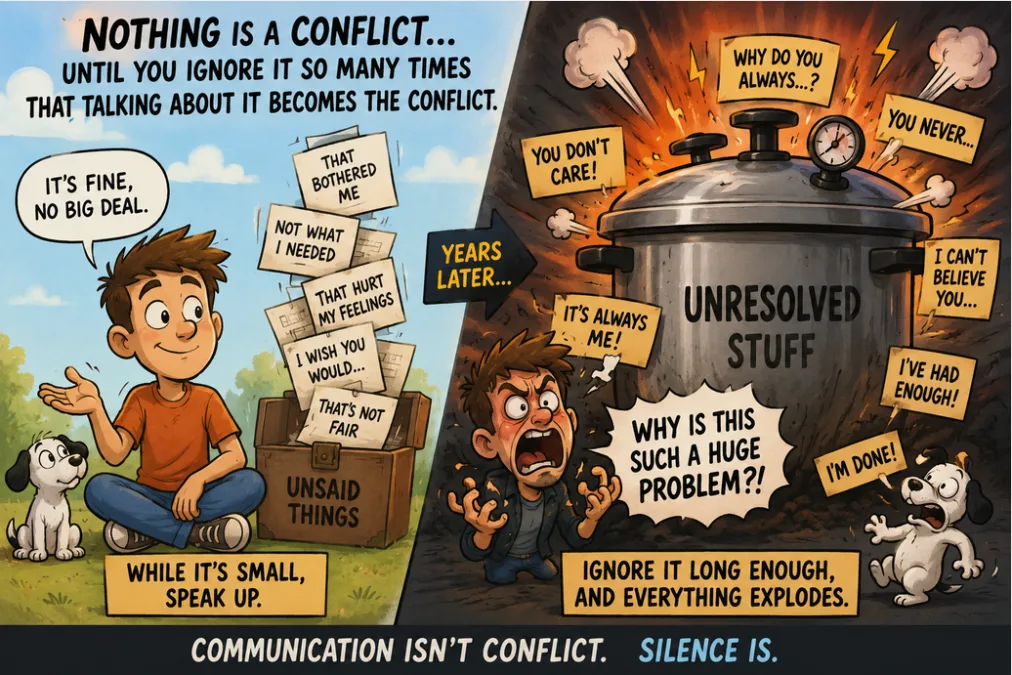
There is a massive, highly toxic misconception that people who avoid conflict are just “chill” or “easygoing.” Let’s shatter that myth right now: they aren’t chill. They are emotional pressure cookers walking around with the safety valve welded shut.
Truly easygoing people? They just say what’s on their mind. They mention a minor annoyance without animosity, fear of repercussion, or baggage, and they move on. For them, a boundary is just a casual data point.
But for the chronic avoider? They treat open, honest communication like dangerous vulnerability, and they treat vulnerability like walking naked into a blizzard. Instead of managing basic expectations, they brush things off. And here is the core tragedy of their existence: Nothing is actually a conflict until you ignore it. It only becomes a conflict because you brushed it off so many times that the sheer weight of your accumulated resentment now makes it impossible to discuss calmly.
Let’s take a Dickensian look back at how a lifetime of dodging minor discomfort transforms tiny, everyday preferences into relationship-destroying atomic bombs.
The Timeline: From Quiet Kid to Isolated Castle-Dweller
The Buried Playground Blueprint > Age 8
The Situation: On the playground, another kid constantly takes their favorite swing right as they run toward it.
The Avoidance: Instead of just saying, “Hey, I was heading for that, can I have a turn after you?” they stand there, kick some gravel, and walk away. They tell themselves, My desire to swing isn’t worth the fuss.
The Pressure Cooker Effect: It wasn’t a conflict. It was a five-second playground interaction. But by swallowing it, they draw the blueprint for a lifetime of treating their own basic needs as an inconvenience to others.
The Dorm Room Cold War > Age 18
The Situation: Their first college roommate keeps borrowing their clothes without asking and leaves them in a crumpled, sweaty pile on the floor.
The Avoidance: An open-minded person would say, “Hey man, ask before you grab my shirts, cool?” and it would be over. Instead, our avoider brushes it off three, four, ten times. By week three, asking nicely feels impossible because they’ve let the anger build. They buy a heavy-duty padlock for their closet and start getting dressed in a tense, hostile silence.
The Pressure Cooker Effect: The roommate has no idea they did anything wrong, but now a literal padlock stands between them. A casual boundary has mutated into a cold war.
The Silent Partner Standoff > Age 25
The Situation: They’ve been dating someone for a year, and their partner asks a completely standard question: “Where do you see us going? What are you looking for?”
The Avoidance: Revealing actual expectations feels like exposing a throat to a predator. They mutter, “Uh, whatever you want, I’m easy,” while mentally checking out. They spend the next six months dodging future talks, silently resenting their partner for “pressuring” them.
The Pressure Cooker Effect: A normal milestone conversation becomes a relationship-ending event because the avoider refused to just say, “I really like you, but commitment scares me a little.”
The Corporate Doormat Special > Age 35
The Situation: A toxic coworker takes blatant credit for a massive project the avoider spent three months staying up until midnight to complete.
The Avoidance: They say absolutely nothing to management because they “don’t want to make a scene.” They let it slide, internalize the rage, develop a raging case of acid reflux, and quietly quit a job they actually loved.
The Pressure Cooker Effect: They didn’t avoid a scene; they just turned the scene inward, sabotaging their own career over a conversation that a confident communicator would have handled in a two-minute email to HR.
The Great Gravy Boat Explosion > Age 45
The Situation: Two decades of unexpressed boundaries, swallowed micro-frustrations, and buried expectations have turned their psyche into a volatile chemical weapon.
The Avoidance: At a standard family Thanksgiving dinner, someone asks them to pass the gravy a little too loudly. The pressure cooker finally blows. They scream, bring up a minor insult from 2017, smash a plate, and storm out.
The Pressure Cooker Effect: Everyone at the table is traumatized because nobody even knew they were upset. By ignoring minor friction for twenty years, they ensured that the eventual conversation would be a catastrophic explosion rather than a calm chat.
The Hermit Era > Age 60+
The Situation: The ultimate, predictable endgame of a lifetime spent running away from honest human interaction.
The Avoidance: They have successfully bypassed all conflict by driving absolutely everyone away. They live alone in a house filled with dust and regret, convinced that “people are just too dramatic and difficult.”
The Pressure Cooker Effect: They remain completely blind to the fact that they were the dramatic one. By letting every tiny issue fester until it became a mountain, they made themselves impossible to live with.
Two Paths Diverged: The Cost of Silence vs. The Power of Speech
It doesn’t have to be this way. Setting expectations isn’t an attack; it’s a manual on how to successfully exist around you. Truly easygoing people don’t run into pressure cookers because they clear the air before the storm can even form.
| Life Scenario | The Avoidance Route (The “Keep the Peace, Lose Your Mind” Track) | The Direct Route (The “Truly Easygoing Adult” Track) |
| A friend constantly cancels plans at the very last minute. | You say, “Omg no worries at all!!” while staring at your phone with pure hatred. You brush it off five times until the friendship feels like a chore, then you ghost them completely. | You say: “Hey, I totally get things come up, but when you cancel last minute it makes it hard to plan my week. Let’s only lock it in if you’re sure.” The friend says “My bad!” and fixes it. |
| A partner does something that hurts your feelings. | You shut down, give them the silent treatment for three days, and wait for them to guess what they did wrong. Because you didn’t address it immediately, it now feels like a huge, terrifying fight to bring up. | You say: “Hey, when you made that joke in front of your friends earlier, it kinda stung. Just wanted to let you know.” It’s spoken with zero animosity, dealt with in 30 seconds, and forgotten. |
| Your boss dumps an impossible workload on your desk. | You smile, say “You got it!”, work 80 hours, burn out, make massive mistakes, and end up getting reprimanded anyway—all while cursing your boss in your head. | You say: “I want to make sure these projects get the attention they need. With my current queue, I can only finish A or B by Friday. Which should I prioritize?” |
The Bitter Pill: When you “avoid conflict” to keep the peace, you aren’t actually avoiding a fight. You are actively creating the fight by letting a minor detail ferment into a major grievance. You are transforming basic human coordination into anxiety, bitter resentment, and a slow-burning disdain for the people you claim to love.
The “Use Your Words” Field Guide: How to Avoid Becoming a Human Pressure Cooker
If that timeline hit a little too close to home, don’t panic. Direct communication is a mechanical skill, not a genetic trait. You can learn it right now. Here is your starter pack for speaking up while things are still small and manageable:
- Address it While It’s Small (Before It’s a “Conflict”): The secret to being easygoing is speaking up when you are at a level 1 out of 10 of annoyance. If you wait until you are at a level 9, it will be a fight. Say it while it’s still a casual, non-emotional observation.
- Stop Scripting the Apocalypse: Avoiders love to write an entire theatrical script in their heads before opening their mouths (“If I say X, they’ll yell Y, and then we’ll break up…”). People who communicate without fear don’t write scripts. They just state their reality calmly and let the other person respond in real-time.
- Ditch the Accusations, Use “I” Statements: Direct communication doesn’t mean being aggressive or picking a fight.
- Aggressive & Delayed: “You always ignore my needs because you’re incredibly selfish.” (An immediate defensive wall goes up).
- Direct & Immediate: “I feel a bit overwhelmed when the kitchen gets left like this. Can we clean it up together real quick?”
- Realize Boundaries are an Act of Generosity: Telling someone what you expect, what you need, and where your limits are isn’t “being mean.” It is giving them the exact blueprint on how to love and respect you successfully. Hiding the blueprint, letting them guess wrong for five years, and then exploding at them is the ultimate trap.
Opening up is terrifying if you’ve spent a lifetime hiding behind a wall of fake compliance, but it is infinitely less scary than an old age spent trapped inside a castle of your own unspoken thoughts. Speak up when it’s simple, or it will eventually become impossible.
SEARCH FOR ANY ARTICLE BY KEYWORD
More results...