
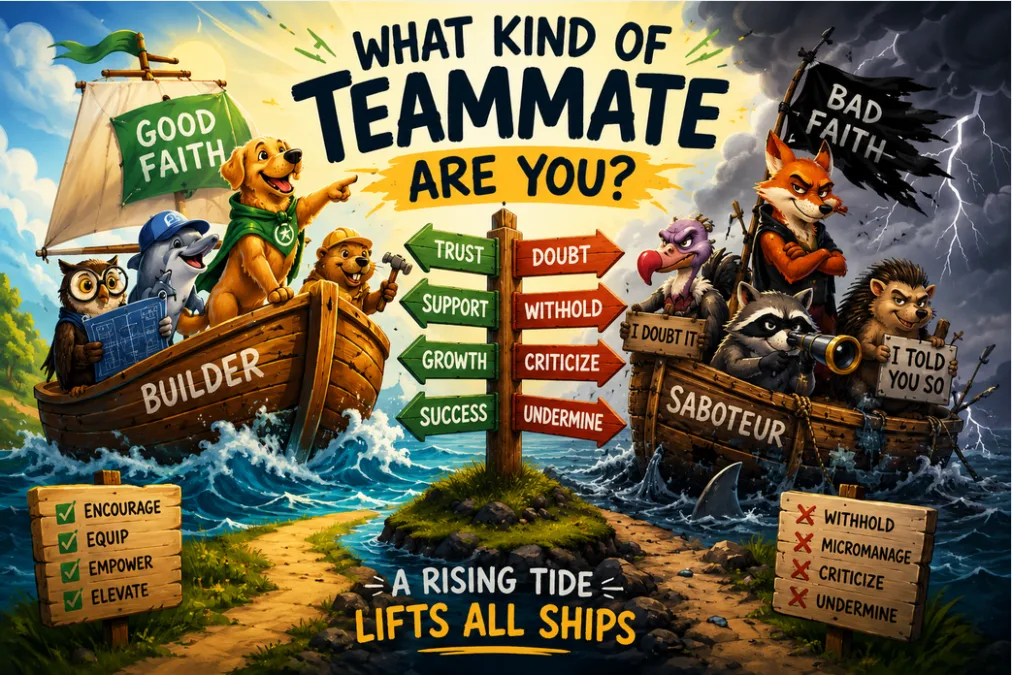
The Power of Assuming Good Faith: Why Believing in People is a Superpower (and How to Stop Being a Saboteur)
We’ve all been there. You’re about to hand off a project, delegate a task, or trust someone with a critical piece of a puzzle. In that split second, you have a choice. Do you look at them and think, “They’ve got this, and if they stumble, we’ll figure it out,” or do you think, “They’re probably going to screw this up, so I better prepare to say I told you so”?
How you answer that question doesn’t just define your leadership style; it defines your character.
Giving people the benefit of the doubt (having genuine, good faith in their physical and intellectual abilities) is like a rising tide. When you lift others up with your trust, everyone’s ship rises. On the flip side, assuming people will fail is a petty, small-minded poison that kills teamwork before the first brick is even laid.
Let’s dive into why trusting people is a superpower, why wanting them to fail is a tragic self-report, and how we can all do better.
The Rising Tide: The Power of Realistic Confidence
Let’s be clear: having faith in people does not mean being blindly, naively optimistic. It doesn’t mean handing a toddler the keys to a forklift and hoping for the best.
True confidence in others is realistic. It means saying, “I believe you have the capacity to learn, adapt, and succeed, and I am going to equip you to do exactly that.”
High compliments are owed to the leaders, mentors, and friends who operate this way. They understand a fundamental truth of human nature: people generally rise or fall to the level of expectation placed upon them.
You can absolutely still be critical. But there is a massive difference between being constructively critical and being inherently negative.
- Constructive criticism says: “I know you can do this at a high level, so let’s tweak this part to get you there.” (It starts with a foundation of belief).
- Negativity says: “I knew you couldn’t do this, so why did we even try?” (It starts with a foundation of doubt).
Before you judge someone’s output, you must first give them the space to prove themselves, and crucially, give them all the tools, context, and support they need for success.
The Saboteur’s Mirror: The Anatomy of a Petty Mindset
Now, let’s call out the elephant in the room. We all know the people who do the exact opposite. They micro-manage, withhold key information, and secretly (or not-so-secretly) root for others to fail.
What is this behavior, really? It is a loud, flashing projection of an inner inferiority complex.
These are the people who suffer from an insatiable need to be right. Because they feel deeply inadequate on the inside, the only way they can feel big is by making sure everyone else stays small.
- They will handicap their colleagues, partners, or friends in any capacity, in any context.
- They set up impossible goalposts.
- They withhold resources.
Why? So that when the other person inevitably falters, the saboteur can step in, cross their arms, and bask in a warped sense of moral and intellectual superiority. It’s a miserable way to live, and it is a cancer to any collaborative effort.
What Kind of Teammate Are You?
Are you a Builder, Coach, Skeptic, or Secret Saboteur?
Answer eight quick questions to discover whether you lift people up, cautiously supervise them, or stand nearby waiting to say, “I told you so.”
A Tale of Two Mindsets: How They Handle the Same Scenarios
To see how these two paradigms play out in the real world, let’s look at how a Builder (someone who assumes good faith) and a Saboteur (someone who assumes failure) handle identical situations.
| Scenario | The Builder (Good Faith) | The Saboteur (Bad Faith) |
| Delegating a complex new task | Gives clear instructions, hands over the best tools, and says, "Take a run at this, my door is open if you hit a wall." | Gives vague directions, withholds past templates, and says, "Let's see if they can even figure out the basics." |
| A teammate makes a mistake | Treats it as a coaching moment. "Why did this happen, and how do we adjust the process so you succeed next time?" | Uses it as ammo. "I knew they weren't ready for this. I'll have to take over and do it myself." |
| Someone proposes a bold, new idea | Listens intently, asks probing questions to strengthen the idea, and looks for ways to make it viable. | Immediately shoots it down, points out minor flaws to dismiss the whole concept, and protects the status quo. |
| Physical/Skill-based learning (e.g., teaching someone a sport or tool) | "Your form is a bit off, try adjusting your grip like this. You’ll get the hang of it!" | "Just let me do it. You don't have the coordination or strength for this." |
A Self-Help Guide for the Small-Minded
(How to stop sabotaging others to feed your own ego)
If you read the "Saboteur" column and felt a little sting of recognition, don't panic. Awareness is the first step. If you have fallen into the trap of wanting others to fail so you can look superior, here is your roadmap out of the cellar:
1. Identify the "I Told You So" Urge
The next time you delegate a task or watch someone try something new, pause. Are you secretly hoping they trip up so you can feel smart? When that urge arises, label it. Tell yourself: "My value is not determined by their struggle."
2. Equip Them Beyond What is "Necessary"
If you are afraid someone will fail, your instinct will be to starve them of resources so you don't "waste" them. Force yourself to do the opposite. Give them the best tools, the clearest documentation, and your undivided attention during handoff. If they succeed, celebrate it; their success is a reflection of your excellent enablement.
3. Separate Your Worth From Being "Right"
You do not need to be the smartest, strongest, or most capable person in every room to have value. True moral superiority doesn't come from watching others drown from the safety of the dock; it comes from being the person who helped them learn how to swim.
4. Practice the "Rising Tide" Mantra
Remind yourself daily: A rising tide lifts all ships. When the people around you succeed, your environment gets better, your team gets stronger, and your own life gets easier. Being surrounded by high-performers makes you look better, not worse.
Let go of the need to handicap others. Give them the benefit of the doubt, hand them the tools, and watch how high we can all float together.
SEARCH FOR ANY ARTICLE BY KEYWORD
More results...