
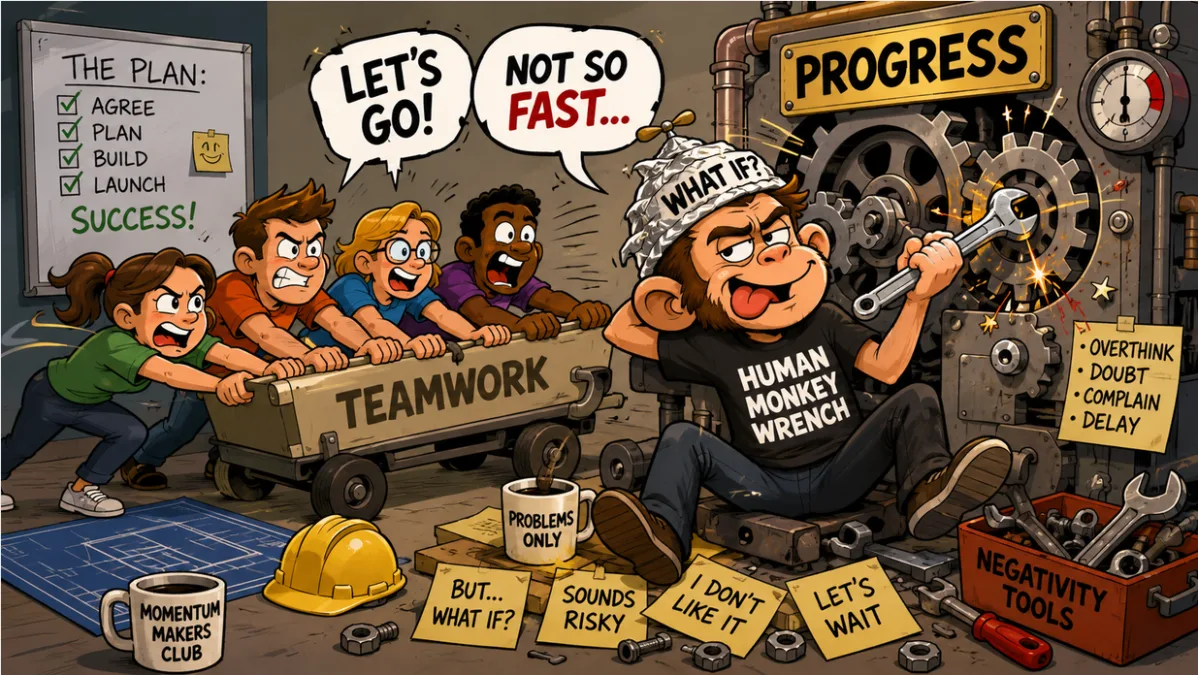
How to stop hindering and start helping
The universe operates on a delicate balance of momentum. People push things forward. Empires are built, cars are purchased, living rooms are painted, and pizzas are ordered.
And then, there is the Human Monkey Wrench.
You know exactly who this is. In fact, there’s a high probability you are currently stuck in a group text with one, waiting for them to approve a dinner spot that they will inevitably veto because “the lighting looks aggressive in the Yelp photos.”
When it comes to getting things done, humanity is divided into two distinct biological categories:
- The Momentum Makers: People who understand how teamwork works, agree on a direction, and pull the cart forward.
- The Human Monkey Wrenches: People whose entire existential purpose is to dive headfirst into the gears of progress, jamming the entire operation because they thought of a hypothetical problem that won’t matter for the next six years.
The Anatomy of a Monkey Wrench
A Monkey Wrench doesn’t just disagree; they sabotage. But they do it under the guise of “just being thorough.” Here is how they operate across standard, everyday scenarios:
- Ordering Food: The group decides on Mexican. Everyone is happy. The Wrench chimes in: “I heard cilantro causes inflammation, and honestly, the concept of a burrito is just structurally flawed. What if it rips?” They don’t offer an alternative. They just leave the group staring at an empty cart on DoorDash for forty-five minutes.
- Picking a Paint Color: The goal is a nice, neutral beige. The Wrench stares at the swatch. “This specific undertone reminds me of the carpet in my dentist’s waiting room in 1998. It’s going to invite negative energy into the drywall. We should wait until the spring equinox to choose.”
- Designing a House / Launching a Project: You’ve spent weeks drafting a beautiful, streamlined blueprint or action plan. Everyone is ready to sign off. The Wrench looks at it for two seconds and says, “What if a freak microburst hits the northwest corner of the structure? Also, I don’t like the font on the presentation.”
Destructive Criticism vs. The “Wrench” Standard
There is a massive difference between constructive criticism and Monkey Wrenching.
Constructive criticism says: “Hey, I think this bridge might collapse under heavy weight. Let’s add two more support beams right here.”
Monkey Wrenching says: “I don’t think we should build the bridge. Bridges are so cliché. What if cars fly in the future? I don’t have a solution for the river problem, but I just think the bridge is a mistake. Let’s table this until next month.”
Monkey Wrenches never offer solutions; they only dwell on problems. They possess zero ability to take the lead from anyone else, yet they absolutely refuse to step up and lead themselves. They simply stand on the sidelines of life, throwing tiny, metallic tools into the machinery of everyone else’s hard work.
The Self-Help Guide for the Recovering Monkey Wrench
If you are reading this and suddenly realizing that you are the reason your friends haven’t gone on a weekend trip since 2021, don’t panic. You can change. Here is a handy, step-by-step self-help guide to stop being an absolute pain in the ass.
Step 1: The “Shut Up and Eat” Protocol
If the group has reached a 70% consensus on a minor life choice (where to eat, what movie to watch, what shade of gray to paint the hallway), and your only objection is a vague, internal preference, stay silent. Eat the taco. Watch the movie. Look at the gray wall. The world will not end, and people will actually invite you places again.
Step 2: The “Bring a Solution or Bring a Beverage” Rule
From this day forward, you are legally banned from pointing out a flaw unless you have a concrete, actionable solution ready to launch immediately.
- Illegal: “I don’t think this website layout works.”
- Legal: “I think this layout is cluttered, so I drew this quick sketch of how we can clean up the sidebar.”If you don’t have a sketch, sit down, be quiet, and hand a beer to the person who is doing the work.
Step 3: Deconstruct Your “Second-Guessing” Fetish
Ask yourself: Why am I over-analyzing this? Is it because the plan is actually bad, or is it because you are terrified of commitment and control? Hint: It’s usually the control thing. Let go of the steering wheel. Sometimes it’s incredibly liberating to let a teammate drive, even if they take a slightly different route than you would have.
Step 4: Practice Saying the Magic Words
If you want to transition from a progress-killer to a beloved team player, write these words on your hand and memorize them:
“Sounds good to me. Let’s roll with it.”
Say it. Feel the weight lift off your shoulders. Watch the gears spin smoothly. Look at that—progress! Wasn’t that easy?
SEARCH FOR ANY ARTICLE BY KEYWORD
More results...