

Studying to classical music? Choose wisely. One playlist = calm genius. The other = sweaty panic, imaginary battles, and zero homework done. 🎻😅
Let’s be honest: when someone says “I study to classical music,” that sentence can mean two very different lifestyles.
On one end of the spectrum, there’s the calm, candle-lit, oat-milk latte crowd. They’re listening to slow piano pieces, breathing deeply, underlining sentences with surgical precision. These people finish homework early and somehow still have time to journal.
On the other end? Absolute chaos. Someone is “studying” to full-volume orchestral battle music, conducting imaginary armies with a pencil, whisper-screaming “THIS IS THE PART” while trying to read a paragraph they’ve already read six times.
This article is for anyone who has ever asked:
“Why am I sweating while trying to read about photosynthesis?”
We’re here to find the chill classical music—the stuff that smooths your brain, not turns your study session into the final boss fight of a medieval RPG.
When it comes finding the best classical music for chill vibes you should focus on music that is piano-centric with a minimal crescendos and drama, without constant building and release of tension, just wanna focus on cool #chillaxing music.
So here’s a quick summary of the best composers and music pieces (nice easy to read lists) that will help you find the best classical music for chill vibes which are conducive to studying, sleep, or just chilling and relaxing.
🎹 Piano-Centric Classical Music With Minimal Crescendos
✅ Safest, Most Reliable Choices (Near-Zero Drama)
- Erik Satie
Why: Flat dynamics, intentionally unemotional, almost anti-crescendo.
Start with: Gymnopédies, Gnossiennes
Verdict: Gold standard for calm piano - Arvo Pärt (piano works only)
Why: Extreme restraint, sparse notes, long silences.
Start with: Für Alina
Verdict: Meditative, almost motionless - Morton Feldman
Why: Intentionally avoids crescendos; dynamics stay soft and flat.
Start with: Palais de Mari
Verdict: Ultra-quiet, deep focus music
✅ Soft Romantic Piano (Controlled, Not Explosive)
- Frédéric Chopin (Nocturnes only)
Why: Expressive but controlled; crescendos are gentle, not theatrical.
Avoid: Ballades, Polonaises
Verdict: Emotional but not disruptive - Johannes Brahms (late piano works)
Why: Warm, inward-looking, avoids sharp dynamic contrasts.
Start with: Intermezzi Op. 117–119
Verdict: Comfortable, steady background - Franz Schubert (Impromptus)
Why: Long melodic lines with smooth dynamics.
Verdict: Narrative without spikes
⚠️ Use Carefully (Some Swells, But Predictable)
- Claude Debussy (solo piano)
Why: Mostly soft, but occasional color-based crescendos.
Safer pieces: Rêverie, La fille aux cheveux de lin
Verdict: Usually safe, occasionally expressive - Ludovico Einaudi
Why: Repetitive piano, but builds over time.
Verdict: Slow crescendos — fine if you don’t mind gradual swelling
🚫 Piano Music to Avoid (If You Hate Tension)
- Beethoven – dynamic contrast king
- Liszt – piano as a weapon
- Rachmaninoff – emotional avalanches
- Prokofiev – percussive & aggressive
🚫 Classical Music bad for studying
- Richard Wagner – sounds like your homework is judging you
- Igor Stravinsky – anxiety, but make it art
- Gustav Mahler – emotional whiplash
- Carl Orff – great for summoning something, not studying
If your goal is studying, choose music that:
- fades into the background
- keeps your heart rate reasonable
- doesn’t feel like it’s building toward a duel
Save the epic symphonies for workouts, long drives, or dramatically staring out a window when life feels poetic. Your GPA will thank you. Your nervous system will definitely thank you.
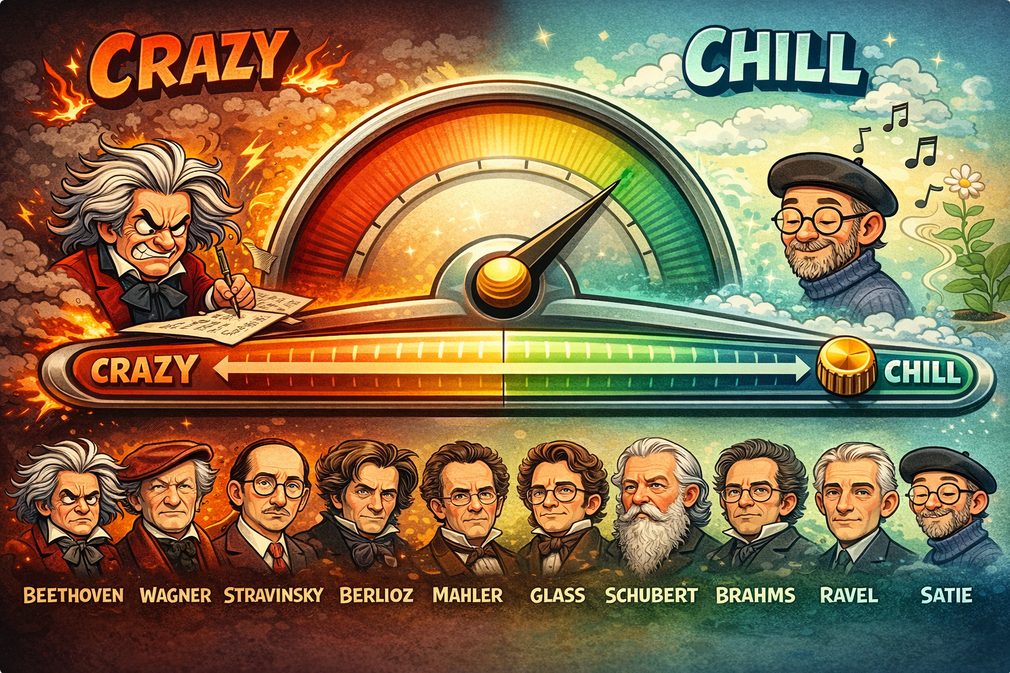
😌 Top 10 Chill Classical Music Styles
- Erik Satie
Intentionally flat dynamics, minimal emotion, zero ego flexing.
Vibe: musical introvert who respects your boundaries. - Johann Sebastian Bach
Mathematical, orderly, predictable. No drama — just perfectly stacked logic.
Vibe: your brain, fully organized. - Philip Glass
Repetition over expression. Changes arrive politely and slowly.
Vibe: calm productivity loop. - Franz Schubert
Emotional, but gently so. Long melodic lines, no sudden explosions.
Vibe: thoughtful walk, no plot twists. - Gabriel Fauré
Elegant, restrained, never theatrical.
Vibe: refined calm with good posture. - Arvo Pärt
Sparse, quiet, meditative. Crescendos are basically illegal.
Vibe: silence with notes. - Claude Debussy (solo piano & slow works)
Colorful, but soft. Expressive without being invasive.
Vibe: calm watercolor, not oil painting chaos. - Johannes Brahms (late piano works)
Warm, inward-looking, emotionally mature.
Vibe: cardigan-core. - Maurice Ravel (selected works)
Precision-focused, emotionally controlled.
Vibe: beautifully engineered calm. - Ludovico Einaudi
Modern, repetitive, emotionally gentle (yes, slow builds — but polite ones).
Vibe: coffee-shop focus music.
🤯 Top 10 Crazy Energy Classical Music Styles
- Ludwig van Beethoven
Deaf. Furious. Revolutionary. Wrote music that argues with itself and usually wins.
Energy: Slamming doors in sonata form. - Richard Wagner
Ego the size of a mountain range. Music lasts longer than most relationships.
Energy: “This opera will change civilization” (it’s 6 hours long). - Igor Stravinsky
Literally caused riots with his music (The Rite of Spring).
Energy: Anxiety invented as rhythm. - Hector Berlioz
Wrote a symphony about obsessively stalking a woman… then poisoning himself.
Energy: Unhinged romanticism with orchestral hallucinations. - Gustav Mahler
Therapy, but make it a 90-minute symphony.
Energy: Emotional whiplash with cowbells. - Sergei Rachmaninoff
Deep sadness, massive chords, emotional avalanches.
Energy: Piano drowning in feelings. - Franz Liszt
The original rock star. Women fainted. Pianos died.
Energy: Finger-based chaos and ego. - Carl Orff
O Fortuna alone earns him a spot.
Energy: Ritual sacrifice, but make it choir. - Dmitri Shostakovich
Wrote music while fearing government execution.
Energy: Paranoia in musical code. - Arnold Schoenberg
Invented atonal music because normal harmony wasn’t stressful enough.
Energy: “What if music had no home base?”
Let’s be real: most classical composers were hot messes. Beethoven was grumpy, Wagner was a megalomaniac, and Mozart was basically a 12-year-old in a grown man’s body. We need the ones who were essentially the Zen masters of the staff paper.
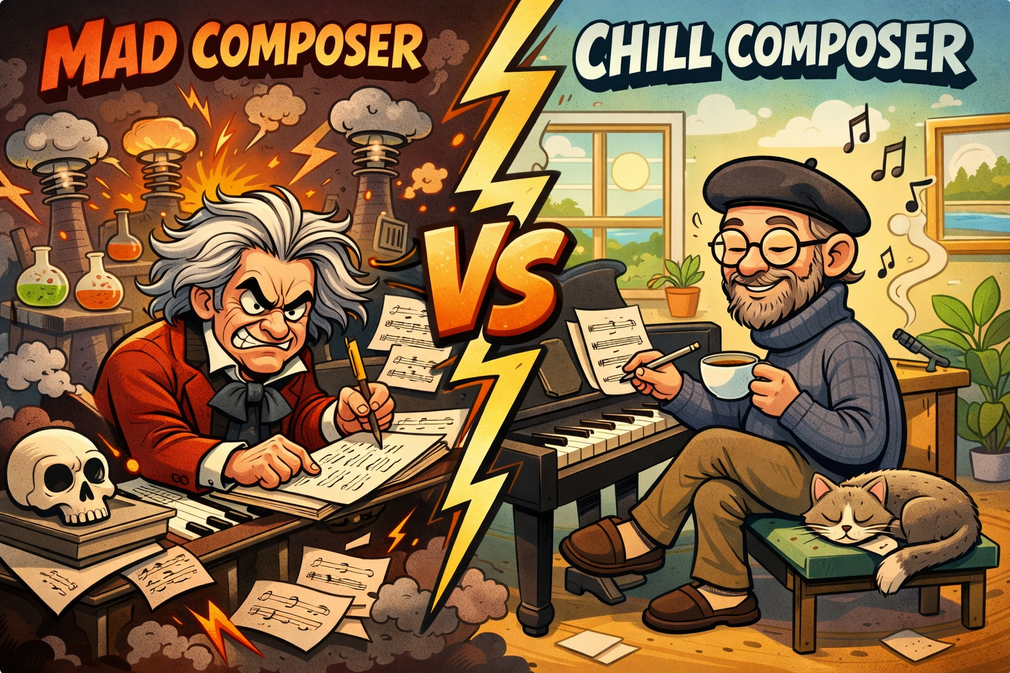
Top 10 Most Eccentric Classical Composers
| Rank | Composer | Primary “Eccentricity” | The “Crazy” Detail |
| 1 | Carlo Gesualdo | Homicidal Perfectionist | Murdered his wife and her lover in a jealous rage, then spent the rest of his life writing eerie, experimental music in isolation. |
| 2 | Erik Satie | Obsessive Minimalist | Only ate white food (eggs, sugar, bones, etc.), owned 12 identical grey suits, and left behind over 100 umbrellas when he died. |
| 3 | Alexander Scriabin | Occult Visionary | Believed his unfinished piece Mysterium would cause the end of the world and transform humanity into light. |
| 4 | Pyotr Tchaikovsky | Severe Anxiety | Held his chin while conducting because he was terrified his head would literally fall off. |
| 5 | Arnold Schoenberg | Triskaidekaphobia | He had a crippling fear of the number 13—he even died on Friday the 13th, exactly 13 minutes before midnight. |
| 6 | Ludwig van Beethoven | “Water Therapy” | To jumpstart his brain, he would pour buckets of cold water over his head while composing, often leaking through the floor into his neighbor’s apartment. |
| 7 | Percy Grainger | Intense “Hobbyist” | Known for a “bondage” obsession and purist language; he once tried to ban all non-English (Latin-based) words from his vocabulary. |
| 8 | Anton Bruckner | Numerical Obsession | Compulsively counted objects like window panes or bricks in a wall and had a morbid obsession with touching the skulls of dead composers. |
| 9 | Richard Wagner | Sensory Extremist | Required pink, perfume-soaked cushions and silk dressing gowns to compose, and allegedly had a room dedicated to cross-dressing. |
| 10 | Edvard Grieg | Superstitious Mascot | Carried a small rubber frog in his pocket and would pat it on the head for good luck before every performance. |
Top 10 Most Stable Classical Composers
| Rank | Composer | Why They’re “Normal” | The “Chill” Detail |
| 1 | Charles Ives | Successful Businessman | He was a high-powered insurance executive who composed in his spare time. He believed a man shouldn’t let his family “starve on his dissonances.” |
| 2 | Joseph Haydn | The “Father” Figure | Known as “Papa Haydn,” he was legendary for his kindness, sense of humor, and professional reliability during his 30 years with the Esterházy family. |
| 3 | Alexander Borodin | Part-time Genius | He was a world-class organic chemist and medical doctor first; music was just a hobby he did on weekends and during “sick” days. |
| 4 | Antonio Salieri | The Ultimate Professional | Forget the movies—the real Salieri was a generous teacher (who taught Beethoven and Liszt for free) and a highly respected civil servant. |
| 5 | Felix Mendelssohn | Well-Adjusted Prodigy | Unlike Mozart, he grew up in a wealthy, stable home. He was a balanced, athletic, and happily married man who treated music like a high-level craft. |
| 6 | Darius Milhaud | Historically Happy | He literally titled his autobiography My Happy Life. He was known for his sunny disposition and incredible productivity, even while in a wheelchair. |
| 7 | Johannes Brahms | The Low-Key Bachelor | He avoided the “rock star” drama. He lived in the same modest apartment for decades, loved hiking, and spent his evenings at the local tavern with friends. |
| 8 | Antonín Dvořák | The Family Man | A humble son of a butcher, he loved steam trains and raising pigeons. He remained deeply grounded and devoted to his family throughout his fame. |
| 9 | Jean Sibelius | National Hero | While he struggled with some vices early on, he spent the last 30 years of his life in peaceful retirement in the Finnish countryside, enjoying nature and cigars. |
| 10 | Gabriel Fauré | The Quiet Teacher | Known as a gentle, unassuming man, he served as the head of the Paris Conservatory and was loved by his students for his calm and encouraging nature. |
Books & Movies for the Classical Curious
Want to look smart at a dinner party? Check these out.
Essential Reading
- The Rest Is Noise by Alex Ross: A gripping cultural history of the 20th century through music. It’s a page-turner for history buffs.
- Musicophilia by Oliver Sacks: A neurologist explores how music literally re-wires our brains.
- Classical Music: A Concise History by H.C. Robbins Landon: For when you want the facts without the 800-page academic snoozefest.
Must-Watch Films
- Amadeus: It’s technically 80% fiction, but it’s 100% entertaining. Mozart as a rock star.
- Maestro: Bradley Cooper’s deep dive into the chaotic, brilliant life of Leonard Bernstein.
- Immortal Beloved: Gary Oldman playing Beethoven with the intensity of a man who hasn’t slept in three years.