
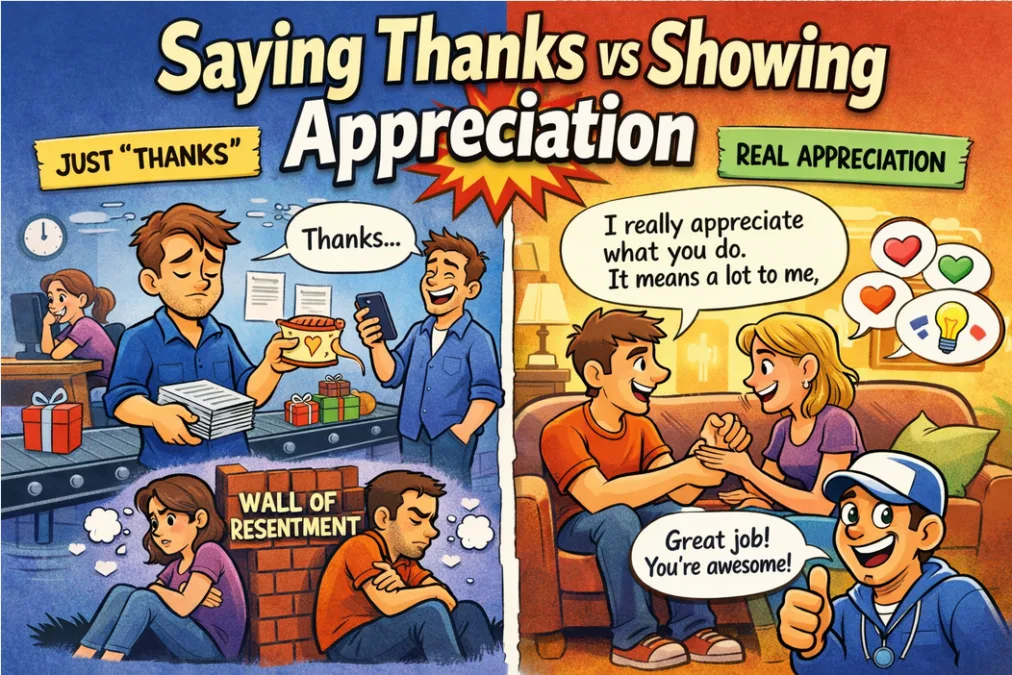
They are not the same. Here’s the difference…
There’s a big difference between saying “thanks” and actually showing appreciation, and most people are out here pretending those two things are the same. They’re not. One is a reflex. The other is effort. One is what you say when someone hands you a receipt. The other is what you say when you actually see someone.
Let’s start with the classic drive-by “thanks.”
You know the one. Someone does something helpful, thoughtful, maybe even slightly above and beyond, and you fire off a quick “thanks” like you’re clearing a notification. It’s polite. It checks the box. It’s the social equivalent of hitting “Agree to Terms and Conditions” without reading a single word.
And to be fair, that kind of thank you has its place. Not everything needs a heartfelt speech. If someone holds the door, you don’t need to grab their shoulders and say, “This act of hinge-based generosity has changed me as a man.” Relax.
But here’s where it gets dumb. People start treating that same low-effort, autopilot “thanks” as if it counts for everything. Long-term relationships. Friendships. Family. Work. Situations where people are consistently showing up, putting in effort, and quietly making your life easier or better.
That’s where the lazy “thanks” starts to feel… hollow.
Because real appreciation is specific. It’s intentional. It requires you to actually pay attention for five seconds and say something like:
“Hey, I appreciate that you always handle X. It makes my day easier, and I don’t say that enough.”
That hits different. Now you’re not just acknowledging the act. You’re acknowledging the impact. You’re telling the person, “I see what you’re doing, and it matters.”
And here’s the wild part. This isn’t some advanced emotional intelligence masterclass. This is basic, entry-level human communication. Every decent coach in sports understands this. You point out what someone is doing right. You reinforce it. You build trust and momentum before you ever get into what needs improvement.
Meanwhile, a lot of adults are walking around acting like appreciation is some rare, limited resource that must be rationed like it’s bottled water during a hurricane.
“Careful, don’t compliment them too much. We don’t want them getting… confident.”
What are we doing?
Then there’s the opposite end of the spectrum. The people who don’t communicate appreciation at all. They just assume the other person knows. They keep everything in their head like it’s a private journal no one else is allowed to read.
And over time, that turns into something ugly.
Because when you don’t express appreciation, the brain fills in the blanks. “They didn’t say anything. Maybe they don’t care. Maybe it doesn’t matter.” Now multiply that over months or years. Congratulations, you’ve just built a nice, solid wall of quiet resentment.
This is how relationships slowly drift into that weird roommate phase where two people technically live together but emotionally might as well be in different zip codes.
No one is saying what they actually feel.
No one is acknowledging what’s being done right.
Everything becomes transactional. Functional. Flat.
Then one day, somebody finally speaks up, but not in a calm, appreciative way. It comes out sideways. Frustration. Built-up complaints. A greatest hits album of everything that’s been silently bothering them for the past three years.
And now the other person is sitting there like, “Where did this even come from?”
It came from the same place all this stuff comes from.
Lack of honest, consistent communication.
Real appreciation requires a little vulnerability. You have to drop the ego for a minute and actually express something real. Not just “thanks,” but why you’re thankful. What it means. How it affects you. That can feel uncomfortable if you’re not used to it, especially if your default mode is sarcasm, avoidance, or pretending everything is fine.
But that’s the price of having real relationships instead of surface-level arrangements.
Because the alternative is pretending everything is good while quietly keeping score in your head. And that always ends the same way. Distance. Resentment. Eventually, people look at each other and realize they don’t even feel known anymore.
At that point, fixing it requires actual work. Honest conversations. Owning your part in it. Maybe even dragging yourselves into therapy and unpacking years of unspoken nonsense. And a lot of people would rather bail than deal with that level of discomfort, especially if it means admitting they contributed to the problem.
So they take the easy exit and call it “it just didn’t work out.”
Meanwhile, the whole thing could have been slowed down or even avoided with something as simple as consistently showing appreciation along the way.
Not grand gestures. Not speeches. Just real, specific acknowledgment.
“Hey, I see you. I appreciate what you do. It makes a difference.”
That’s it. That’s the secret.
And here’s the funny part to end on. You will never hear someone complain that their partner, friend, or coworker appreciates them too much.
“Honestly, it’s exhausting. They keep noticing things I do and telling me it matters. I can’t live like this.”
Said no one, ever.
So yeah. Say “thanks” when it fits. But if that’s all you’ve got in situations that actually matter, don’t be surprised when people start feeling like background characters in your life instead of someone you genuinely value.
Because appreciation isn’t about politeness.
It’s about connection.
And that takes a little more than one word.
SEARCH FOR ANY ARTICLE BY KEYWORD
More results...