
A Comedy Roast of Emotional Avoidance
Let’s talk about one of the most destructive habits a human being can develop. No, it’s not smoking. It’s not drinking. It’s not impulse-buying a pontoon boat because you watched three YouTube videos and suddenly convinced yourself you’re a “lake person.” It’s emotional avoidance. Specifically, the kind where a person becomes so uncomfortable with honest communication that they spend their entire life dodging conversations that might involve feelings, vulnerability, disagreement, accountability, or self-reflection.
These people treat direct communication the way medieval peasants treated the plague. If an uncomfortable conversation appears on the horizon, they immediately run in the opposite direction. If someone asks how they’re really doing, they provide the same answer they’ve been giving since 1987. “Fine.” If something is bothering them, they won’t mention it. If they need something from somebody, they won’t ask for it. If a relationship is slowly deteriorating before their eyes, they’ll stand there watching it sink into the ocean while insisting everything is perfectly normal.
What makes this behavior particularly fascinating is that many of these people genuinely believe they’re being mature. They think they’re “keeping the peace.” They think they’re avoiding drama. They think they’re taking the high road. In reality, they’re simply avoiding discomfort. The problem is that reality doesn’t care about your avoidance strategy. Problems don’t disappear because you refuse to discuss them. They simply grow larger, more complicated, and more expensive emotionally until they eventually burst through the wall you’ve built around them.
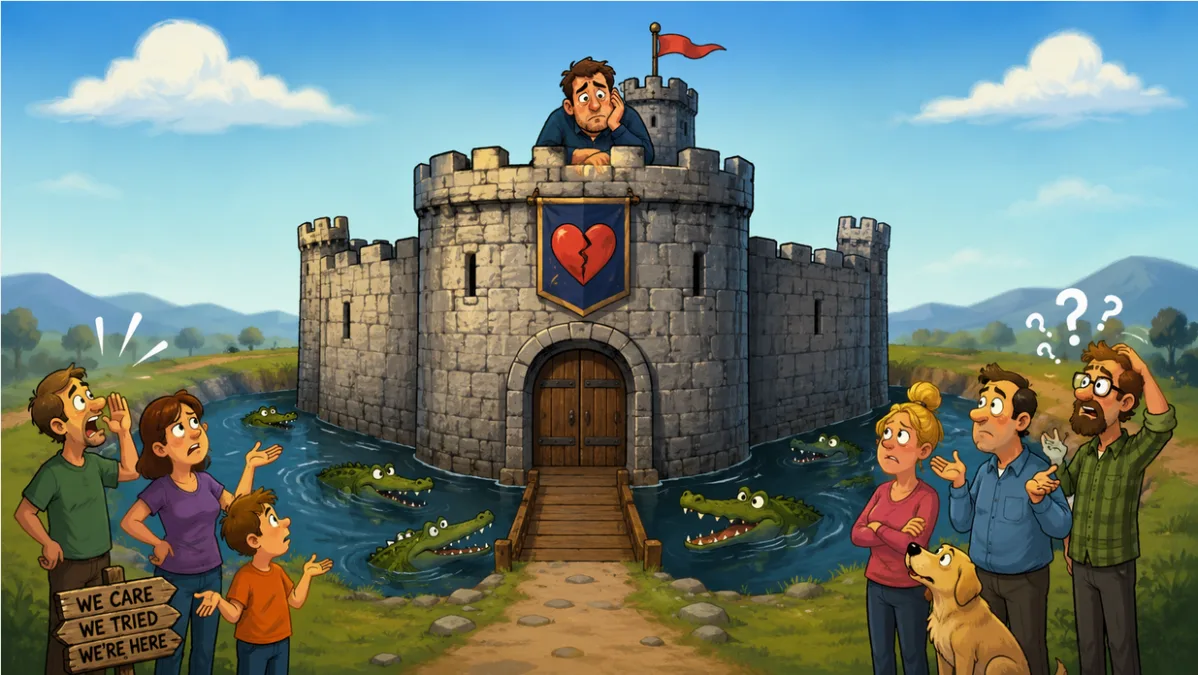
Over time, these people construct elaborate emotional fortresses around themselves. At first the walls seem helpful. They protect against awkward conversations, difficult emotions, and the terrifying possibility of being genuinely known by another human being. The trouble is that walls work both ways. They keep pain out, but they also keep connection out. After enough years, nobody really knows who these people are. Not their spouses. Not their children. Not their friends. Sometimes not even themselves.
By middle age, many of them are living in a strange kind of emotional exile. They’re surrounded by people yet feel isolated. They have relationships but little intimacy. They have conversations but almost no meaningful dialogue. They have opinions, frustrations, hopes, fears, dreams, and disappointments locked away in a mental storage unit that nobody is allowed to enter. Then they wonder why life feels shallow, disconnected, and strangely lonely.
The answer is surprisingly simple. Nobody can have a meaningful relationship with a person who refuses to show up emotionally. If your entire personality is hidden behind a wall of “I’m fine,” people eventually stop trying to climb over it. Not because they don’t care, but because there’s nothing to work with.
The Slow-Motion Train Wreck
One of the reasons emotional avoidance is so difficult to recognize is that the consequences arrive slowly. Nobody wakes up at age 65 and says, “Thank goodness I spent decades refusing to have honest conversations.” The damage accumulates quietly. It looks less like a car crash and more like rust. Year after year, opportunities for connection are missed, relationships remain superficial, and small problems are allowed to grow into major sources of resentment.
Imagine two people standing at a series of crossroads throughout life. One chooses direct communication. The other chooses avoidance. Neither decision seems particularly important in the moment, but the long-term results become dramatically different.
| Age | Opportunity | Healthy Communicator | Emotional Avoider |
|---|---|---|---|
| 10 | Friend hurts feelings | Says something | Says nothing and carries resentment |
| 16 | Has a crush | Takes a chance | Fantasizes silently |
| 25 | Boss treats them unfairly | Has a conversation | Complains to everyone except the boss |
| 35 | Marriage issue emerges | Addresses it early | Lets it simmer for years |
| 45 | Friendship starts fading | Reaches out | Waits for the other person |
| 55 | Family conflict develops | Attempts resolution | Avoids gatherings entirely |
| 70 | Reflects on life | Deep relationships remain | Wonders why nobody feels close |
What’s striking is that none of these moments require extraordinary courage. Nobody is storming a beach under enemy fire. Nobody is wrestling a bear. These are ordinary conversations that most people encounter every week. Yet for emotional avoiders, asking for what they need can feel as intimidating as negotiating a peace treaty between two hostile nations.
The irony is that avoidance often feels safer in the short term. Every uncomfortable conversation avoided creates immediate relief. The problem is that life charges interest on unresolved issues. What begins as mild discomfort today often returns years later as resentment, confusion, distance, loneliness, or regret.
The Myth of “Keeping the Peace”
Avoiders often describe themselves as easygoing. They say things like, “I don’t like confrontation,” or “I don’t want to create drama.” Unfortunately, avoiding every difficult conversation doesn’t eliminate conflict. It merely transforms conflict into something larger, stranger, and harder to solve.
Imagine refusing to address a leaking roof because you don’t enjoy climbing ladders. The leak doesn’t care. Water continues entering the house whether you acknowledge it or not. Eventually the ceiling collapses and suddenly you’re dealing with a much larger problem than the one you were trying to avoid.
Relationships work the same way. Unspoken frustrations accumulate. Expectations go uncommunicated. Boundaries remain unclear. Assumptions multiply. Eventually people stop arguing about the original issue entirely because they’ve forgotten what it was. They’re now fighting about fifteen years of unresolved baggage that has been stacked in the emotional attic.
Good Communicators vs. Emotional Avoiders
The differences become obvious when both groups encounter the same situations.
| Situation | Good Communicator | Emotional Avoider |
|---|---|---|
| Hurt feelings | Discusses it | Suppresses it |
| Conflict | Addresses it | Escapes it |
| Attraction | Expresses interest | Keeps it secret |
| Boundaries | States them clearly | Hopes others guess |
| Disagreement | Engages respectfully | Avoids discussion |
| Friendship problems | Reaches out | Withdraws |
| Marriage issues | Talks early | Explodes later |
| Loneliness | Builds connection | Waits to be rescued |
| Anxiety | Shares concerns | Pretends everything is fine |
| Gratitude | Expresses appreciation | Assumes people already know |
Notice how neither approach eliminates discomfort. That’s the part emotional avoidance conveniently leaves out of the sales brochure. The communicator experiences discomfort now. The avoider experiences discomfort later. The difference is that later often turns into years.
The great scam of emotional avoidance is that it feels like you’re saving yourself from discomfort when you’re actually signing up for a much larger payment plan. The communicator suffers through ten awkward minutes and moves on with life. The avoider spends years carrying around unresolved baggage, strained relationships, and unanswered questions. That’s not efficiency. That’s financing your emotional problems at a predatory interest rate.
At some point, many avoiders begin asking a heartbreaking question.
“Why does nobody really know me?”
The answer is usually simple.
Because you’ve spent decades making sure they couldn’t.
How to Fix Your Life Before It’s Too Late
The good news is that emotional avoidance isn’t a permanent personality trait. It’s a habit. Habits can change. The first step is recognizing that honesty and conflict are not the same thing. Many avoiders treat every difficult conversation as if it’s guaranteed to become a screaming match. In reality, most healthy communication sounds remarkably boring. It’s often just two adults calmly discussing reality.
Start small. Tell people when something bothers you instead of silently collecting evidence for a future resentment trial. Express appreciation when you feel it instead of assuming others already know. Ask questions instead of making assumptions. Tell people what you need rather than hoping they’ll magically discover it through telepathy.
Most importantly, learn to tolerate temporary discomfort. Every meaningful relationship requires awkward conversations from time to time. There is no workaround. There is no premium subscription that lets you skip this step. The strongest relationships aren’t built by people who avoid difficult discussions. They’re built by people who have those discussions and survive them.
The truth is that vulnerability is not weakness. Vulnerability is how human beings create trust. It’s how friendships deepen, marriages improve, families heal, and misunderstandings get resolved. Without it, relationships become little more than polite arrangements between people who never truly know each other.
Final Thoughts
The saddest part about emotional avoidance isn’t the arguments that never happened. It’s the connections that never happened. It’s the friendships that never deepened, the marriages that never became intimate, the apologies that never arrived, the gratitude that was never expressed, and the love that was never spoken out loud.
Many people spend their entire lives waiting for the perfect moment to be honest. Then suddenly they’re old. The perfect moment never arrived because the perfect moment was every moment.
If your life feels lonely, disconnected, frustrating, repetitive, confusing, or strangely shallow, there is a decent chance the problem isn’t everyone else. It might be that you’ve spent years building emotional walls and then wondering why nobody can get inside.
The solution isn’t becoming louder. It isn’t becoming dramatic. It isn’t picking fights with people. It’s learning to tell the truth. Kindly. Directly. Consistently.
Because at the end of the day, the shortest distance between two human beings isn’t perfection. It’s honesty… And the longer you avoid it, the more likely your life turns into the very thing you’ve been trying to avoid all along. A complete and utter shit show.
SEARCH FOR ANY ARTICLE BY KEYWORD
More results...