
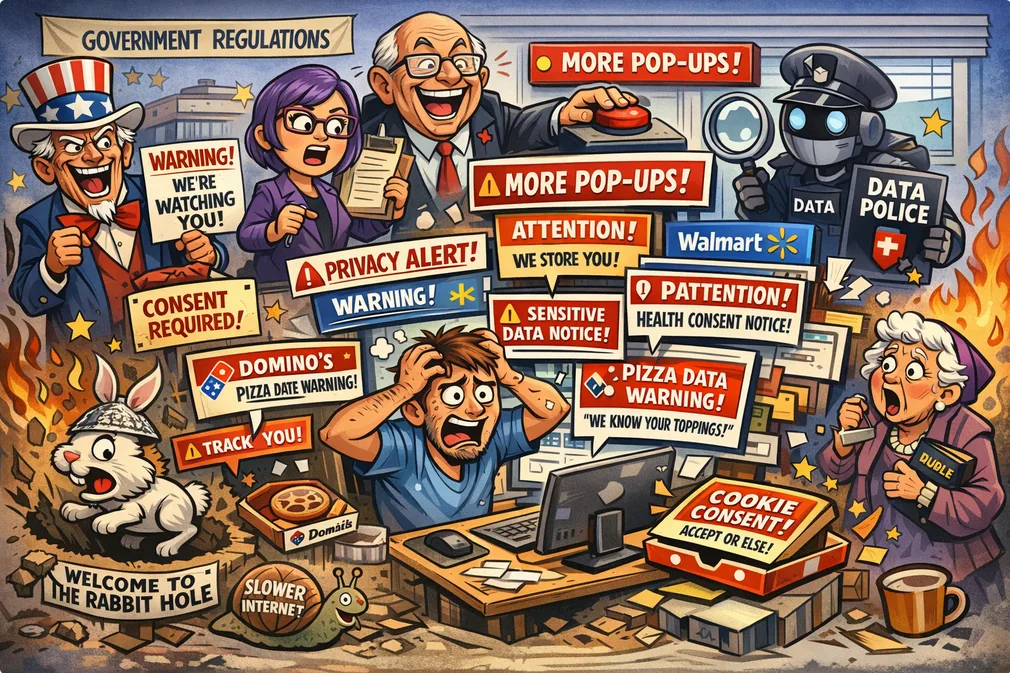
Pop-Up Politics: How Dumb Politicians Regulations Keep Ruining the Internet
There was a time—gather round, children—when the internet was a place you could visit without being screamed at by twenty pop-ups before your eyeballs touched content. You typed a URL, hit enter, and boom: information, products, or a picture of a cat wearing a tiny hat. No legal disclaimers. No “consent experiences.” No passive-aggressive banners implying you were one click away from international crime.
Then politicians discovered the internet.
And like toddlers handed a permanent marker, they immediately began drawing on the walls.
The Latest Episode of Internet Idiocracy
Welcome to the newest season of Lawmakers Who Don’t Understand Technology, where major retailers like Walmart and Target are now being forced—by the state of Virginia—to show pop-up warnings telling users that the website stores data about people who order birth-control-related products.
Let’s pause here.
Because this deserves a slow blink.
An e-commerce website…
…that ships physical products…
…stores customer information…
Yes.
That is not a scandal.
That is how mailing things works.
This is like warning people at the post office:
⚠️ “Privacy Alert: The USPS knows your address.”
No kidding. That’s the whole business model.
What Politicians Think Is Happening vs. Reality
Politicians’ Fantasy Version
- Evil corporations are secretly tracking sensitive purchases
- Data is being hoarded in underground vaults
- Consumers are moments away from dystopian surveillance hell
- Only government pop-ups can save us
Actual Reality
- Name, address, payment method
- Stored so the item can be shipped
- Stored again for refunds, fraud prevention, customer service
- Deleted or anonymized per existing laws and internal policies
In other words: commerce.
The Slippery Slope Nobody Asked For
If this logic keeps going unchecked, here’s what the future looks like:
- Domino’s Pizza:
⚠️ “Privacy Warning: We collect data about your food preferences.”
(Yes. You ordered extra cheese 14 times. That’s on you.) - Amazon:
⚠️ “Consent Required: We know you buy the same phone charger every year.” - Netflix:
⚠️ “Sensitive Data Disclosure: You watched that documentary and immediately rewatched The Office.” - Home Depot:
⚠️ “We have reason to believe you own a house.”
This is where we are headed when people who still print emails start regulating digital systems.
A Brief History of Pop-Up Hell
If this all feels familiar, it’s because we’ve already lived through the beta test.
Exhibit A: The EU Cookie Apocalypse
Five to ten years ago, European regulators decided cookies were a problem. Not tracking misuse. Not abuse. Cookies. Period.
The result?
- Every website: pop-up
- Every visit: pop-up
- Every click: “Accept All”
- Nobody reads anything
- Everyone clicks blindly
- Ad blockers explode in popularity
🎉 Congratulations, regulators! You trained the entire planet to ignore privacy notices.
That’s not consumer protection.
That’s UI vandalism.
The Pop-Up Effect (A Simple Chart)
| Action Taken | Intended Outcome | Actual Outcome |
|---|---|---|
| Force warning pop-ups | Educate users | Users ignore everything |
| Add more consent screens | Increase trust | Decrease usability |
| Mandate disclosures | Transparency | Banner blindness |
| Over-regulate websites | Safety | Ad blockers everywhere |
Pop-ups don’t educate.
They desensitize.
The Great Myth: “People Care Deeply About This”
Here’s the dirty little secret nobody wants to say out loud:
Most people do not care.
They want:
- The page to load
- The item to ship
- The service to work
That’s it.
The number of people who read privacy disclosures carefully is roughly the same number of people who read shampoo instructions for fun.
Yet somehow, entire laws are written around the idea that the average person wants a legal novella shoved in their face every time they open a website.
Spoiler alert: they don’t.
Who Actually Benefits from These Laws?
Let’s check the scoreboard.
Big Corporations
✔️ Already have compliance teams
✔️ Can afford lawyers
✔️ Can implement pop-ups easily
Small Businesses
❌ Legal risk
❌ Development cost
❌ UI clutter
❌ Competitive disadvantage
Users
❌ Worse experience
❌ More clicks
❌ More interruptions
This is regulation that protects incumbents and punishes innovation.
Why Politicians Should Keep Their Noses Out of the Internet
Here’s the uncomfortable truth:
Most lawmakers:
- Don’t understand browsers
- Don’t understand cookies
- Don’t understand APIs
- Don’t understand data storage
- Don’t understand UX
- Don’t understand human behavior online
Yet they confidently dictate how websites must behave.
This is like regulating aviation based on how birds feel about wind.
Market Forces Already Solve This Problem
You know what actually works?
- Competition
- Reputation
- Consumer choice
- Laws against actual harm (fraud, misuse, leaks)
If a company:
- Misuses data
- Sells sensitive info
- Loses customer trust
The market responds immediately.
People leave.
Sales drop.
Brand damage spreads faster than any government memo.
No pop-up required.
The Irony Nobody Talks About
By forcing more pop-ups:
- Users install ad blockers
- Trackers go dark
- Analytics break
- Legitimate compliance becomes harder
- Bad actors go underground
Regulation intended to increase transparency ends up reducing visibility.
Chef’s kiss.
What Actually Helps (Instead of Pop-Ups)
Here’s a radical idea:
- Enforce existing privacy laws
- Penalize real abuse
- Require clear policies (not banners)
- Let browsers handle consent globally
- Stop micromanaging UI
Let websites function.
Let users browse.
Let adults be adults.
Final Roast: A Message to Politicians
Dear lawmakers,
The internet is not broken.
Your understanding of it is.
Every time you mandate another pop-up:
- A UX designer cries
- A user clicks “Accept” without reading
- A small business considers quitting
You are not protecting people.
You are training them to ignore warnings.
And when everything screams “WARNING,”
nothing means anything anymore.
Please—step away from the pop-up generator.
The market already knows what it’s doing.
TL;DR:
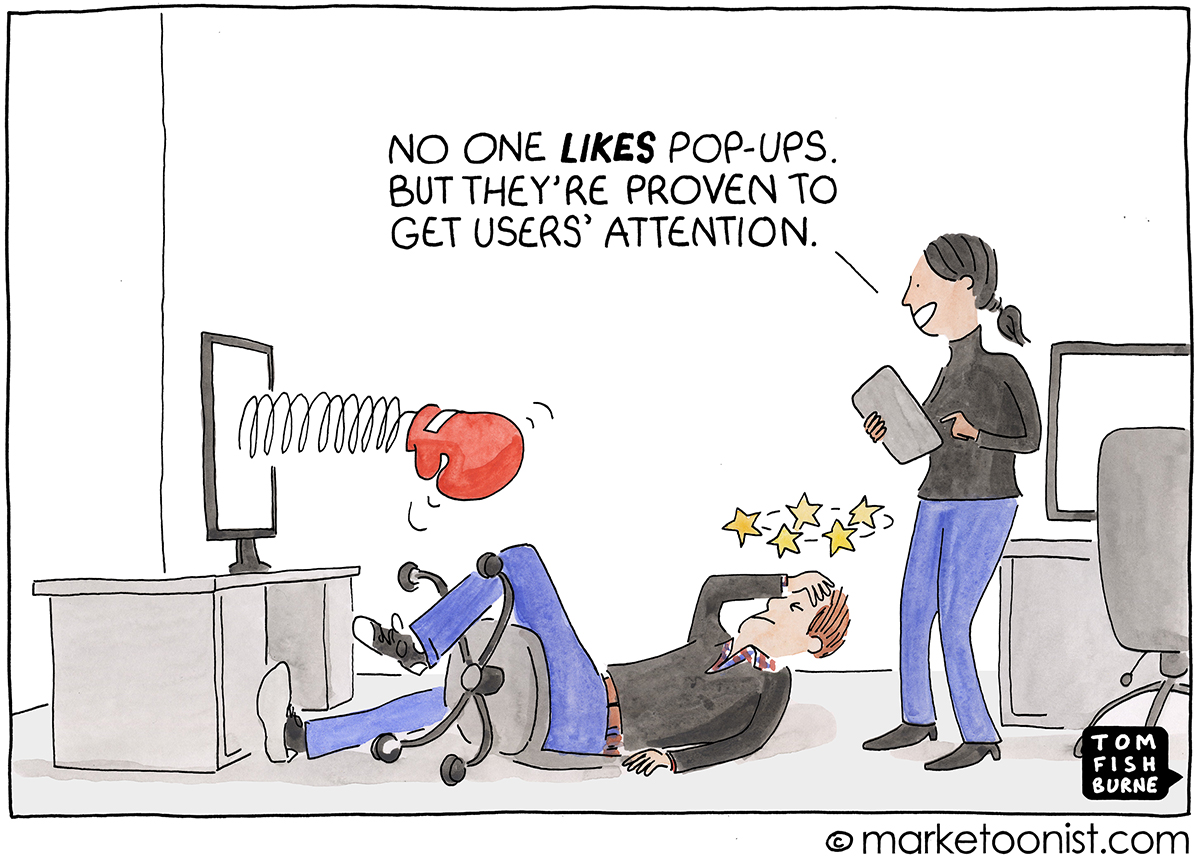
Pop-ups don’t protect privacy.
They protect politicians from having to understand technology.
And the internet deserves better.